
Most RAG failures aren’t language-model failures. The system retrieved text that sounded related, then asked the model to guess the connection.
GraphRAG for small teams can fix that problem when answers depend on relationships across documents, policies, people, products, or events. It isn’t a default upgrade for every chatbot, though. In many cases, better chunks, metadata, hybrid search, and reranking will do more for less effort.
My view is simple: prove a repeatable retrieval failure before you operate a graph.
Key Takeaways
- GraphRAG adds relationship-aware retrieval to RAG, helping answer multi-hop questions that connect entities and evidence across documents.
- It is not a default upgrade: clean parsing, metadata, permission filtering, hybrid search, reranking, and citations often solve simpler retrieval failures for less effort.
- GraphRAG introduces indexing, model, governance, versioning, and permission costs, so stale graphs or loose access controls can create new failure modes.
- Small teams should prove a repeatable baseline failure with real evaluation questions before adding graph infrastructure.
- The strongest architecture routes requests by query shape, using conventional RAG for simple questions and GraphRAG only when relationships are the missing evidence.
What GraphRAG for small teams actually changes
GraphRAG is a form of Retrieval-Augmented Generation that adds relationship-aware retrieval through a knowledge graph. Instead of treating source material as loosely related text chunks, it models named entities and the relationships between them.
Microsoft Research’s GraphRAG project describes the approach as a combination of text extraction, network analysis, and LLM summarization over private datasets. That description matters because GraphRAG is a pipeline, not a checkbox in a vector database.
The graph adds explicit relationships
A knowledge graph stores entities as nodes and connections as edges, linking them back to source evidence. A node might be a product plan, support policy, software component, customer segment, regulation, or document version. The edges express how those items relate.
That extra structure helps when the answer needs more than topical similarity. A refund question may depend on a plan type, purchase channel, cancellation timing, and an exception policy. Basic retrieval might find passages about each item, but it may not preserve their connections.
The model still needs good prompts and trustworthy sources. Large language models don’t become database experts through better retrieval. The approach gives them a more useful evidence trail.
It supports multi-hop evidence retrieval
A multi-hop reasoning question needs several connected facts before the answer is safe. For example, “Which customers are affected by a security issue after the latest integration update?” may require a path across product releases, integration records, incident notes, and account data.
Flat retrieval can return four useful passages with no order or relationship. The model then has to infer whether they belong together. Graph retrieval can follow a defined path, such as release -> integration -> affected component -> eligible accounts.
That is where the approach earns attention. It improves the evidence available for complex questions. It does not guarantee correct reasoning after retrieval.
Why vector-only RAG misses relationship questions
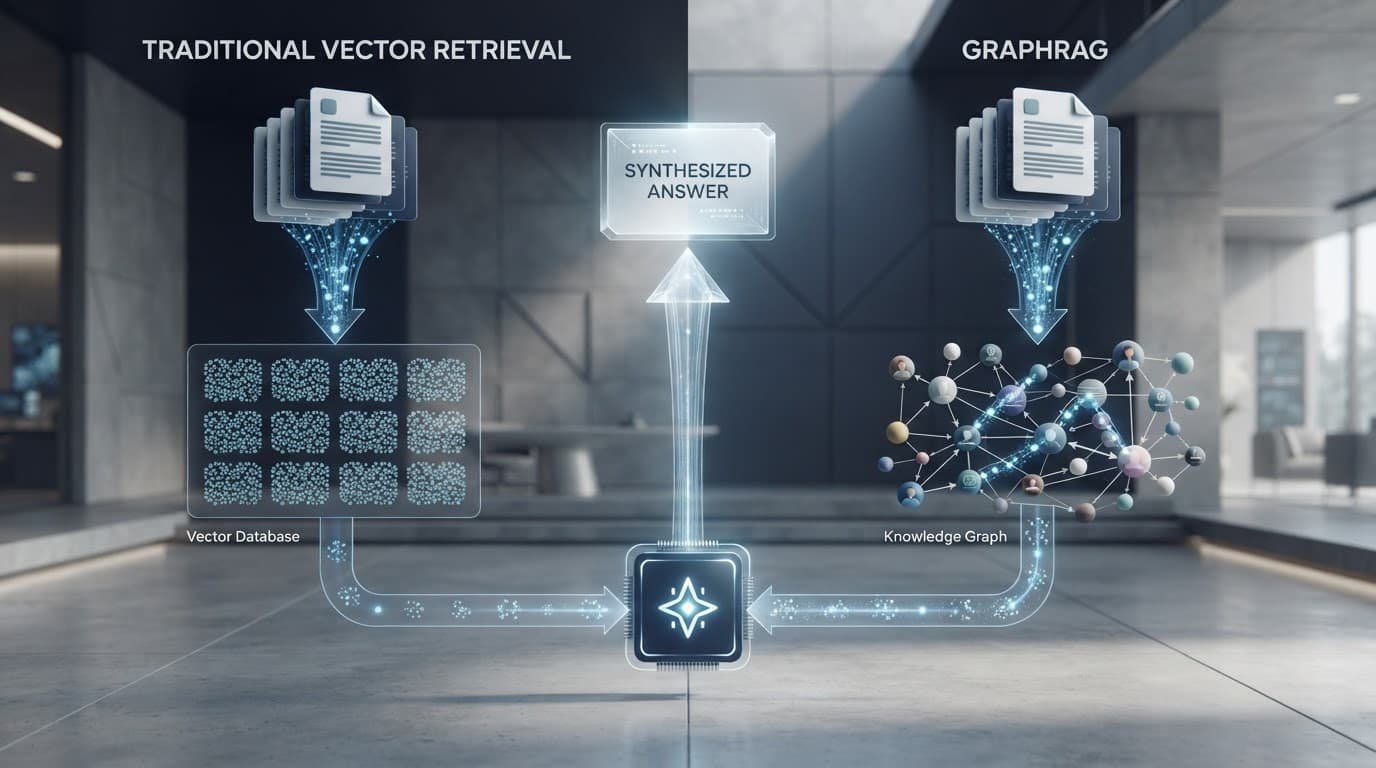
Vector search is still the right foundation for many small RAG applications. It turns text chunks and queries into comparable text embeddings, then retrieves passages with similar meaning through semantic search. That works well for questions answered by one or two passages.
GraphRAG becomes useful when a query needs evidence linked across multiple passages.
The problem starts when similarity is mistaken for proof.
Similarity does not explain a connection
A vector database can find a paragraph about cancellation rules, another about annual plans, and a third about app-store purchases. It cannot, by itself, show that one clause overrides another.
Metadata filters, cleaner chunks, and a well-designed retrieval flow all help. I’d test a hybrid RAG baseline for document retrieval before reaching for graph traversal. Parsing, filtering, or ranking may be the real failure. A practical RAG architecture for SaaS should already handle document scope, source freshness, permissions, and citations.
When a chatbot misses an answer because it retrieved the wrong policy paragraph, adding a graph is often the wrong repair. Fix the corpus first.
Multi-step questions expose the gap
Relationship-heavy questions often require multi-hop reasoning and fail in predictable ways:
- The answer requires an exception buried in a separate policy document.
- A user needs an explanation of how a change affected dependent systems.
- Several records are individually relevant but only one connected path answers the question.
- The query asks for a pattern across the whole corpus, not a passage-level answer.
A vector-only system can retrieve pieces of this puzzle, but it may supply them in a confused order. A knowledge graph preserves links between those pieces, not merely more passages. GraphRAG can narrow the evidence around connected entities, which gives the model less room to improvise.
How the GraphRAG indexing and query pipeline works
GraphRAG shifts more work to indexing time. That is the trade many optimistic diagrams skip.
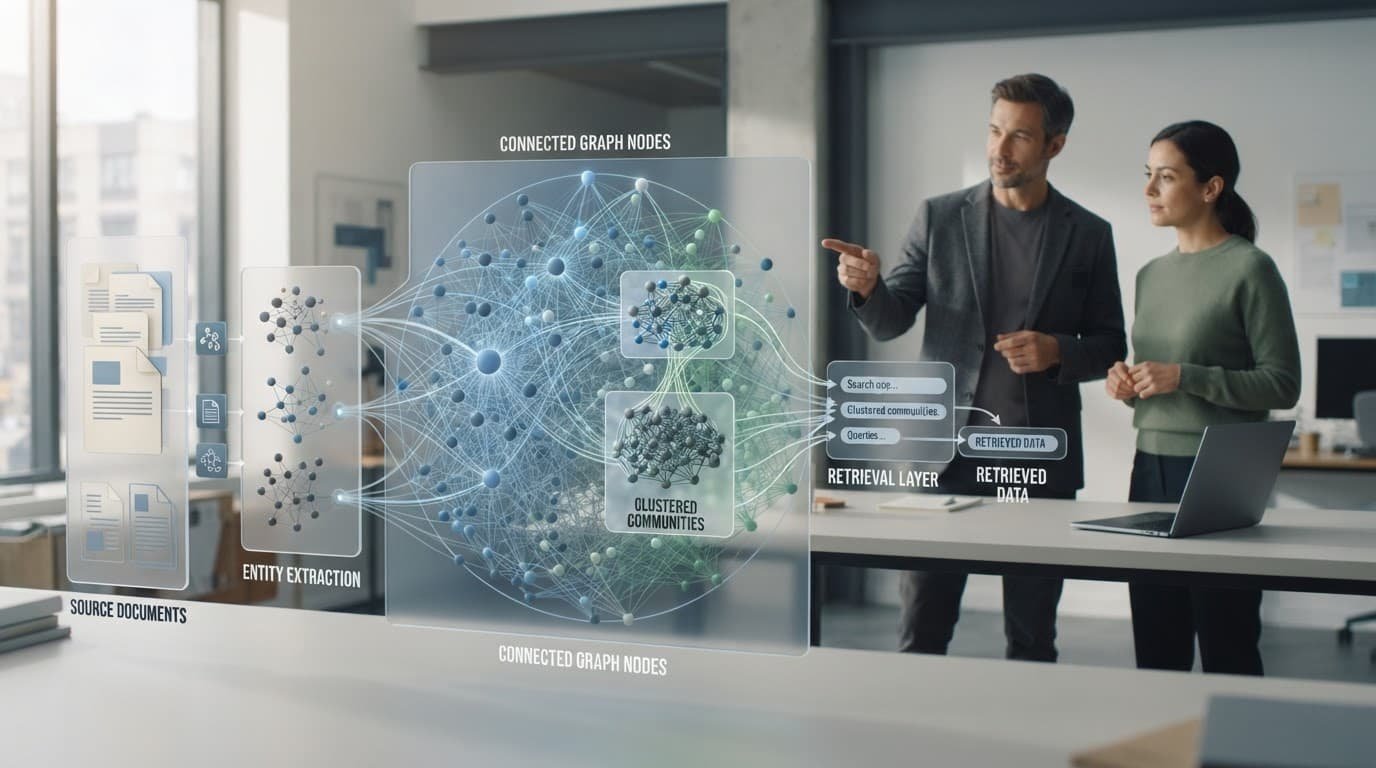
The official Microsoft GraphRAG documentation describes a data pipeline that extracts a knowledge graph from raw text, builds a community hierarchy, and generates summaries for those communities.
Indexing turns text into graph artifacts
A typical pipeline parses source documents and preserves metadata for freshness, permissions, and audits. It keeps title, section, version, source URL, date, and access rules. Documents are chunked, then an LLM identifies entities and relationships inside those chunks.
The system maps that output to typed nodes and edges through a graph schema. It may also resolve repeated names, group connected entities into communities, and generate summaries for those groups.
Many implementations combine hierarchical clustering with community-detection methods such as Leiden to find densely connected communities. The method is less important than output quality. If entity extraction misclassifies a feature name as a product or joins unrelated people, errors can spread through communities and summaries.
Local and global queries use different evidence
Local search is useful for a targeted question about a known entity. It can retrieve an entity’s neighborhood, connected relationships, and relevant source chunks.
Global search is built for broad questions, such as “What themes appear across our customer feedback?” It can use community summaries as an intermediate layer instead of forcing the model to read the entire corpus.
The original GraphRAG research paper explores this query-focused summarization approach. For a small team, community summaries can reduce processing across hundreds of raw passages. Generating them can still make broad synthesis expensive and slow.
When GraphRAG for small teams earns its place
GraphRAG earns its place when relationships shape the product answer, not when the dataset merely looks large. A 5,000-page knowledge base can work well with conventional RAG. A much smaller set of linked policies and records may contain enterprise knowledge that justifies a graph.
Use it for connected, high-context questions
I would consider a pilot when your users repeatedly ask questions that involve:
- Policy exceptions, dependencies, ownership chains, or document lineage.
- Technical troubleshooting across services, releases, APIs, and incident history.
- Compliance research where explainability depends on an auditable chain between rules, controls, and evidence.
- Product intelligence questions that connect feedback, accounts, features, and releases.
- Corpus-wide analysis where isolated chunks cannot show the full pattern.
In these cases, relationships are evidence. Treating them as background metadata leaves useful context on the table.
Skip it when the answer lives in one source
Don’t adopt GraphRAG because “knowledge graph” sounds more advanced. A support bot that answers current help-center questions usually needs accurate chunks, source filtering, hybrid RAG, and citations.
It is also a poor fit when documents change hourly and you cannot maintain incremental indexing. The graph will become stale faster than it becomes helpful.
A graph is unnecessary if your query log shows a simpler issue, such as bad PDF parsing, missing headings, duplicate chunks, or weak keyword matching. Those are common problems with cheaper fixes.

The costs a GraphRAG diagram does not show
GraphRAG adds infrastructure, model calls, data quality work, and operational responsibility. It also requires data governance for source ownership, review, retention, and access boundaries. It can be worthwhile, but it isn’t a free retrieval improvement.
Indexing can cost more than answering
Standard RAG usually embeds chunks and stores them. The indexing stage may add entity extraction, relationship extraction, graph construction, clustering, and summary generation before the first user query.
That creates an up-front cost and a re-indexing problem. A large source update can change entities, relationships, communities, and summaries. You need a plan for partial updates, failed jobs, duplicate entities, and model-output review.
Microsoft’s GraphRAG repository describes its code as a demonstration rather than an officially supported Microsoft offering. I would treat that as a clear signal to budget engineering time, not only model spend.
Permissions and versioning get harder
Graph traversal can expose relationships that a user should not see. An employee may have access to a product document but not an internal incident linked to it. A graph edge must never become a shortcut around source permissions.
Keep access controls, tenant boundaries, document lifecycle state, and effective dates attached to the source evidence. Apply authorization before vector search, graph traversal, reranking, and prompt assembly.
A graph can explain how evidence relates, but it cannot repair a stale policy or a loose permission boundary.
For policy and regulated content, version-aware retrieval for reliable RAG is often more urgent than graph retrieval. An accurate answer based on an expired document is still a failure.
Start with the smallest retrieval stack
Most small teams should prove a simpler architecture before adopting GraphRAG. It is easier to evaluate, cheaper to run, and far easier to maintain when the product changes.
Build a strong baseline before adding a graph
My default starting point is clean parsing, heading-aware chunks, document metadata, permission filtering, and application-selected evidence before prompt augmentation. The retrieval layer should use vector search, keyword retrieval, and hybrid RAG for document retrieval, with reranking and citation-required answers.
Hybrid search for RAG systems combines semantic search with lexical retrieval. It protects exact terms such as error codes, plan names, product SKUs, legal language, and API parameters. Those terms often matter more than a semantically adjacent paragraph.
Add reranking only when tests show the correct evidence enters the candidate set but ranks too low. Add a graph only after tests document a baseline failure mode that the hybrid RAG baseline cannot address. Reranking cannot recover a passage that wasn’t retrieved.
Pick tools based on the stack you already own
Microsoft GraphRAG is useful as a reference implementation and research-driven starting point, but it is not the only route. A graph database stores relationships, while a graph schema defines how the broader retrieval workflow represents them.
Neo4j’s GraphRAG Python package is a more direct fit if your team already wants Neo4j as the graph store. Its documented Python tooling covers graph construction and retrieval workflows.
LlamaIndex’s PropertyGraphIndex guide is a sensible option if you already use LlamaIndex for ingestion and retrieval. It supports property graph workflows without forcing you to rebuild the rest of your application.
LangGraph has a different role from LangChain. It can coordinate routing, approvals, and stateful workflows around retrieval, but it is not a retrieval indexing engine. The LangChain versus LlamaIndex comparison helps separate retrieval design from workflow orchestration, while teams already using LangChain can keep orchestration there.
Prove value with an evaluation set
A pilot should beat the baseline on real questions. If it cannot, the GraphRAG system is an expensive architecture diagram.
Start with the questions your current RAG misses
Build a small evaluation set from support tickets, internal research requests, failed chatbot sessions, and queries that require multiple documents. I would begin with 50 to 100 reviewed questions rather than thousands of synthetic prompts.
Include easy questions too, alongside relationship-heavy cases that require multi-hop reasoning. The system shouldn’t become worse at finding a single policy clause while handling sophisticated tasks.
For each question, record the expected source evidence, allowed user scope, acceptable answer, and failure condition. Measure retrieval recall, citation precision, citation coverage, latency, cost, and safe abstentions. For broad corpus questions, evaluate community summaries against source evidence rather than treating them as proof alone.
Compare retrieval paths under the same rules
Run the same questions through your baseline hybrid RAG flow and the graph-enhanced flow. Hold the source versions, permission rules, model, and answer format steady.
A useful result isn’t “the graph produced a smarter answer.” It’s “the graph found the required evidence for dependency questions that hybrid RAG missed, while staying inside the response budget.”
When the result is mixed, route by query type. Keep ordinary support questions on the cheaper path. Send relationship-heavy questions to GraphRAG only when detection is reliable.
Keep GraphRAG inside boundaries it cannot cross
Connected data can make a system more helpful. It can also amplify an access-control mistake.
Retrieve only evidence the user may access
Tenant identity, role, department, document status, and time-based access rules should constrain retrieval before the model sees a token. Don’t rely on a prompt that says, “ignore confidential data.”
This rule applies to graphs and vectors alike. A model cannot safely unsee a document that made it into the context window.
Test hostile and awkward cases before release. Ask for another tenant’s information or query a revoked document. Test conflicting access claims and prompt injection hidden in retrieved content.
Treat citations as a hard contract
Give the model allowed chunk IDs, not a list of source URLs it can freely cite. The application should resolve those IDs into source titles, excerpts, and links after the answer passes validation.
If a claim lacks retrieved evidence, remove it, qualify it as uncertain, or route it to human review. Don’t keep the sentence because it sounds polished.
For high-risk answers, a short source excerpt is more useful than a decorative citation badge. Readers need to verify the claim, not admire the interface.
Choose based on query shape, not document count
Use this as a practical filter before committing to graph infrastructure.
| Query pattern | Better starting point | Reason |
|---|---|---|
| “What does the current refund policy say?” | Standard or hybrid RAG | One authorized, current passage should answer it. |
| “Which plan includes feature X?” | Exact-term retrieval | Exact plan names and product terms matter. |
| “Why did this integration break after the release?” | GraphRAG pilot | The answer may cross releases, dependencies, and incident records. |
| “What issues connect most customer complaints?” | Relationship-focused pilot | The task needs connections across complaints and broader communities. |
| “What was Q2 revenue by region?” | Governed SQL or table retrieval | Numeric results should be calculated, not inferred from text. |
The strongest architecture is often a mix of retrieval methods. Use the source type and question shape to choose the path, rather than forcing every request through the most complicated system.
Frequently Asked Questions
What is GraphRAG?
GraphRAG is a Retrieval-Augmented Generation approach that adds a knowledge graph to represent entities and their relationships. It gives the model a connected evidence trail instead of only a set of semantically similar text chunks.
When should a small team use GraphRAG?
Consider it when users repeatedly ask relationship-heavy questions involving dependencies, policy exceptions, document lineage, technical incidents, or patterns across a corpus. The approach is most valuable when the answer requires several connected sources rather than one passage.
When is GraphRAG unnecessary?
GraphRAG is usually unnecessary when the answer lives in one current, authorized document or when the real problem is poor parsing, weak chunks, missing metadata, or bad ranking. Fix the simpler retrieval failure before operating a graph.
How should a team evaluate GraphRAG?
Build an evaluation set from real failed queries, support tickets, and multi-document research requests, then compare hybrid RAG with the graph-enhanced flow under the same rules. Measure evidence recall, citation quality, permissions, latency, cost, and safe abstentions rather than judging whether the answer merely sounds smarter.
How should permissions work in a GraphRAG system?
Tenant, role, document status, and time-based access rules must constrain retrieval before evidence reaches the model. Graph edges should never bypass source permissions, and citations should resolve only to evidence the user is authorized to view.
Final thoughts
GraphRAG is useful when relationships are the missing evidence. It is unnecessary when ordinary retrieval is merely poorly built.
Start with clean documents, strict permissions, and source citations. Build a permission-aware hybrid RAG baseline and an evaluation set from real failures. Add GraphRAG only when those foundations show a repeatable gap.
The right outcome is not a bigger AI stack. It is a more defensible answer to the questions your product actually needs to handle.