A small retrieval-augmented generation app can look finished long before it is reliable. The demo answers a few familiar questions, then fails on an outdated policy, an exact error code, or a PDF with broken extraction when working with large language models.
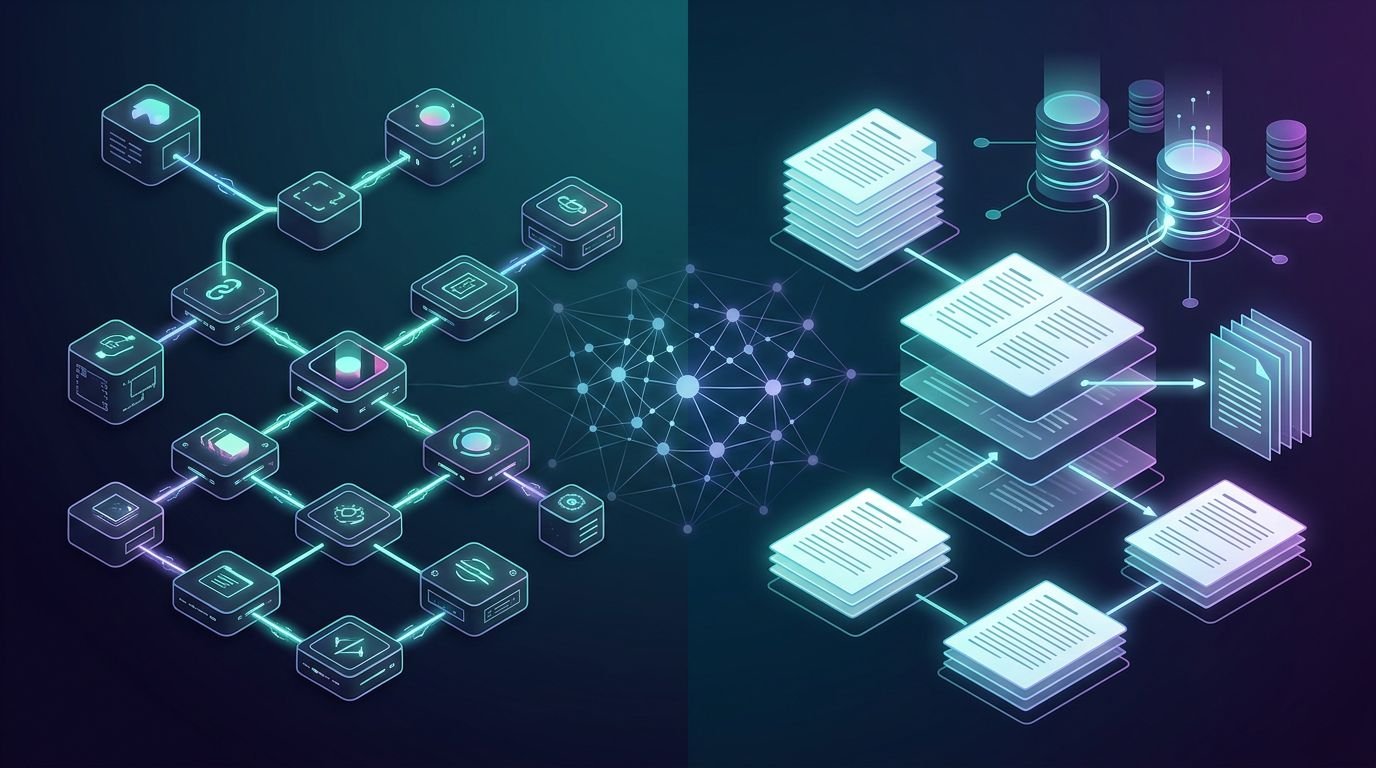
The LangChain vs LlamaIndex decision matters because each framework puts its weight in a different place. LangChain gives you broader control over application flow. LlamaIndex gives you more retrieval-focused building blocks for RAG pipelines. When comparing LangChain vs LlamaIndex, developers often find that LangChain excels at orchestration, while LlamaIndex specializes in data indexing.
For most small teams, the right choice depends on where the real failure sits. Start with the problem your app must solve, not the framework with the most integrations.
Key Takeaways
- Choose LlamaIndex for retrieval-first apps: LlamaIndex excels at data ingestion, document structure, chunking, and query engines, making it ideal for document search and knowledge assistants.
- Choose LangChain for workflow orchestration: LangChain provides broader capabilities when your app requires branching logic, tool calls, state management, and multi-step actions.
- Measure retrieval before tuning answers: Build a evaluation set of 50 to 100 real questions to test retrieval accuracy, hit rates, and metadata filtering before modifying prompts or changing models.
- Combine frameworks when necessary: You can use LlamaIndex for data ingestion and retrieval while leveraging LangChain or LangGraph to handle external tools and application flow.
The decision is retrieval depth versus workflow control
Building a retrieval-augmented generation system involves two distinct jobs that teams often bundle together. First, the application must find the right evidence. Then it must decide what to do with that evidence.
LlamaIndex is usually the more direct fit when your application is a document assistant, internal search tool, product knowledge bot, or policy lookup system. Its core concepts center on data connectors, robust data ingestion, indexing, retrieving, and forming an answer around the returned context.
LangChain has retrieval components too, acting as a flexible orchestration framework that utilizes document loaders and vector stores to power semantic search. Its strength is broader application composition. You can connect models, retrievers, APIs, structured outputs, tools, prompts, and stateful workflows. That matters when retrieval is only one step in a larger task.
I frame the choice this way:
- Pick LlamaIndex when bad retrieval is the main product risk.
- Pick LangChain when the app needs branching logic, tools, approvals, or multi-step work.
- Use both when retrieval and orchestration are equally important.
IBM’s framework comparison reaches a similar high-level distinction. LlamaIndex is more data and retrieval focused, while LangChain is built for broader LLM application development.
For a small retrieval-augmented generation app, broad capability can become unnecessary surface area. If users only ask questions over a controlled document set, you don’t need an agent that can call five tools and retry its own work. You need accurate parsing, sensible chunks, metadata filters, and a clear refusal when evidence is missing.
A fluent answer is not a successful RAG response if the retrieved source is outdated, incomplete, or unavailable to the user.
The table below shows where LangChain vs LlamaIndex tend to fit in practice.
| Decision area | LangChain | LlamaIndex | Better starting point for a small app |
|---|---|---|---|
| Basic document Q&A | Works well with a retriever and vector store | Built around indexing and query flows | LlamaIndex |
| Complex multi-step tasks | Strong support for chains, tools, and state | Possible, but less central | LangChain |
| PDF-heavy knowledge base | Requires you to compose more pieces | Strong data ingestion and node concepts | LlamaIndex |
| Agentic support workflow | Better fit for tool calls and conditional paths | Useful as the retrieval layer | LangChain |
| Retrieval tuning | Flexible, but more assembly is on you | More retrieval-oriented abstractions | LlamaIndex |
| Production tracing | Strong ecosystem support through LangSmith | Can integrate with external observability tools | LangChain |
| Small team maintenance | Can grow complex quickly | Often simpler for retrieval-first apps | LlamaIndex |
The practical difference in any LangChain vs LlamaIndex evaluation is not that one framework can do RAG and the other cannot. Both build effective RAG pipelines. The difference is how much work you must do before the system matches your actual problem.
LangChain vs LlamaIndex: the architectural split

LangChain is a set of composable application primitives. A typical app might load documents, split text, create text embeddings, search a vector database, call large language models, parse structured output, and apply prompt templates before routing the result into an API or another tool.
That freedom is useful when your retrieval-augmented generation app has real workflow requirements. Consider an IT support assistant. It may search internal runbooks, check a user’s account status through an API, open a ticket if confidence is low, and request human approval before changing anything. Retrieval is only one part of that sequence.
LlamaIndex starts closer to the data. It gives you a retrieval-oriented model for documents, nodes, indexes, query engines, post-processors, and response synthesis. That model helps when the app’s value depends on finding the correct section in a messy corpus.
I don’t treat LangChain vs LlamaIndex as a strict boundary. LangChain can run a very good document chatbot, and LlamaIndex can call external tools. But the default path differs. With LangChain, I usually assemble the retrieval design more explicitly. With LlamaIndex, I usually spend more time deciding how data should be parsed, labeled, indexed, and retrieved for retrieval-augmented generation.
That distinction becomes visible after the first real support failure.
If a user asks, “Can annual plans bought through Apple receive a refund?” large language models need the exact exception, not five broadly related refund snippets. No orchestration framework repairs a retrieval system that returns the wrong policy section.
For broader framework context and a useful summary of the retrieval-versus-orchestration split, see this RAG framework comparison. I would treat published performance numbers as directional only. Your documents, queries, permissions, model, and vector store drive the result.
Choose LlamaIndex when retrieval is the product

LlamaIndex is my first choice when a small retrieval-augmented generation app mainly answers questions over private data. That includes a SaaS help center, employee handbook, legal policy library, technical manual archive, or sales enablement portal.
These projects usually fail in predictable ways:
- PDF extraction scrambles tables, headings, or reading order.
- The index mixes old and current document versions.
- A user retrieves content from the wrong tenant or department.
- A relevant passage appears too low in the results.
- Chunks contain a keyword but not the condition or exception that gives it meaning.
LlamaIndex makes it easier to think in retrieval-specific units. A document isn’t only a string. It can become structured nodes with metadata, parent-child relationships, source references, and retrieval rules. Those details matter once the app moves beyond a clean folder of Markdown files.
Start with the source, not the embedding model
I don’t tune chunk size on raw PDF output. First, I check whether headings, tables, clauses, lists, and reading order survived data ingestion. Tools like LlamaParse help clean up messy documents before embedding models convert text into vector representations. A poor parser can separate a policy rule from its exception. More overlap won’t repair that.
Store metadata that helps both filtering and citations:
- Stable document ID and source file
- Heading path and page range
- Product, customer, or tenant scope
- Version and effective date
- Access rules where permissions vary
This is where a retrieval-focused framework earns its place. You can keep document structure available through LlamaIndex query engines instead of flattening every source into anonymous text chunks inside a vector database.
For most small teams, I would start with dense retrieval, metadata filters, and a labeled question set. Add hybrid search when users ask for product codes, error strings, legal clauses, or exact version names. This guide to hybrid search for developers explains why dense search and keyword search often need to work together in modern retrieval-augmented generation apps.
A reranker is usually the next upgrade when the right result appears in the candidate set but lands below weaker near-matches based on semantic similarity. It should not be the first fix for broken parsing or missing metadata.
LlamaIndex fits a narrow, evidence-first product
A useful small LlamaIndex product might have only three visible features: ask a question, show source citations, and hand off unanswered requests. That is enough if retrieval is dependable.
In that case, LlamaIndex gives you a direct path without forcing agent logic into a problem that doesn’t need it. The app is easier to inspect because the main trace is straightforward: source document, retrieved nodes, answer, citation.
I would still avoid treating any framework abstraction as a quality guarantee. LlamaParse node parsers, LlamaIndex query engines, and retrievers save implementation time during data ingestion and building RAG pipelines. They do not decide whether your chunks preserve meaning or whether your users have permission to see the returned source.
Choose LangChain when the app must take action

LangChain is the better fit when your RAG app needs control flow around retrieval. The app may need to decide which tool to call, validate an answer, branch based on risk, retain state across turns, or wait for human approval.
A support copilot is a good example. It can retrieve a troubleshooting guide, inspect account data, check an incident status page, and draft a response. If the request involves a refund or account deletion, it should stop and send the action to a person. The key engineering problem is not only retrieval quality. It is reliable routing.
LangGraph is often the more appropriate LangChain ecosystem component once these workflows become stateful. It is designed for graph-based flows where a task can move through several defined steps instead of one prompt chain, enabling better multi-step reasoning and context retention for advanced AI agents.
I use LangChain when I need to make decisions explicit:
- Classify the request before search.
- Apply access and metadata filters.
- Retrieve documents or call a connected tool.
- Check whether the evidence supports an answer.
- Return a cited response, ask for clarification, or escalate.
That sequence is easier to model than a single prompt asking a chatbot to figure it out. It also gives you better places to log failures, especially when you use LangSmith to monitor tool orchestration, prompt templates, and workflow automation.
More flexibility means more choices to own
The LangChain ecosystem is large. That is useful, but it can lead small teams to build too much too soon.
I have seen simple document assistants turn into a collection of chains, prompt templates, callbacks, memory layers, routers, and tools before anyone has tested retrieval against real questions. The result looks sophisticated but remains weak at the one job users care about.
Keep the first version narrow. One retriever, one vector store, a small model shortlist, structured citations, and a refusal path are enough. Add AI agents only when the product requires external actions or multi-step decisions.
If you expect to build agentic applications later, LangChain gives you room to grow. If the app will remain a focused knowledge search tool, that flexibility may be more maintenance than value, and debugging with LangSmith helps keep that complexity under control.
The combined stack is often the practical answer
The LangChain vs LlamaIndex choice does not always need a winner. For a more demanding app, I would separate the concerns.
Use LlamaIndex for data ingestion, chunking, indexing, metadata handling, and retrieval. Then use LangChain or LangGraph to manage tool use, state, escalation, structured response steps, and human review.
This split works well for retrieval-augmented generation workloads and internal operations assistants. A user might ask why an invoice failed. LlamaIndex handles initial data ingestion and retrieves the billing policy and account notes. LangGraph checks the invoice state through a billing API, powers tool orchestration for the next action, and prepares a response with citations.
The architecture stays easier to reason about because each framework has a defined job. It also prevents a familiar mistake: asking the orchestration layer to compensate for weak retrieval.
Don’t combine frameworks because the architecture diagram looks complete. Each dependency has a cost. You now own version compatibility, tracing across layers, deployment settings, and failure handling. A two-person team should only accept that cost when a single framework creates a real limitation in your workflow automation.
For most small apps, I would start with LangChain or LlamaIndex and a clean interface around retrieval. You can build advanced RAG pipelines and swap components later if you log inputs, retrieved chunks, metadata filters, output citations, latency, and errors from day one.
Test the retrieval path before judging answers
Framework selection matters less than measurement. I don’t judge a RAG app by whether its answer sounds convincing. I check whether it found the evidence a correct answer required, especially when building retrieval-augmented generation systems using tools like LangChain.
Build a small evaluation set before you tune. Fifty to 100 real questions can expose common failures. Pull them from support tickets, sales calls, failed searches, product documentation, and internal requests.
Include uncomfortable cases:
- Exact product IDs and error codes
- Questions with outdated terminology
- Similar documents with conflicting answers
- Requests that should return “I don’t know”
- Permission-sensitive questions across customers or teams
- Questions that need more than one source passage
Track retrieval separately from generation. When evaluating your RAG pipelines and vector stores, Hit Rate@5 tells you whether an approved source appeared among the first five results. Recall@K helps when several pieces of evidence are required. Context precision shows how much noise reached the large language models. Groundedness tests whether the final answer stays inside the retrieved evidence.
You should also evaluate how well your embedding models convert raw data into precise text embeddings. This directly impacts whether semantic search and semantic similarity scores successfully surface the right context for large language models.
I also measure p95 latency. Average latency hides the slow requests that users remember, especially after you add reranking, multiple retrieval paths, or tool calls.
Change one variable at a time. If you change chunk size, overlap, embedding models, top-K, reranking, and prompts in one release, you won’t know what fixed the failure. This is the practical discipline behind a reliable RAG architecture for small SaaS.
Keep operating cost tied to a measured problem
Small RAG apps rarely fail because a team started with too little infrastructure. They fail because the team added complexity before it had evidence.
A sensible baseline includes a managed vector database, a cost-efficient embedding model, metadata filters, source citations, and an evaluation set. That setup is enough to establish whether dense retrieval works for your corpus during early data ingestion.
Add hybrid search when exact terms fail. Add a reranker when relevant chunks rank too low. Add LangGraph when the application has genuine state and branching. Every component should answer a measured failure in your RAG pipelines.
Reranking can improve answer quality, but it adds latency and per-query cost. Multiple retrievers can raise recall, but they also make tracing harder. Agent loops can handle real workflows, but they need limits, timeouts, audit logs, and clear human handoffs. As you scale, you can evaluate different embedding models and rely on a scalable vector database to handle larger collections without losing precision.
For a closer look at the second-stage ranking decision, compare the available RAG reranking models. The right model is the one that improves your labeled queries inside your latency and budget limits. To keep track of expenses and trace token usage across large language models, teams often integrate tools like LangSmith to monitor performance. Using LangSmith also helps pinpoint where retrieval fails before you expand your infrastructure budget.
The framework should fit the failure you need to fix
LlamaIndex is usually the better starting point for a small retrieval-first app, especially when building retrieval-augmented generation systems that prioritize ingestion, indexing, source structure, and query quality.
LangChain is the better choice when the product needs to do more than answer from documents, scaling up to support AI agents and agentic AI features powered by large language models. When comparing LangChain vs LlamaIndex, its value grows with tool calls, state, routing, structured outputs, and human review steps.
The best small RAG app is not the one with the most framework features. It is the one that returns allowed, current, evidence-rich context before the model writes a word.
Frequently asked questions
Is LlamaIndex better than LangChain for RAG?
LlamaIndex is often the better fit for retrieval-augmented generation applications because its concepts focus on data ingestion, text embeddings, vector stores, and query engines. When comparing LangChain vs LlamaIndex, developers find that LangChain is broader and often requires more assembly for simple search tasks.
Should a small team use LangChain or LlamaIndex?
Use LlamaIndex for document Q&A, internal knowledge bases, PDF search, and other evidence-first apps that rely heavily on data connectors, document loaders, and semantic search. Use LangChain when retrieval is one step inside a workflow with APIs, tools, routing, state, or approval paths.
Can LangChain and LlamaIndex work together?
Yes. A common design uses LlamaIndex for document processing and retrieval, then LangChain or LangGraph for application flow and external tools. Only combine them when each framework solves a clear requirement.
Does a better framework fix RAG hallucinations?
No. Hallucinations often start before generation. Check document extraction, metadata, permissions, versioning, chunk boundaries, retrieval rank, and source coverage before rewriting prompts or switching models.
When should a small RAG app add reranking?
Add reranking after evaluation shows that the correct evidence appears in initial retrieval results but ranks too low. It is not a substitute for clean source documents, useful metadata, or permission filtering.
Suggested related internal articles:
- RAG Architecture for Small SaaS Teams
- Hybrid Search RAG: A Practical Guide for Developers
- RAG Reranking Models: Best Picks for Small Apps