
Is Proxy-Seller a strong choice for automation, scraping, SEO checks, and legitimate multi-account work in 2026? Whether you are looking for a reliable proxy server to manage your digital tasks or a versatile proxy provider for large-scale data collection, the answer depends on your specific needs. After testing its setup, proxy categories, session controls, and workflow fit, I think it is a capable mid-market solution, though it may not be the universal answer for every use case.
This is a sponsored article. My opinions and test criteria are my own, and I have kept the limits and trade-offs in view throughout my assessment. Proxy-Seller has a useful range of options and competitive entry pricing, yet your target sites, countries, and traffic volume will ultimately decide whether it makes sense for your projects.
Key Takeaways
- Proxy-Seller provides a diverse range of options, including Residential proxies, ISP proxies, Mobile proxies, and Datacenter proxies, to accommodate different budgets and risk profiles.
- I found the dashboard approachable for basic setup, with enough advanced controls for developers and technical SEO teams.
- Residential proxies and Mobile proxies come at a higher cost, but they are essential for tasks where location accuracy and session continuity are critical.
- Datacenter proxies offer superior value for high-volume jobs that are permitted and do not require the masking capabilities of residential IPs.
- It is recommended to test your required locations and measure successful responses with ISP proxies or other types before committing to larger traffic packages.
Proxy-Seller Review: What Is This Proxy Provider and Who Is It Built For?
Proxy-Seller is a professional proxy provider that has been in operation since 2014. A proxy routes your web traffic through a different IP address, which is essential when you need to verify localized search results, test specific ad placements, or collect public data without relying on a single office connection.
The company offers a vast IP address pool of more than 47 million IPs spanning over 220+ GEO locations. Because residential targeting can reach down to the country, city, and ISP levels, this service is highly versatile. However, coverage varies significantly by proxy category and specific region, so it is best to view these large numbers as a starting point rather than a guarantee that every city will perform identically.
The Main Proxy Types I Found
Proxy-Seller offers a wide range of solutions, including rotating residential, static residential or ISP, 4G/5G mobile proxies, and datacenter IPv4 and IPv6 options.
Residential proxies rotate frequently and generally carry more trust with public websites, making them ideal for localized checks and low volume collection. ISP proxies provide a residential-looking IP that stays consistent for longer sessions, which is excellent for approved, login-based work.
Mobile proxies are highly effective for mobile-specific testing, though they come at a higher price point. Meanwhile, datacenter IPv4 and IPv6 proxies are fast and affordable, perfect for SERP tracking, public page monitoring, and high-volume repeatable tasks. Since these are often private proxies, they offer a level of exclusivity, though they are easier for some targets to identify than residential alternatives.
How Proxy-Seller Fits AI and SEO Workflows
I use these proxies for localized Google checks, competitor price monitoring, ad verification, and browser automation. These tools are also vital for SEO optimization and streamlined SMM promotion, as they allow for controlled data collection at scale. In any AI workflow, the proxy acts only as the transport layer. It does not replace the need for robust extraction rules, fresh data sources, or strong validation.
For effective automation design, I always pair proxy limits with retry controls and error logging. My Make.com AI automation workflow review covers why retries and run history are critical once a workflow starts handling real volume.
A proxy can reduce friction, but it does not override a website’s terms, privacy rules, rate limits, or access controls.
How I Tested Proxy-Seller in Real-World Workflows
I tested several proxy types across locations using consistent request sizes, time windows, retry rules, and public targets. I recorded request completion, response time, timeouts, IP consistency, location checks, rotation behavior, bandwidth use, setup time, and recovery after an error.
I kept my observations separate from vendor specifications. Proxy-Seller advertises fast speed capabilities up to 1 Gbps for eligible plans and uptime figures near 99.9%. Those numbers are useful benchmarks, but they aren’t a guarantee for a particular country, website, or time of day. It is also worth noting that the service maintains a strong reputation, backed by a high Trustpilot score and a significant volume of positive customer reviews.
Performance, Speed, and Reliability Results
Datacenter and ISP connections felt more predictable for repeated requests. Residential routes were sometimes slower, which is normal because traffic passes through consumer networks. For scraping, I care more about completed valid responses than a low latency number alone.
A fast proxy that causes frequent retries can cost more than a slower route with fewer failures. I tested concurrency conservatively, then increased it only after checking timeout and error patterns.
IP Rotation and Sticky Session Behavior
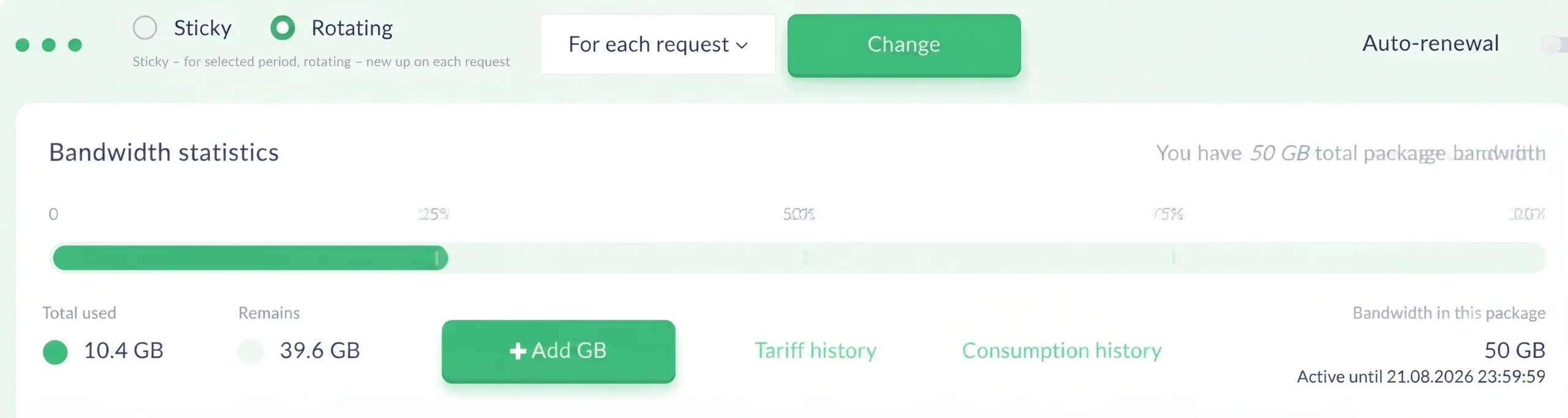
Proxy-Seller supports rotation per request, timed rotation, and sticky sessions for applicable proxy types. When using the pool of rotating proxies, I rely on per-request rotation for public-page collection. I use sticky sessions for browser automation, approved account sessions, and checkout testing.
A sticky session keeps the same IP for a defined period. It improves continuity, but it doesn’t guarantee a site will trust or accept that IP.
Dashboard Setup and Everyday User Experience
The control panel let me select location, generate credentials, set authentication, and review usage without unnecessary friction. Username and password authentication worked for quick tests. IP whitelisting is the better option for fixed servers.
I also found proxy checking, port scanning, IP ping, and IP tracing useful for first-pass diagnosis. The interface is clear for a first-time buyer, while API access gives technical users room to automate provisioning. If you encounter hurdles during configuration, the technical support team is available to assist with setup or diagnosis.

Features That Matter for AI Automation and Web Scraping
Proxy-Seller offers robust protocol support, including HTTP(S) and the SOCKS5 protocol, plus an API for managing proxy access. That makes it workable with Python scripts, Puppeteer, Playwright, AdsPower, and GoLogin. Advanced users will also appreciate that the service provides access to various subnets to ensure better distribution for complex scraping tasks.
For example, I could run a Playwright script through a Chicago residential endpoint to compare visible search results against a Dallas endpoint. The script still needs a low request rate, structured retry handling, and validation of the resulting data.
AI Automation Use Cases I Would Consider
I would consider residential proxies for localized research and ad checks. ISP proxies make more sense for stable browser sessions. Datacenter IPs are often enough for permitted API-like collection from public sources.
For AI research pipelines, I validate every collected field before sending it into a retrieval system or model prompt. Page layouts change, authentication can fail, and bot checks can return incomplete content. Developer discussions about practical AI scraping stacks reach the same practical point: the proxy is only one part of the stack.
Web Scraping Projects That Benefit Most
Public product monitoring, travel research, inventory checks, market research, and SERP tracking are reasonable fits when site rules permit access. Geographic targeting and rotation help produce more representative results.
Small scheduled jobs need modest traffic and careful retries. Large projects need bandwidth planning, concurrency caps, response validation, and documented permission. I don’t treat raw request volume as a performance metric. Clean, usable records are what matter.
Multi-Account Management and Browser Profiles
For legitimate multi-account work, I would pair one static residential, ISP, or mobile proxy with one browser profile. I would keep the account’s location consistent and monitor login health.
Proxies must not be used to evade bans, create fake engagement, commit fraud, or bypass platform rules. If your use case depends on doing any of that, Proxy-Seller is not an appropriate solution.
Proxy-Seller Pricing, Value, and Promo Code Details
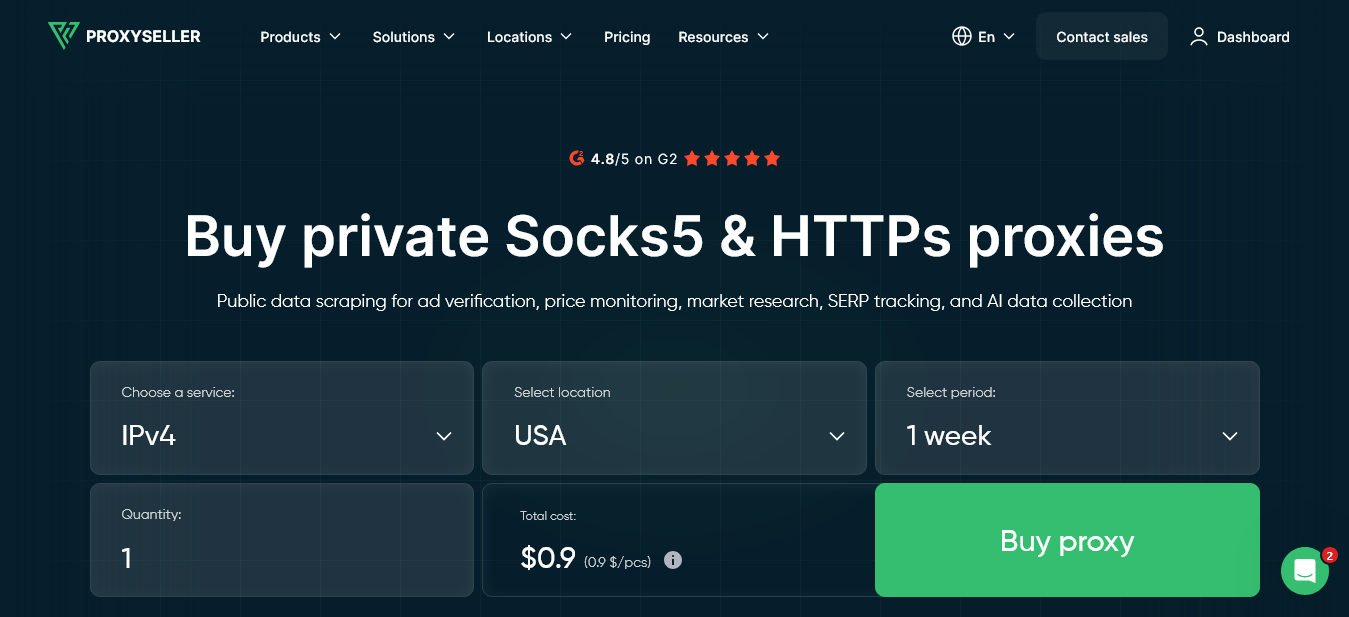
Pricing fluctuates, so I recommend confirming current rates on their website before completing your purchase. These are the starting price points I identified while evaluating Proxy-Seller as a top contender among marketplace proxies.
| Proxy type | Reported starting price | Best fit |
|---|---|---|
| Datacenter IPv4 | Starting $0.76 per IP | Bulk public-page tasks |
| Datacenter IPv6 | Starting $0.08 per IP | Low-cost compatible targets |
| ISP static residential | Starting $1.50 per IP | Longer stable sessions |
| Rotating residential | $1.99 per 500 MB | Geo-targeted collection |
| Mobile | Starting $10 per IP for a week | Mobile-specific testing |
Residential traffic can reach approximately $2.20 per GB at larger volume tiers. Your actual cost depends on variables like page weight, retries, image loading, JavaScript assets, and rotation frequency. A crawler that downloads unnecessary media will burn through your traffic allowance quickly.
Readers can use my exclusive discount code AIFLOWER15 to secure a percentage off eligible Proxy-Seller purchases. If you are looking for a functional promocode to lower your overhead, this is a great way to test their services, though I still recommend starting with the smallest plan that fits your technical requirements.
When the Pricing Makes Sense, and When It Does Not
Residential pricing is the logical choice when a target requires city level location checks or more natural IP distribution. However, it does not make financial sense for media heavy crawling that could easily run on inexpensive datacenter proxies. When building your architecture, consider that ISP proxies offer the stability of residential addresses with the speed of data centers.
I always measure costs based on the price per successful result rather than the price per request. An IPv4 or IPv6 datacenter proxy priced at $0.08 is extremely cheap, but it holds no value if your specific target blocks that IP range entirely. Always factor in your success rate when calculating your true return on investment.
Security, Privacy, and Customer Support Check
I treat privacy claims as a due-diligence task. Proxy-Seller references GDPR and CCPA compliance, but I would verify current data handling terms, IP sourcing, retention rules, acceptable-use limits, and any ISO/IEC 27001 or ePrivacy statements before connecting sensitive workloads.
Use strong credentials, IP whitelisting, least-privilege access, and separate automation accounts. The technical support team is available 24/7 and can help with configuration or replacements, though they cannot override a target site’s anti-bot decisions. Checking recent customer reviews can also provide insight into how the provider handles security concerns in real-world scenarios.
What I Liked About Proxy-Seller
- Broad GEO locations and several proxy categories in one account.
- Flexible rotation options for collection jobs and sticky sessions.
- API access and support for common browser automation tools.
- Useful diagnostic tools for checking a connection before deployment, often resulting in fast speed across various networks.
Where Proxy-Seller Could Be Better
Performance can vary by country and proxy type. Residential bandwidth becomes expensive at scale. Advanced automation still requires technical skill, and aggressive anti-bot systems can block any provider’s IPs.
A large residential pool does not mean every location has equal availability or quality.
How Proxy-Seller Compares With Major Alternatives
Choosing the right proxy provider depends largely on your specific infrastructure needs, as each service targets different operating models.
| Provider | Proxy range | Best fit | Pricing approach |
|---|---|---|---|
| Proxy-Seller | Residential proxies, ISP proxies, mobile proxies, and datacenter | Flexible small-team workflows | Per IP, GB, or rental |
| Bright Data | Broad residential and data tools | Enterprise collection | Premium usage-based |
| Oxylabs | Residential, ISP, scraping products | Large data teams | Premium usage-based |
| Decodo | Residential, mobile, datacenter | Developers and agencies | Usage-based tiers |
| SOAX | Residential and mobile targeting | Geo-focused collection | Traffic-based plans |
Enterprise providers can offer stronger governance, managed collection products, and procurement support. Proxy-Seller is more appealing when I want raw proxy choice without paying for a large enterprise package.
Which Provider Fits Each Common Scenario?
A small scraper can start with Proxy-Seller datacenter or residential traffic after testing its target. An SEO agency can use it for localized checks and controlled SERP work. An AI developer may prefer it when building their own collection layer, then manage model cost and fallbacks through an AI gateway for LLM cost and log management.
For enterprise data teams, Bright Data or Oxylabs may be a better fit when managed APIs, contracts, and governance outweigh price. Social media managers should only use stable proxies for approved accounts and platform-compliant work.
Who Should Use Proxy-Seller, and Who Should Look Elsewhere?
I would consider Proxy-Seller for developers needing API access, SEO teams checking local results, marketers testing ads, and agencies running controlled public data projects. It is also useful when one provider needs to cover several proxy types.
I would look elsewhere if I wanted the lowest possible price, a managed scraping API instead of raw proxies, or enterprise governance with custom contracts. Users planning activity that violates platform rules should not use proxy services for that purpose.
How I Would Choose the Right Plan
I define the permitted target sites first. Then I choose the specific GEO locations, estimate bandwidth, and select the right proxy server for my needs. Whether I decide to use static IPs or rotating proxies, I always test for latency, completion rate, and session behavior.
Keep a small test dataset. Compare usable responses across providers instead of trusting advertised IP totals. Community reports on web scraping tool testing can provide ideas, but your own target tests are the deciding evidence.
Frequently Asked Questions About Proxy-Seller
Is Proxy-Seller good for web scraping?
It is an excellent fit for public-data collection, SEO monitoring, and price research. Whether you choose datacenter proxies for high-speed tasks or residential proxies for better anonymity, your results will depend on the target website, your chosen location, and your specific request behavior.
Does Proxy-Seller support AI automation?
Yes. With full support for HTTP(S) and the SOCKS5 protocol, alongside robust API access and compatibility with major browser automation tools, the service is well-suited for AI research and data-heavy workflows.
Which Proxy-Seller proxy type is fastest?
Datacenter proxies typically provide the fastest speeds for high-volume tasks. ISP proxies offer a great balance, remaining stable for persistent sessions. Meanwhile, residential and mobile routes may trade raw speed for superior IP trust and broader location coverage.
Does Proxy-Seller offer residential and mobile proxies?
Yes. The platform provides a wide range of options, including rotating residential proxies, static residential or ISP addresses, and high-quality 4G/5G mobile proxies.
How does IP rotation work?
You can configure your rotation settings to switch an IP per request or at specific timed intervals. Alternatively, you can maintain a sticky session for a set period, which is ideal if you need to perform tasks that require continuity.
Is Proxy-Seller safe and legal?
Using a proxy is legal for many business and research applications. However, your actual activity must comply with local laws, data privacy obligations, and the specific terms of service or platform rules of the websites you access.
Does Proxy-Seller work with Python or Playwright?
Yes. Because the service supports the SOCKS5 protocol and standard HTTP(S) connections, it integrates seamlessly with Python, Playwright, Puppeteer, and other popular automation frameworks.
Does AIFLOWER15 apply to Proxy-Seller purchases?
The AIFLOWER15 code applies to eligible purchases on the platform. Please verify the current checkout terms and conditions before completing your transaction to ensure the discount is applied correctly.
Final Thoughts
My Proxy-Seller review finds a practical provider with broad proxy choice, useful targeting, and pricing that can work well for smaller teams and technical users. Overall, this Proxy-Seller review concludes that the service is a solid option for legitimate AI automation, localized SEO checks, controlled scraping, and compliant multi-account workflows.
I would choose another provider if I needed enterprise controls or managed extraction tools. Use the discount code AIFLOWER15 on eligible purchases if it helps, but as always, start small, test the required locations, measure successful results, and review the current terms before scaling your operations.