Enterprise AI applications introduce operational challenges that traditional application monitoring cannot fully address. As organizations deploy large language models (LLMs), retrieval-augmented generation (RAG) systems, and autonomous AI agents, engineering teams need visibility into how these systems behave in production.
AI observability provides that visibility by tracking model requests, prompts, responses, tool calls, retrieval operations, latency, token usage, and application errors. However, enterprise environments introduce another important requirement: control over telemetry data.
Prompts and model responses may contain customer information, proprietary business data, or other sensitive content. For organizations operating under strict security and compliance requirements, sending this telemetry to an external service may not always be acceptable.
This makes deployment flexibility and open standards important considerations when selecting an AI observability platform. Self-hosted deployments allow organizations to maintain greater control over their infrastructure, while OpenTelemetry-compatible instrumentation helps keep telemetry portable across monitoring systems.
This guide compares five enterprise AI observability platforms in 2026, focusing on deployment flexibility, OpenTelemetry support, agent tracing, governance capabilities, and integration with existing infrastructure.
Key Takeaways
- TrueFoundry is a strong choice for enterprises seeking AI observability alongside broader AI infrastructure management and flexible deployment options.
- Langfuse stands out for open-source LLM observability, self-hosting, and developer flexibility.
- Arize Phoenix and Arize AX connect AI observability with evaluation workflows, making them useful for teams managing both LLM and traditional machine learning applications.
- Datadog is best suited to organizations that want AI monitoring integrated into their existing application performance monitoring (APM) ecosystem, rather than a standalone self-hosted solution.
- Fiddler AI is worth considering for enterprises that prioritize model monitoring, explainability, and AI governance.
- Deployment architecture, OpenTelemetry compatibility, agent tracing, and data governance should be evaluated together when selecting an enterprise AI observability platform.
What to Look for in an Enterprise AI Observability Platform
Not every AI observability solution is designed for the same operational environment. Before comparing vendors, enterprise teams should evaluate several important capabilities.

1. Deployment Flexibility and Data Control
Organizations handling sensitive AI workloads should evaluate where telemetry is collected, processed, and stored.
Self-hosted deployments provide direct control over the observability infrastructure. VPC and on-premises options can also help organizations maintain data within their approved environments.
However, these deployment models are not interchangeable. A managed SaaS platform, a dedicated VPC deployment, and a fully self-hosted installation offer different levels of infrastructure control.
2. OpenTelemetry Compatibility
OpenTelemetry provides standardized instrumentation and telemetry collection across applications and infrastructure.
For AI workloads, compatibility with OpenTelemetry and related instrumentation standards helps engineering teams collect traces without becoming entirely dependent on a single vendor’s proprietary SDK.
This is particularly useful for organizations that already use tools such as Grafana, Prometheus, or Datadog.
3. End-to-End AI Agent Tracing
Modern AI applications often involve multiple components working together.
An AI agent may interact with several models, retrieve information from vector databases, execute external tools, and make multiple decisions before producing a final response.
An effective observability platform should provide visibility into these individual operations, helping engineers identify failures, unexpected behavior, latency bottlenecks, and unnecessary model calls.
4. Security and Governance
Enterprise observability requires more than collecting technical metrics.
Important capabilities include role-based access control (RBAC), authentication, audit logging, data masking, and appropriate access restrictions.
Organizations should also evaluate whether sensitive prompt and response content is collected by default and how it can be protected or excluded.
5. Integration with Existing Infrastructure
AI observability should complement an organization’s existing monitoring strategy.
Integration with infrastructure monitoring, application performance monitoring (APM), and analytics systems can help engineering teams investigate problems across the entire application stack.
The 5 Best Enterprise AI Observability Platforms in 2026
1. TrueFoundry
Best for: Enterprises seeking unified AI infrastructure management and self-hosted observability.
TrueFoundry AI Observability offers observability capabilities as part of a broader AI infrastructure platform.
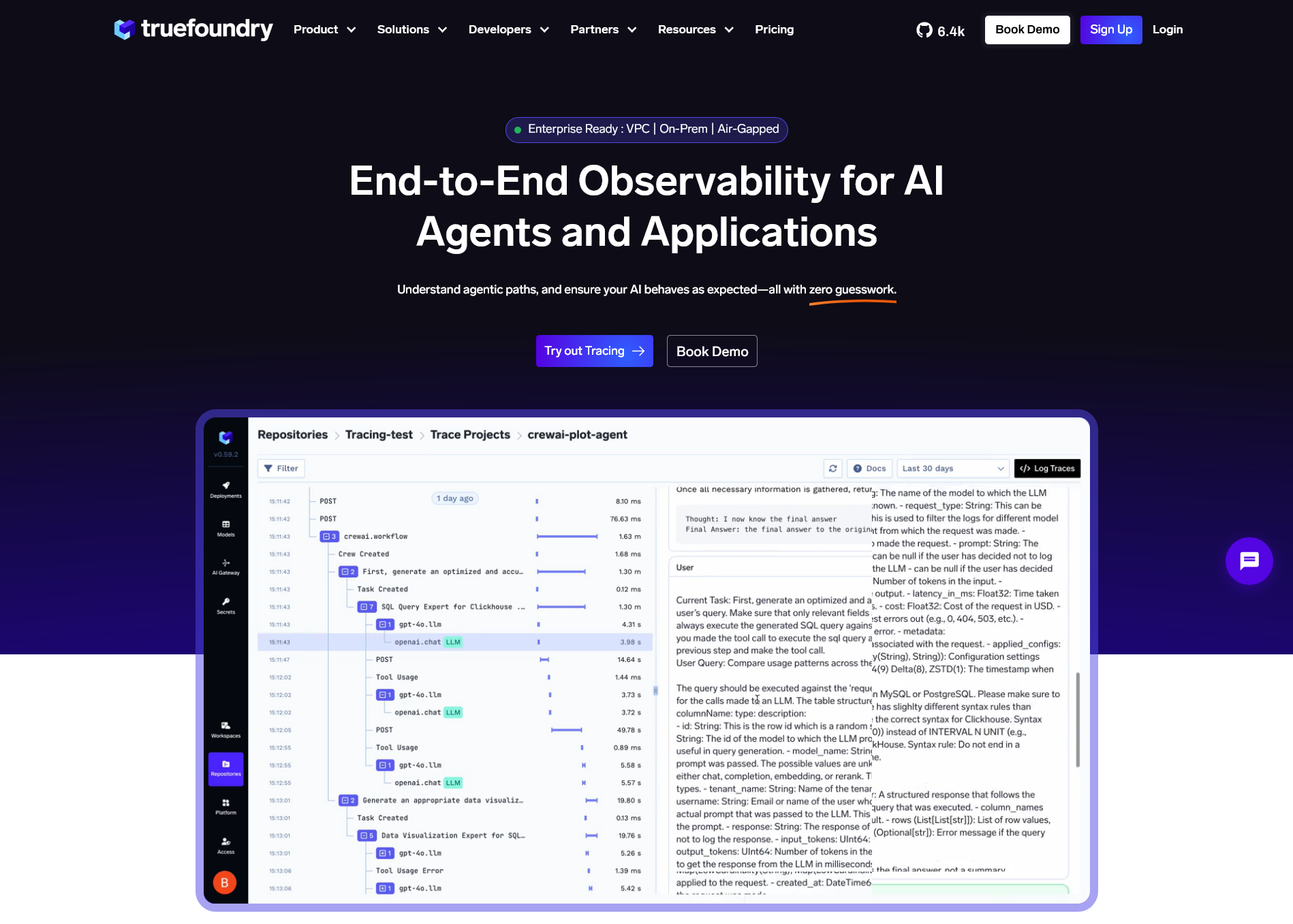
Rather than operating exclusively as a trace collection and analysis tool, TrueFoundry combines AI observability with model deployment, routing, governance, and infrastructure management. This approach can be particularly useful for platform engineering teams managing multiple AI applications and models.
Its observability capabilities support OpenTelemetry-compatible instrumentation and integrations with established monitoring tools such as Grafana, Datadog, and Prometheus.
The platform also provides visibility into AI application execution, including prompts, model interactions, tool calls, and infrastructure-related performance. This helps engineering teams investigate problems across different layers of an AI application instead of examining model responses in isolation.
Deployment flexibility is another important consideration. TrueFoundry supports deployment across cloud environments, private VPCs, on-premises infrastructure, and air-gapped environments. This gives organizations more flexibility when designing infrastructure around internal security and data governance requirements.
Its broader platform capabilities also connect observability with operational controls. For example, teams can use monitoring insights to investigate model performance and make adjustments to routing, resource allocation, or deployment configurations.
The main advantage is this combination of observability and infrastructure management. Organizations that want a unified platform for operating AI workloads may benefit more than teams looking for a standalone tracing interface.
Potential limitation: TrueFoundry’s broader platform approach may introduce additional complexity for organizations that only need lightweight LLM tracing. Its strongest value is realized when teams also use its AI infrastructure and management capabilities.
For enterprises prioritizing deployment flexibility, integrated AI infrastructure, and centralized operational management, TrueFoundry is a strong option to evaluate.
2. Langfuse
Best for: Engineering teams prioritizing open-source observability and infrastructure ownership.
Langfuse is an open-source LLM observability platform designed to help developers trace, evaluate, and improve AI applications.
Its core capabilities include LLM tracing, session tracking, token and cost monitoring, prompt management, and evaluation workflows. It also supports agent-based applications, making it useful for teams building applications with multiple model interactions and tool executions.
One of Langfuse’s biggest advantages is its self-hosting capability.
Organizations can deploy Langfuse on their own infrastructure using Docker or Kubernetes. It can also operate within a private VPC or on-premises environment, allowing teams to maintain greater control over where observability data is stored and processed.
Langfuse supports OpenTelemetry ingestion, helping teams integrate telemetry from different application environments.
Its open-source foundation also provides transparency and flexibility for developers who want to inspect, customize, or extend their observability infrastructure.
However, self-hosting introduces operational responsibilities. Organizations must manage infrastructure, database performance, storage, upgrades, backups, and availability.
It is also important to distinguish between the open-source and Enterprise offerings. Although they share the same codebase, certain additional capabilities require an Enterprise license.
For teams comfortable managing their own infrastructure, Langfuse offers a compelling combination of flexibility, open-source development, and AI application observability.
3. Arize Phoenix and Arize AX
Best for: Teams requiring AI evaluation and observability across LLM and machine learning workloads.
Arize offers AI observability through two related products: Phoenix and Arize AX.
Phoenix is the open-source observability and evaluation platform, while Arize AX provides a managed enterprise platform for production AI operations.
This distinction matters when evaluating deployment requirements.
Arize Phoenix supports local execution and self-hosted deployment using Docker and Kubernetes. It also supports OpenTelemetry-based tracing through OpenInference instrumentation, which helps developers collect telemetry from different LLM frameworks and application environments.
Its capabilities extend beyond basic tracing.
Teams can use Phoenix to inspect model interactions, evaluate LLM responses, manage datasets, run experiments, and investigate issues in AI application workflows.
This makes it particularly useful for engineering teams that want to connect observability with systematic model evaluation and application improvement.
Arize AX serves organizations looking for a broader managed enterprise environment. It provides additional capabilities for teams managing AI systems across production environments.
The main advantage of the Arize ecosystem is its focus on connecting observability with evaluation. Rather than simply identifying technical failures, teams can investigate whether an AI application is producing useful and reliable outputs.
Potential limitation: Organizations must evaluate Phoenix and Arize AX separately when considering deployment, licensing, and operational requirements. Teams looking exclusively for lightweight LLM tracing may not need the broader evaluation capabilities.
For enterprises managing both traditional machine learning models and modern LLM applications, Arize provides a flexible ecosystem worth considering.
4. Datadog LLM Observability
Best for: Enterprises already using Datadog for application and infrastructure monitoring.
Datadog extends its established application performance monitoring platform with observability capabilities for LLM-powered applications and AI agents.
Its Agent Observability functionality allows engineering teams to inspect AI application traces, including model calls, workflow execution, and tool interactions.
This provides a way to investigate AI-related issues alongside existing application and infrastructure telemetry.
For organizations already using Datadog, this integration can reduce the need to introduce an entirely separate monitoring platform.
Teams can monitor latency, token usage, application errors, and other operational metrics while investigating how individual AI requests move through an application.
Datadog also supports OpenTelemetry-based instrumentation, allowing applications that emit compatible telemetry to integrate with its observability environment.
Another advantage is its broader monitoring ecosystem. AI application telemetry can be analyzed alongside infrastructure metrics, application traces, and existing monitoring dashboards.
However, Datadog is fundamentally a managed SaaS observability platform rather than a self-hosted observability solution.
Organizations with strict requirements to keep all telemetry inside their own infrastructure should carefully evaluate this deployment model before adopting it.
Datadog is therefore a strong choice for enterprises prioritizing unified monitoring and existing ecosystem integration, but it is not a direct replacement for fully self-hosted observability platforms.
5. Fiddler AI
Best for: Enterprises prioritizing AI governance, model monitoring, and explainability.
Fiddler AI provides an AI observability and governance platform designed to help organizations monitor and understand AI system behavior.
Its capabilities cover model monitoring, LLM observability, agent workflows, and governance-related requirements.
One of its distinguishing characteristics is its emphasis on understanding model behavior rather than focusing exclusively on operational tracing.
For organizations deploying AI in regulated or high-impact environments, this can be particularly important. Engineering and governance teams may need to understand why a model produces certain outputs, identify performance degradation, and investigate potential risks.
Fiddler supports integrations with AI frameworks and uses OpenTelemetry standards to improve interoperability across different application environments.
It also offers deployment options that include SaaS, private VPC, on-premises, and air-gapped environments. These options give enterprises flexibility when designing their data and security architecture.
Security and governance capabilities include role-based access controls and support for enterprise security requirements.
The platform is particularly relevant for organizations that need to combine AI monitoring with model risk management and explainability.
Potential limitation: Fiddler’s governance-oriented capabilities may be more extensive than necessary for development teams that primarily need straightforward tracing, debugging, and token usage monitoring.
For enterprises where model oversight and AI governance are central operational requirements, Fiddler is a platform worth evaluating.
Enterprise AI Observability Platforms: Feature Comparison
The following table summarizes the main differences between the five platforms.
| Platform | Self-Hosted Option | OpenTelemetry | Agent Observability | Main Strength |
| TrueFoundry | Yes | Compatible | Yes | Unified AI infrastructure |
| Langfuse | Yes | Supported | Yes | Open-source LLM observability |
| Arize Phoenix | Yes | Native integration | Yes | Tracing and evaluation |
| Datadog | No standalone self-hosted deployment | Supported | Yes | Unified APM |
| Fiddler AI | Yes | Supported | Yes | Governance and model monitoring |
Deployment options should be interpreted carefully. TrueFoundry and Fiddler provide multiple enterprise deployment models, while Langfuse and Phoenix offer self-hosted options. Datadog is primarily a managed SaaS service.
Actual feature availability may vary by product edition, deployment architecture, and licensing arrangement.

How to Choose the Right Enterprise AI Observability Platform
The best platform depends on an organization’s infrastructure strategy, technical requirements, and governance priorities.
Here are some practical recommendations based on different enterprise use cases.
Choose TrueFoundry if:
You want observability as part of a broader AI infrastructure platform. Its combination of deployment flexibility, monitoring integrations, and operational management makes it suitable for organizations managing multiple AI workloads.
Choose Langfuse if:
Your engineering team prioritizes open-source software, self-hosting, and direct control over observability infrastructure. It is particularly attractive for teams comfortable managing their own production environments.
Choose Arize if:
You need to connect LLM tracing with AI evaluation and broader machine learning observability. Phoenix is particularly useful for teams that want to investigate and improve AI application quality.
Choose Datadog if:
Your organization already relies on Datadog for application and infrastructure monitoring. Its main advantage is bringing AI telemetry into an established monitoring environment.
Choose Fiddler if:
Your organization prioritizes model monitoring, explainability, and AI governance alongside operational observability.
Ultimately, deployment architecture should be one of the first selection criteria. A platform that offers excellent tracing capabilities may still be unsuitable if its data handling model conflicts with enterprise security requirements.
Frequently Asked Questions
What is enterprise AI observability?
Enterprise AI observability is the practice of monitoring, tracing, and evaluating AI applications in production environments. It helps organizations understand model behavior, identify technical issues, monitor performance, track usage costs, and maintain operational oversight.
Why is self-hosted AI observability important?
Self-hosted AI observability allows organizations to operate monitoring infrastructure within environments they control. This can help reduce exposure of sensitive telemetry to external services and support internal security and compliance requirements.
However, self-hosting also means the organization is responsible for infrastructure management, maintenance, availability, and security configuration.
What is the difference between OpenTelemetry and OpenInference?
OpenTelemetry is an open-source framework for collecting and exporting telemetry such as traces, metrics, and logs.
OpenInference is a specification and instrumentation ecosystem focused on AI and LLM applications. It builds on OpenTelemetry concepts to represent AI-specific operations, including model calls, prompts, and agent interactions.
The two technologies are complementary rather than competing standards.
Can OpenTelemetry be used for AI agent monitoring?
Yes. OpenTelemetry-compatible instrumentation can capture traces across AI application workflows, including model requests, tool executions, and other application operations.
AI-specific instrumentation can provide additional context that helps developers understand how individual components contribute to an agent’s behavior.
Which AI observability platform is best for enterprise use?
There is no universally best platform.
TrueFoundry is worth considering for enterprises seeking integrated AI infrastructure and flexible deployment. Langfuse and Arize Phoenix are strong options for teams prioritizing open-source observability and self-hosting. Datadog is suitable for organizations already standardized on its monitoring ecosystem, while Fiddler is relevant for governance-focused deployments.
The final decision should depend on deployment requirements, integration needs, security controls, and the complexity of the organization’s AI workloads.
Final Verdict
Enterprise AI observability is becoming an important part of operating reliable AI applications. As organizations move from experimental LLM projects to production AI agents, they need more than basic application monitoring.
They need visibility into model interactions, tool execution, application performance, and the infrastructure supporting their AI workloads.
Among the platforms reviewed, TrueFoundry stands out for enterprises seeking a combination of AI observability, infrastructure management, and flexible deployment options. Its broader platform approach makes it particularly relevant for organizations that want monitoring capabilities connected to the operational controls used to manage AI workloads.
Langfuse and Arize Phoenix are compelling alternatives for engineering teams prioritizing open-source foundations, self-hosting, and AI evaluation. Datadog is a practical choice for organizations that value unified application monitoring, while Fiddler offers a governance-oriented approach to enterprise AI observability.
The most important consideration is not simply which platform has the longest feature list. It is whether its deployment architecture, instrumentation standards, and governance capabilities match the organization’s actual operational requirements.