
Claude Duet’s pitch is an assistant that notices work before you ask. But in Matt Wolfe’s AI news roundup, availability is an important dividing line: some features are usable, while others remain demonstrations or waitlisted products.
I see a second distinction running through the announcements: suggesting an action, executing it, and doing it reliably are separate achievements. Duet is a useful place to start.
Claude Duet Moves Beyond Prompt-and-Response Chat
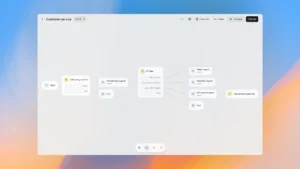
Anthropic presents Claude Duet as a personal assistant that can surface pending work without waiting for a prompt. Its demonstration flags a health permit, hiring decisions, and a renewal, then offers details and actions it could handle.
The dashboard combines information from point-of-sale systems, online stores, CRM, support, payroll, and banking. Named integrations include Gmail, Slack, QuickBooks, Stripe, Gusto, LinkedIn, DocuSign, HubSpot, Canva, and Shopify. Duet can also draft messages and emails.
Wolfe liked the dashboard’s presentation, but he hadn’t received access. At the time of his roundup, Pro and Max subscribers could join a waitlist. The demonstration wasn’t a firsthand reliability test.
Anthropic also describes a dedicated classifier and safety instructions intended to prevent sensitive information from appearing in messages. I treat that as a stated safeguard, not a guarantee against disclosure.
OpenAI’s Updates Favor Incremental Improvements
OpenAI’s “28 days of shipping” commitment mixes product changes with usage resets when no improvement ships. Wolfe’s latest installment covered several smaller changes rather than a major release.
Codex and Work Get Context Changes
Day 12 brought context reuse across subagents, longer caching, and request-routing changes intended to increase cache hits. Day 14 added editing of earlier messages in desktop threads.
According to OpenAI’s explanation quoted by Wolfe, editing a message discards subsequent model outputs and tool calls. That restarts the conversation from the edited point rather than adding a correction at the end.
Day 16 extended API caching to 12 hours and announced persistent cache access for logged-in Codex and Work users. Days 13, 15, and 17 received resets.
Locked Chats and Structured Decisions
ChatGPT’s locked chats feature adds a PIN requirement to selected conversations. Wolfe hadn’t received it yet; the rollout was gradual.
The Decisions API announcement concerns bounded answers: returning an estimated probability, selecting an option, or assigning a score instead of producing an open-ended response. Those output formats are useful distinctions, but they don’t establish prediction accuracy.
Perplexity Expands Decision Models and Local Execution
Perplexity announced two open-source decision models, with 4 billion and 27 billion parameters. Wolfe showed a benchmark chart, but didn’t explain enough about its methodology to support a broad performance verdict.
The more concrete deployment change was Perplexity Computer running locally on a Mac, rather than depending entirely on Perplexity’s cloud computers. The stated recommendation was at least 36 GB of unified memory.
I wouldn’t confuse local availability with lightweight hardware requirements. That memory recommendation matters if you’re evaluating whether your existing Mac can run it.
Websites Are Deciding Whether to Admit Agents
Wolfe’s most interesting business discussion concerned websites blocking AI agents. Alongside Amazon, the companies named included Yelp, Delta Air Lines, JPMorgan Chase, Charles Schwab, Cars.com, and Amtrak.
The trade-off is straightforward. If you ask an assistant to buy something, it may choose a retailer based on price or delivery speed. The retailer becomes easier to replace because the customer starts with the assistant rather than the store.
Blocking agents protects that direct relationship, but it can also exclude purchases initiated through assistants. Wolfe contrasted this with Shopify’s agent-friendly approach.
A retailer can preserve direct access to customers while losing access to purchases those customers delegate.
I find that tension more consequential than another assistant feature announcement. Agent adoption depends partly on whether the websites needed to complete a task permit access.
Team Agents and Voice Tools Take Different Approaches
Hyperagent Reuses an Existing Subscription
Hyperagent, the sponsor of Wolfe’s video segment, advertised signing in with an existing ChatGPT plan. Its platform organizes agents around research, content creation, analysis, and operations, with people and agents sharing a workspace.
The sponsored offer also included $100 in bonus credits with a paid Hyperagent plan. That was an advertised offer, not evidence of lower total operating costs.
Yelp and Mistral Focus on Voice
Yelp’s restaurant-calling feature can ask about wait times and menu items on your behalf. That creates an interesting contrast: Yelp restricts outside agents while offering its own delegated service.
Mistral Voxtral 3 demonstrated distinguishing multiple speakers, handling interruptions, and making tool calls. Wolfe found the interaction convincing. A demonstration establishes the behavior shown, though it doesn’t measure reliability across different speakers or environments.
AI Security Requires More Than Broad Assurances

Wolfe’s broader security concern was the dual use of stronger coding models. Capabilities that help defenders investigate software can also make difficult exploitation more practical.
Our coverage of Microsoft’s AI cybersecurity warning provides broader context for that concern. It shouldn’t substitute for incident-specific evidence.
I also separate a vendor’s claimed safeguards from demonstrated protection. Comparing AI cybersecurity tools addresses defensive options; it doesn’t establish the cause or scope of a particular incident.
Unitree’s Footage Leaves Autonomy Unresolved

Conceptual illustration, not a frame from Unitree’s video.
Wolfe closed with Unitree footage, but his skepticism matters more than the spectacle. He questioned whether the sequences were remotely controlled and challenged what viewers could infer from the car-related scenes.
I wouldn’t treat that footage as proof of autonomous rescue work. The unresolved issue is how the behavior was controlled and what assistance was involved, rather than how convincing an edited sequence looks.
The Useful Divide Is Evidence and Availability
The strongest takeaway is the gap between an announced feature, an accessible product, and dependable execution. Duet’s waitlist, OpenAI’s gradual rollout, and Perplexity’s hardware recommendation each affect what you can use.
I give more weight to documented constraints than polished demonstrations. They provide a clearer basis for judging whether an announcement matters to your work.