Matt Wolfe’s Gemini 4 Argon video presents Google’s new model as a tool for complex, longer-running work. My main takeaway is that useful chat answers and dependable task execution remain separate capabilities.
Wolfe had early access, so the demonstrations are his tests, not independent testing by AI Flow Review. His account is most useful when examined feature by feature, particularly where the Tasks workflow stalled.
What Gemini 4 Argon Is Designed to Handle
According to Wolfe, Google announced Argon roughly two weeks before giving paying users broader access. The earlier announcement described the model, but most users couldn’t try it yet.
The stated focus is complex work that takes longer than a typical question-and-answer exchange. Wolfe identifies coding as a major priority, consistent with the emphasis he sees across recent model releases.
Google also says Argon produces more direct answers, uses fewer clichés, and follows style instructions more reliably. Those are company claims reported in the video, separate from the practical demonstrations.
Antigravity, Search, and the Gemini App
Wolfe describes Argon appearing in the Gemini app, Google Search’s AI Mode, and Antigravity, Google’s coding environment. Antigravity offers low, medium, and high modes for the model.
He compares the coding platform with Codex, Claude Code, and Cursor. The broader direction is familiar: conversational assistance and coding tools are moving into the same product experience.
Wolfe also reports plans to bring Antigravity’s coding interface into the Gemini app on macOS. He hadn’t tested that integration, so it remains a reported product direction rather than a demonstrated feature.
Chat and Tasks Have Different Jobs
In Wolfe’s account, Chat handles questions and discussion. Tasks is intended to carry out work on your behalf.
He understands Tasks to be a rebranding of the earlier Gemini Spark agent feature. He also describes connections with services including Instacart, OpenTable, Adobe, and Shopify, though the video doesn’t demonstrate those integrations.
Paid Access and API Billing
The access rules Wolfe describes distinguish general model access from coding-platform access.
| Subscription | Access Described in the Video |
|---|---|
| Google AI Pro | Argon in Gemini and Search’s AI Mode |
| Google AI Ultra | Those features, plus Argon in Antigravity |
Antigravity is therefore a separate subscription consideration in his account.
Wolfe estimates starting subscription prices at about $20 monthly for Pro and $100 for Ultra. He reports an introductory price of $2 per million input tokens and $10 per million output tokens. Planned rates are $4 and $20.
These are release-period figures reported by Wolfe, not verified current prices. His cost comparison also depends on that introductory period, so it doesn’t establish a lasting price advantage.
Coding Tests: Portraits, Games, and Physics

Conceptual illustration of the game and physics test subjects.
Wolfe starts with a recurring prompt: generate Gary Busey as an SVG. At recording time, the test wasn’t on his leaderboard, and his demo account provided no reliable token-use or cost data.
His other recurring test asks models to recreate the 3D game Megabonk with the same prompt. He evaluates graphics and playability separately, which matters when assessing generated prototypes.
The physics test asks for a cannon playground with Earth, Mars, and Moon gravity presets. It includes launch angle, speed, gravity, wind acceleration, target distance, and real-time adjustments.
These are focused prototype demonstrations, not a formal benchmark. They don’t establish performance on repository maintenance, debugging, or production development, the everyday work covered in our guide to how AI coding assistants help developers.
Chat Tests: Scheduling and Subscription Research
Scheduling With Explicit Constraints
Wolfe’s scheduling prompt involves Alex and Blair starting at 9 a.m. Both are unavailable between noon and 12:30 p.m., each can handle only one task at a time, and tasks can’t be interrupted or split.
Argon returns assignments, start and finish times, an earliest completion time of 2 p.m., and a constraint-by-constraint check.
Wolfe considers the response strong. The complete task list isn’t available in his spoken explanation, however, so the demonstration doesn’t provide enough information to independently establish that 2 p.m. is optimal.
Comparing Chat Plans With API Access
Another prompt compares ChatGPT Plus, Claude Pro, and Google AI Pro, asking whether their subscriptions cover API use in an app.
The response shown says ChatGPT Plus and Claude Pro don’t include API calls, while Google AI Pro includes $10 monthly in Gen AI and cloud developer credits. It also compares chat surfaces and coding-agent access.
Those are findings returned during Wolfe’s test, not independently confirmed current entitlements. The useful distinction is between paying for a consumer assistant and paying for model usage inside your own software.
Turning a Portrait Into a Printable Bust
After Google highlighted 3D-printable files during a briefing, Wolfe supplied a Gary Busey portrait and requested an STL bust suitable for his Bambu Lab printer.
He didn’t name Busey in the prompt, but the resulting file used his name. Wolfe opened it in Bambu Studio, inspected the model, and printed it.
His assessment was mixed in a useful way: the front view looked convincing, while the profile was less persuasive. He liked the physical result enough to consider displaying it.
This is a concrete example of image input leading to a physical output. It’s still one creator’s successful print, rather than evidence of consistent results across different subjects or printers.
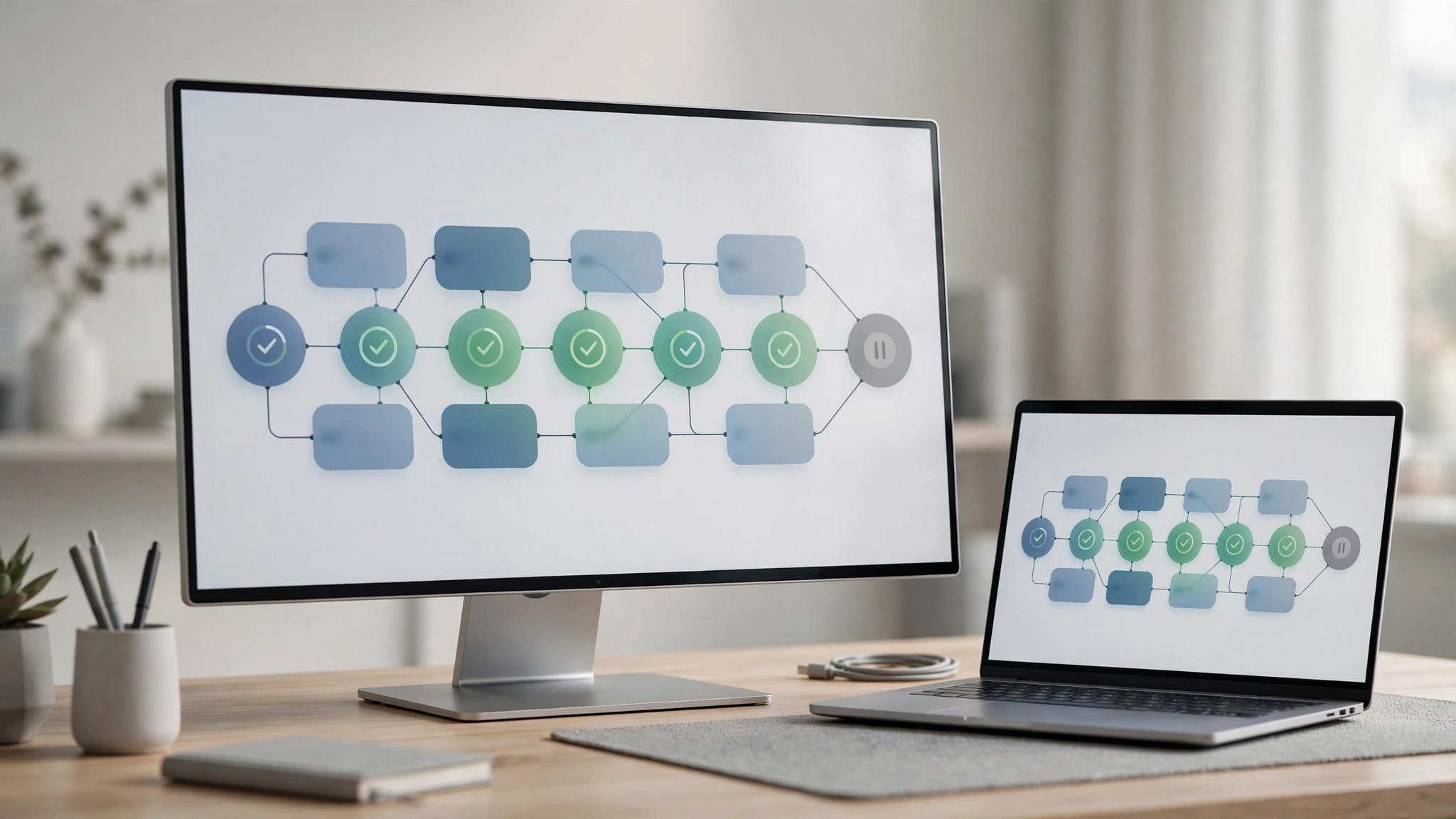
Gemini Tasks Stalled During Early Access
The weakest part of Wolfe’s account is the Tasks workflow.
He requested research on five significant AI product announcements from the preceding seven days. After roughly an hour, it appeared stalled, and the plan view showed no available plan.
A second request asked for a six-slide Google Slides presentation explaining the cybersecurity topic of prompt injection to a non-technical small-business owner. That workflow also appeared stuck, although a six-slide deck was accessible through the plan view.
The presentation existed, but the task interface still appeared unfinished. Producing an artifact and completing the workflow were separate outcomes.
Wolfe suspected early-access bugs. I wouldn’t generalize that failure to every release, but it limits what this demonstration establishes about dependable automation.
Robotics and Google’s Ecosystem Are Separate Questions

Conceptual illustration of a cornhole robotics setup.
Wolfe also includes a robotics demonstration involving cornhole. That application belongs in a different evaluation category from coding assistance or office-task automation.
For professional users, Google’s existing software ecosystem is the more immediate context. Wolfe points to Gmail, Calendar, and Chrome as distribution advantages.
Our 2025 Google Gemini review also identifies Google-service integration as a central strength. That matters because usefulness depends partly on where assistance appears in your workflow, not only on the model behind it.
Frequently Asked Questions
What is Gemini 4 Argon designed to handle?
According to Wolfe, Argon is designed for complex work that takes longer than a typical question-and-answer exchange, with coding as a major focus. Google also claims it gives more direct answers and follows style instructions more reliably.
Where does Wolfe say Argon is available?
Wolfe describes Argon in the Gemini app, Google Search’s AI Mode, and Antigravity, Google’s coding environment. In his account, Antigravity access is included with Google AI Ultra, while Pro includes access in Gemini and Search’s AI Mode.
Did Gemini Tasks work reliably in Wolfe’s tests?
No. Two Tasks requests appeared stuck, though a six-slide presentation was accessible through the plan view. Wolfe suspected early-access bugs, so the tests don’t establish how Tasks performs across later releases.
What do Wolfe’s coding demonstrations show?
They show Argon attempting focused prototypes, including an SVG portrait, a 3D game, and a physics playground. Wolfe’s demonstrations aren’t a formal benchmark and don’t establish performance on production development work.
The Practical Takeaway
I see Wolfe’s account as a useful early look at several distinct capabilities, rather than a single verdict on Argon. Chat responses, coding prototypes, printable files, and autonomous tasks require different evidence.
The clearest limitation is workflow reliability. A model can produce an accessible slide deck while leaving the surrounding task unresolved, and that gap matters when you’re evaluating AI for work.