
A shared AI runtime can be efficient, but it can also turn one weak permission check into a cross-customer data problem. AI agent multi-tenancy only works when each customer workspace remains a hard security boundary, not a label passed around in a prompt.
The risk isn’t that an agent suddenly becomes malicious. It is that it follows an untrusted instruction, receives a broad token, or calls a tool with missing tenant context. I wouldn’t approve a customer-facing agent until the system can prove who requested the work, which agent acted, and what that agent was allowed to do.
Key takeaways
- Treat each agent as a non-human identity with its own owner, role, tools, and revocation path.
- Bind tenant, user, resource, action, approval status, and credential expiry to every tool request.
- Apply tenant filtering before information reaches the model. A vector database filter alone is not enough for sensitive data.
- Keep browsing, code execution, and authenticated sessions in isolated environments with restricted network access.
- Require human approval for actions that are hard to reverse, including payments, exports, deletion, publishing, deployments, and role changes.
- Record policy decisions and tool calls per tenant, without turning logs into another unprotected customer-data store.
How AI agent multi-tenancy should work
AI agent multi-tenancy means one platform can operate agents for many customers without letting one customer’s users, documents, memories, or tool permissions bleed into another workspace. Sharing infrastructure is fine. Sharing authority is not.
A model provider, orchestration service, and control plane may be shared. The customer boundary must still apply to retrieval, memory, credentials, actions, logs, caches, and background jobs.

Shared infrastructure is not shared access
A SaaS product can use a common agent runtime while keeping customer records logically isolated. The important question is where the isolation is enforced.
If a shared service receives a request for Tenant A, it should use a trusted tenant identifier from the authenticated application session. The model should never decide which tenant a request belongs to. Neither should a tool argument produced by the model.
For high-risk workloads, separate storage or separate accounts may be appropriate. For many products, strong logical controls can work, but only when authorization is checked server-side on every request.
Tenant context must follow every request
The tenant ID should travel with every operation, including retrieval, tool calls, asynchronous jobs, cache reads, approval requests, and audit events. It must come from a signed, trusted source.
A request such as “find the latest renewal contract” is incomplete without context. The policy layer needs the customer workspace, requesting user, agent identity, permitted document set, and requested operation. If any of those fields are missing or conflict, the safe result is denial.
A valid token is not proof that an agent may access the requested customer record. The resource and tenant still need their own authorization check.
Build the identity and permission boundary
Many agent deployments collapse user access, agent access, and service credentials into one broad service account. That shortcut makes incident review nearly impossible. It also gives an agent more authority than its job needs.
Microsoft’s least-privilege guidance for AI agents recommends dedicated identities, task-based roles, tool allowlists, downstream authorization checks, auditing, and tested revocation. That is a practical baseline, not enterprise theater.
Keep three identities separate
A secure request includes three distinct proofs:
| Proof | Security question | Common failure |
|---|---|---|
| User identity | Who asked for the work? | The agent keeps acting after the user’s access changes |
| Agent identity | Which workload made the request? | Several agents share one credential |
| Delegated authority | What may this agent do now? | A broad token grants unrelated actions |
A support agent might retrieve an active case and draft a response. It should not inherit the manager’s ability to change account ownership, reset credentials, or export every customer’s records.
I prefer action-level permissions over vague application access. “Read this case and create a draft” is enforceable. “Use the CRM” is not.
Check permissions outside the model
Prompts can guide behavior, but they cannot enforce authorization. The tool layer must inspect every request before the connector runs.
Use a policy decision that evaluates the agent identity, user identity, tenant, action, resource, data classification, credential expiry, and approval state. The AI agent permissions guide outlines the same principle: a tool call should be limited by a clear job description, not a convenient all-powerful token.
IBM’s AI agent security tutorial demonstrates a useful pattern where a permission manager intercepts tool calls. The product or framework can vary. The architectural point does not: the tool request must be checked before it reaches a downstream API.

Stop cross-tenant data leaks before retrieval
The safest document is the one an agent never receives. Retrieval should narrow the search space before the model sees content, not retrieve broadly and hope the model follows instructions.
This matters with RAG systems, customer support agents, sales assistants, and any chatbot connected to shared knowledge bases.
Filter records at the source
Every document, embedding, conversation, and memory item needs tenant metadata. That is only the first layer. The retrieval service should also validate the user’s entitlement, department or project scope, document status, and current access.
Don’t rely on a post-retrieval filter. Don’t trust a model-generated tenant ID. Don’t assume a semantic search result is safe because the similarity score is high.
Test queries that attempt to access another customer’s documents, use ambiguous language, omit tenant context, or contain conflicting tenant claims. Also test deleted documents, expired delegated access, cache reads, and changed entitlements.
Treat retrieved content as untrusted input
A customer document, webpage, ticket, repository file, or email can contain instructions aimed at the agent. Those instructions are data, not policy.
NIST’s Generative AI Risk Management Framework profile identifies prompt injection as an attack type. That risk becomes more serious when an agent can retrieve documents and act on them.
A malicious support ticket might tell an agent to export account records. A repository file might tell a coding agent to inspect credentials. The model may not reliably distinguish hostile instructions from useful context. Permissions, output validation, and tool restrictions limit the damage when it gets that judgment wrong.
Isolate execution and require approvals
Read access can expose data. Write access can change systems. Agents that browse authenticated sites or run code create a third category of risk because they can reach files, sessions, downloads, and networks.
I treat connected automation as privileged automation with a conversational interface. It deserves stronger controls than a drafting assistant.
Put browser and code agents in a sandbox
A browser agent should not run in an employee’s everyday browser profile. Use a disposable profile with no stored passwords, no personal cookies, and a low-privilege account where authentication is necessary.
Code agents also need boundaries around files, commands, compute, secrets, and network egress. The AI agent sandboxing guidance covers the practical distinction: a container can help with reproducibility, but it may not be enough isolation for untrusted code or sensitive credentials.
Restrict outbound destinations with allowlists. Give each agent distinct short-lived credentials. Keep secrets out of prompts, environment dumps, and long-lived configuration.
Make risky actions wait for a person
Some actions should never be autonomous in a customer workspace:
- Payments, refunds, purchases, and contract changes need approval.
- Data exports, external sharing, deletion, and publishing need approval.
- Production deployments, credential creation, and permission changes need approval.
The reviewer should approve the exact action, target, and scope. A vague approval for “continue the workflow” is weak. Approval tokens should expire quickly and be consumed after one use.
For more detail, see human approval for AI agents. A well-designed gate checks the reviewer’s current role when the action occurs, not only when the notification was sent.
Make every action auditable and reversible
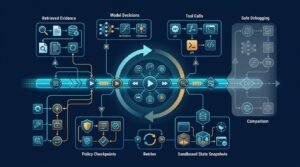
A successful API response does not prove a tool call was appropriate. It only proves the downstream endpoint accepted it. Security teams need to reconstruct what happened without guessing which customer, agent, or permission was involved.
Log the decision, not only the outcome
Per-tenant logs should capture the requesting user, agent identity, tenant, session or correlation ID, tool name, operation, target resource, policy rule, decision, approval reference, and result.
Keep sensitive payloads separate from the central audit trail when retention is needed. Logs full of prompts, tokens, and customer records become their own exposure.

The AI agent audit logs guide recommends retaining policy versions, classifications, decisions, and exception references. Those details matter when a prompt injection attempt reaches a blocked export or a denied tool call.
Test revocation before production
A kill switch should disable the agent identity, revoke active tokens, and remove tool access without a redeploy or a long incident call. If that process is slow, the access model is unfinished.
Test these failure paths before widening access:
- A user loses workspace access while an agent job is still running.
- A token expires during a multi-step workflow.
- A document is deleted or reclassified while cached.
- A tool returns malformed or hostile content.
- A request tries to use Tenant A credentials against Tenant B data.
The secure architecture for AI agents has the right starting point: treat model outputs, retrieved text, and tool results as untrusted inputs.
A practical rollout for customer workspaces
Don’t begin with an agent that can change billing, permissions, or production systems. Start with a read-heavy workflow where a person can review the result, such as support triage, account research, or knowledge-base response drafting.
Build the request path in this order:
- Authenticate the user and resolve the tenant from the application.
- Assign the agent a named workload identity and a narrow set of tools.
- Apply authorization and data filters before retrieval or tool execution.
- Issue short-lived, scoped credentials after policy evaluation.
- Route irreversible actions through a human approval gate.
- Log every decision and test revocation, denial, and cross-tenant failure cases.
AI agent multi-tenancy is not a feature toggle. It is a set of boundaries that must hold when a request is malformed, a document is hostile, or a permission changes halfway through a task.
FAQ
Is role-based access control enough for multi-tenant AI agents?
No. Role-based access control is useful, but it is only one input. The policy decision also needs tenant, resource, operation, data classification, user, agent, delegated scope, expiry, and approval state.
A user with a manager role may read a document. That does not mean an agent should receive permanent administrative authority or access unrelated records.
Can a shared vector database securely support many customers?
It can, but only with reliable tenant-aware retrieval and server-side authorization. Metadata filters are useful, yet they should not be the only defense when customer data is sensitive.
Use validated tenant filters, entitlement checks, restricted indexes or namespaces where appropriate, cache isolation, and tests that attempt cross-tenant queries. The model should receive only records already authorized for that user and workspace.
What is the safest first AI agent workflow?
Start with one that has predictable volume, few tools, reversible consequences, and a human fallback. Support classification, approved knowledge retrieval, and response drafting are better first candidates than account changes or payment actions.
An agent that drafts a reply can create value without receiving authority to send it. Add write access only after the access model, audit trail, approval flow, and rollback path have been tested.
Build boundaries before autonomy
A capable agent is not automatically a safe agent. The difference is whether it stops when the tenant, instruction, data source, or requested action falls outside its permitted scope.
The strongest AI agent multi-tenancy design gives every customer workspace a real boundary across identity, retrieval, tools, execution, approvals, and logs. Shared infrastructure is practical. Shared authority is where the trouble starts.