Bad training data can cost more than the model training run itself. Small teams often discover this after a vendor quote arrives, or after an internal labeling effort produces inconsistent data that nobody trusts.
Data annotation pricing in 2026 ranges from cents per image to premium hourly work for specialized reviewers, making reliable AI training data a significant investment for machine learning projects. The number matters, but the unit of work matters more, especially when building dependable artificial intelligence systems. A cheap bounding box is not cheap if it creates rework, weak evaluation data, or model failures in production.
I use a simple rule: budget for the labels your model needs to make a reliable decision, not the largest dataset you can afford.
Key Takeaways
- Budget for the labels your model needs to make reliable decisions, not simply the largest dataset you can afford.
- Always run a 200 to 500 item pilot to determine real accepted-label costs, check annotator agreement, and refine instructions.
- Factor in hidden expenses such as guideline creation, quality assurance labor, data formatting, and rework reserves.
- Choose your pricing and operating model carefully based on task complexity, taxonomy stability, and domain expertise requirements.
Data Annotation Pricing: What Small Teams Should Expect
The first question is not “What does annotation cost?” It is “What exactly are we asking a person to decide?” Managing the total cost of data labeling starts with understanding these task requirements.
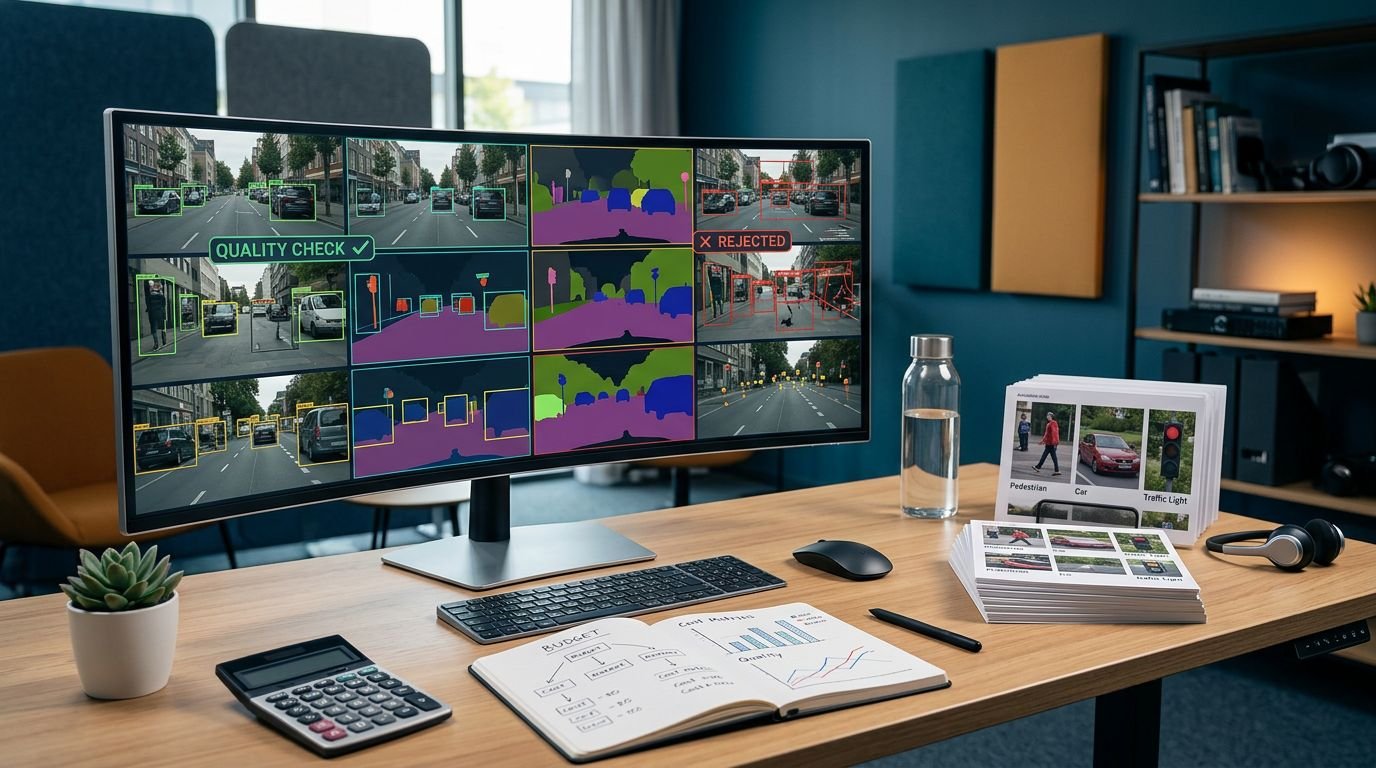
Simple image annotation can be quick. A worker sees one image and applies one category. Instance segmentation, medical image review, intent labeling, or multi-turn conversation scoring take longer and need better instructions.
Published 2026 data annotation pricing benchmarks place simple image classification around $0.02 to $0.10 per image. Basic bounding box annotation often falls in a similar per-object range. Polygon annotation can run roughly $0.30 to $0.80 per image, while dense semantic segmentation can move into the $1.50 to $4.00 range.
Those figures are planning bands, not quotes. A photo with one clear car and a fixed ontology is nothing like a warehouse scene with partial occlusion, seven object classes, and ambiguous boundaries.

For US-based labor, I would budget roughly $15 to $25 per hour for general annotation work under standard hourly rate pricing. Advanced domain expertise, onshore review, and QA leads can push that to $25 to $60 or more per hour. When evaluating different data annotation services, a cross-region 2026 labor cost comparison also shows why geography changes a quote so sharply.
The useful cost metric is not cost per label. It is cost per accepted label after quality review.
A small team building a chatbot may label intent, sentiment, escalation reasons, and answer quality. A computer-vision startup may draw boxes or polygons. The workflow changes, but the budgeting issue stays the same: estimate the time per difficult item, not the average easy item.
Compare Pricing Models Before Requesting Quotes
Annotation providers package work in several ways. Each model can work, but a mismatch creates unpleasant budget surprises.
| Pricing model | Typical use | What you pay for | Main risk |
|---|---|---|---|
| Per item | Images, documents, short text | Completed labels or objects | Complex items get under-scoped |
| Per hour | Research, edge cases, changing rules | Annotator or reviewer time | Slow work is hard to forecast |
| Per task | Defined batch with stable guidelines | A fixed project outcome | Change requests raise cost |
| Platform usage | Internal or hybrid labeling teams | Seats, usage units, storage, workflow features | Labor cost sits outside the platform fee |
| Managed service | High-volume production programs | Labor, QA, project management, tooling | Minimum commitments and less direct control |
Per-label pricing is easiest to compare. Ask what counts as an item. One street image might contain 40 objects. One support ticket might require three labels and a written rationale. If the vendor bills per item, request a sample invoice based on your hardest cases.
An hourly rate pricing approach is better when the taxonomy is still moving. I prefer it for the first few hundred examples, when I expect instructions to change after reviewers find edge cases and when turnaround time needs to remain flexible.

Platform pricing is different. You might pay for annotation tools and software licenses, then still need internal reviewers or a managed workforce. This is why comparing data labeling services with software platforms as if they are identical products produces bad forecasts. Outsourcing data annotation through a managed partner can sometimes eliminate the need to license and maintain separate infrastructure internally.
For the platform decision, my Labelbox vs Scale AI pricing comparison is a useful starting point. Labelbox can be practical for a self-serve pilot. Scale AI is more likely to involve an enterprise-style, volume-based contract utilizing project-based pricing.
Hidden Costs That Distort Annotation Budgets
The visible quote is only part of the spend. I see four annotation cost factors that small teams miss most often.
First, there is guideline development. Annotators need examples of correct labels, wrong labels, hard negatives, exceptions, and escalation rules. A one-page instruction sheet rarely survives real production data.
Second, quality assurance adds labor. Consensus labeling, gold-standard tasks, spot checks, and adjudication are not optional for high-risk labels. If three reviewers disagree on a medical image or support-ticket escalation, the disagreement is useful evidence. It often means the label definition is weak.
Third, format and integration work can become a small engineering project. Images need import rules. Text annotation workflows need redaction. Video annotation tasks need frame sampling. Export files must map cleanly into your training and evaluation pipeline.
Finally, rework is expensive. A team may save 30% by using a low-cost labeling process, then lose far more when it discovers the model learned inconsistent classes. Managing your data volume carefully prevents these surprises.
I don’t approve a full batch until a pilot proves two things:
- Independent reviewers can reach acceptable agreement on the task.
- The exported labels work in training, evaluation, and error analysis to produce reliable ai training data.
For natural language processing, chatbot, and RAG work, I also separate training examples from evaluation examples. Build a small golden set from real user questions and known failure cases. Do not let the same loose labels define both the system and the test that declares it successful.
Build a Budget From a Pilot, Not a Guess
A useful estimate starts with a representative sample. Pull easy, typical, and difficult examples. Include poor-quality inputs, rare classes, duplicates, and cases where the correct answer is uncertain.
Then measure the work in a controlled pilot:
- Label 200 to 500 representative items with a draft taxonomy.
- Review a meaningful sample independently, then record disagreement by class.
- Fix ambiguous instructions and repeat the difficult cases.
- Measure accepted-label throughput, not raw labels completed, factoring in quality assurance checks across your total data volume.
- Multiply the accepted unit cost by your production volume, then add a rework reserve.

Suppose your computer vision project needs 20,000 product images labeled with boxes. A vendor providing data labeling services may quote $0.08 per object for bounding box annotation. If each image averages three objects, the base estimate is $4,800. That figure excludes quality assurance, difficult images, taxonomy revisions, and project management.
A more realistic working budget might add 15% to 30% for review and exceptions. The right percentage comes from the pilot. I would not use an arbitrary contingency when a week of sample work can give you an actual error rate.
Automation can reduce cost, but only after the label policy is stable. Model-assisted pre-labeling works well for repetitive objects and mature classes. It works poorly when the team has not agreed on what the object boundary means.
Choose the Operating Model That Fits the Workload
Small teams usually choose among in-house labeling, freelancers, a managed workforce, or a hybrid setup.
In-house work gives you the fastest feedback loop. It is a good fit when subject-matter knowledge is hard to outsource, such as legal documents, proprietary industrial imagery, or internal support tickets. For complex machine learning projects in specialized fields like healthcare or autonomous vehicles, domain expertise remains critical. The drawback is opportunity cost. Engineers and product experts should review edge cases, not spend weeks drawing routine boxes.
Managed services make sense when volume is steady and deadlines matter. Many teams rely on external data annotation services and specialized data labeling services to accelerate delivery. Ask for worker qualifications, QA design, data retention terms, escalation paths, and sample deliverables before signing.
A hybrid model is often the most practical choice. When outsourcing data annotation, external annotators handle routine work while internal experts define the ontology, audit samples, and resolve edge cases. That keeps expensive expertise focused where it changes label quality.
If annotation feeds a retrieval product, include downstream infrastructure in the forecast. Vector search has separate usage costs that can grow with stored data and query volume. My Pinecone pricing and usage review and Weaviate Cloud cost analysis cover the trade-offs I check before treating the labeling budget as the full project budget.
Better Labels Beat Bigger Batches
Data annotation pricing is manageable when the team treats labels as a product input with measurable quality. The cheapest bid can work for simple, stable tasks. It is rarely the best answer for ambiguous, high-stakes, or domain-heavy work, especially in complex machine learning projects where long-term performance matters.
Start with a representative pilot. Track agreement, accepted throughput, and rework. Then scale the process that produces evidence your model can use.
Investing in professional data annotation services or taking the time to build clean training data yields a better return on investment than high-volume loose labeling. A smaller dataset with clear, consistent labels usually gives a small ML team more value than a large batch nobody can defend.
FAQ
How much does data annotation cost per image in 2026?
Simple classification commonly costs about $0.02 to $0.10 per image for basic computer vision tasks. Basic bounding box annotation can cost $0.02 to $0.09 per object. Polygon semantic segmentation work costs more because reviewers must trace detailed boundaries for advanced artificial intelligence models.
Is in-house data annotation cheaper than outsourcing?
It can be cheaper for small, specialized datasets, especially when internal experts already understand the material. Outsourcing data annotation and utilizing specialized data annotation services is often less expensive for repetitive, high-volume tasks. I compare total accepted-label cost, including staff time, review, tooling, and rework.
How large should an annotation pilot be?
For most small teams, 200 to 500 representative items is enough to expose unclear instructions and difficult classes. Use more examples when the data has many classes, rare events, or multiple annotators.
What are the main annotation cost factors and how does turnaround time affect pricing?
Key annotation cost factors include task complexity, data ambiguity, and required domain expertise. When teams demand a faster turnaround time, vendors often charge higher rates to accommodate overnight shifts or larger workforce allocations.
Suggested Related Articles