
Last month I had one of those “everything projects” that looks small on a Trello card but hides four different jobs inside it: I needed quick research for a new offer, a landing page draft, a messy spreadsheet cleaned up, and a set of follow-up emails to go out after a webinar. I tried pushing most of it through manus ai, partly out of curiosity and partly because I didn’t want to book four separate freelancers for one sprint.
This isn’t a hype piece. I’m going to separate the tasks Manus can fully own (end-to-end deliverables) from the tasks that still need a human touch. When I say “autonomous agent,” I mean something simple: it plans steps and executes them while I’m away, instead of waiting for me to guide every move like a chatbot.
The real twist is that Manus can run asynchronously in the cloud. It keeps working while I’m in meetings or asleep, and that changes the economics of hiring. By the end, you’ll have a decision framework, examples by job type, and a clear sense of when I still hire freelancers anyway.
What Manus AI is actually good at (and why it feels like a freelancer)
Manus AI, at its best, behaves less like a chat window and more like a project doer. I give it an outcome, it breaks the work into steps, runs them, self-corrects when something doesn’t look right, and hands me back a packaged output I can use.

That maps closely to the kinds of “deliverable-based” gigs freelancers often get hired for. From my hands-on use and the common workflows it supports, Manus is comfortable producing things like clean tables, structured documents, drafts that follow a template, and operational automation that doesn’t need creative taste.
Here are freelancer-like deliverables I’ve seen Manus handle end-to-end when the brief is clear:
- Clean data output: turning messy notes or exports into a structured, tabulated sheet I can analyze or share.
- Landing page copy and email drafts: first-pass copy that follows a goal (capture leads, confirm a meeting, re-engage a list).
- Localization and translation: adapting content into another language while keeping formatting and tone consistent.
- Simple web tools: basic utilities like calculators or unit converters that are more useful than a static blog page.
- Operational automation: reminders, recurring tasks, calendar events, and bulk file renaming with consistent rules.
That’s the upside. The realistic limits show up fast when any of the following are true: my brief is fuzzy, the work is taste-based (brand voice, design judgement), the content touches compliance or sensitive data, or the project needs a clear owner when something breaks. Manus can produce, but it can’t be held accountable in the way a person can.
If you want broader context on how agent tools fit into the bigger trend, I like this roundup of top AI agents of 2025 because it frames what matters (reliability, coverage, integrations) instead of treating all “agents” as the same thing.
Where Manus shines: repeatable workflows, messy inputs, and overnight runs
Manus is strongest when I can describe a workflow that has steps I can verify. Think tables, structured docs, checklists, consistent naming rules, and “before vs after” transformations.
A few examples that fit that shape really well:
Turning raw meeting notes into a clean table is one of my favorites. If I can define columns (owner, task, due date, status), Manus can organize the chaos and hand me something export-ready. The same goes for “export to table” style tasks where the goal is structure, not prose.
Document translation works better than you’d expect when the formatting needs to stay intact. I’ve used that approach for internal SOPs where the layout matters, and I’d rather not rebuild the doc after translation.
On the automation side, tasks like creating automated reminders or managing calendar events are very “agent-shaped,” because the steps don’t require taste. Same with batch file renaming, where consistency is the whole point.
One newer mental model that helps: treat these workflows like reusable “skills.” Once I get a workflow working, I can run it again next week without reinventing the prompt.
My quick tip: I start with a tiny test task (one file, one email, one data sample). If it comes back clean, I scale it. That simple habit prevents most of the “wow it went fast, and also it went wrong” moments.
Where it still struggles: taste, trust, and liability
Freelancers don’t just produce output. They interpret feedback, ask clarifying questions, read the room, and carry risk with you. That’s where Manus still feels like software, even when it’s impressively autonomous.
Taste is the obvious gap. Brand voice is more than grammar, it’s judgment. Design direction is more than “make it modern,” it’s knowing what matches a market and what will look cheap. Stakeholder management is also a human skill, and it matters when a project has multiple decision-makers.
Trust and liability are the other big gaps. If a freelancer ships the wrong thing, I can route fixes through one accountable person. If an agent does it, I’m the backstop. That’s fine for low-risk work, and stressful for mission-critical deadlines.
I also plan for reliability swings. Agent tools can have off days (timeouts, odd choices, incomplete runs). So before I let an agent run solo, I ask myself a short checklist:
- What’s the source of truth for this task (doc, sheet, repo), and is it unambiguous?
- How will I verify the output quickly without redoing the whole job?
- What happens if it’s wrong, and can I roll back or recover?
If any answer makes me nervous, I keep a human in the loop.
Manus AI vs ChatGPT vs Claude: how I choose the right tool for the job
I don’t treat these tools as a single winner. I treat them like a small team, each with a different personality.
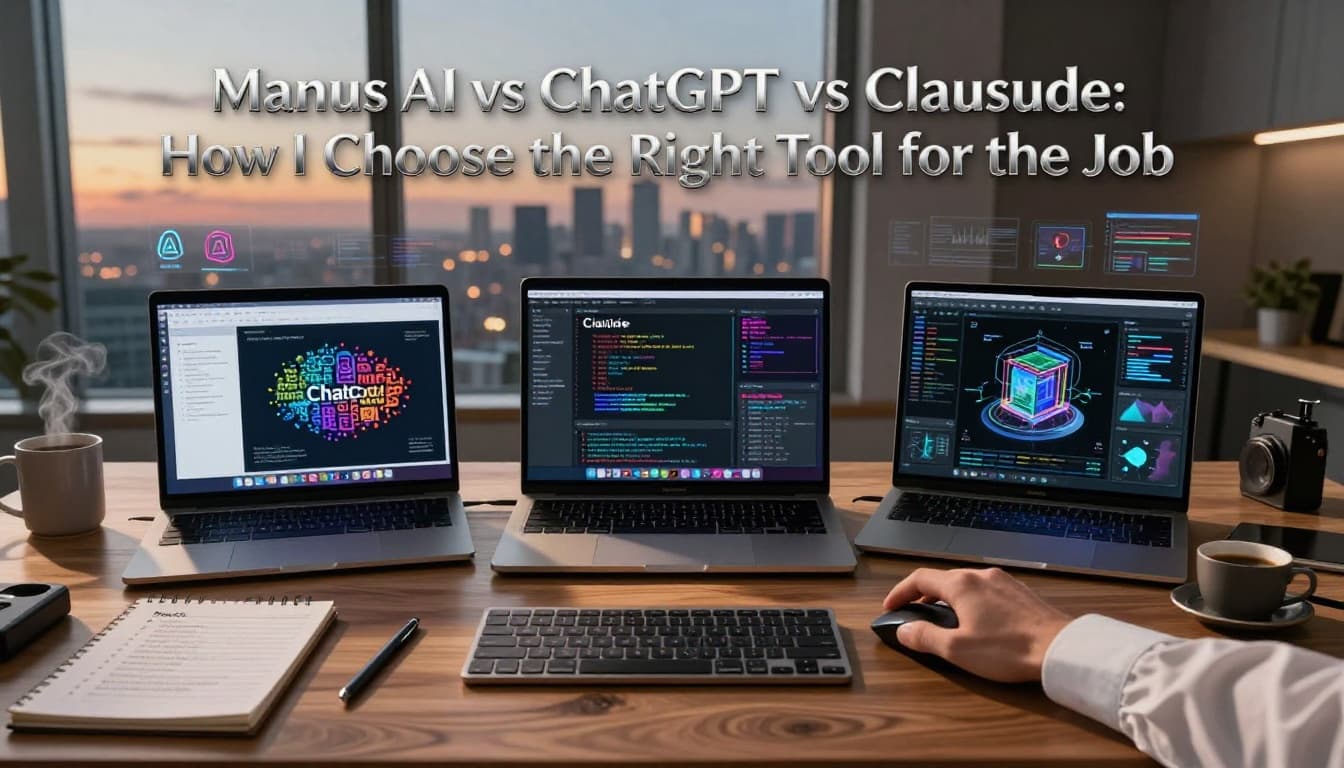
ChatGPT is fast for brainstorming, outlining, and iterating on copy. Claude is the one I trust most when I’m working with long documents, dense specs, or careful reasoning. Manus is the one I reach for when I want an actual deliverable produced while I do something else.
So my choice usually comes down to five simple criteria: autonomy (does it act), speed (time to a usable result), writing quality, long-document handling, and workflow automation.
Pricing also affects how I use them, but I’m cautious here. Manus is often described as credit-based, and in practice that can feel unpredictable because complex tasks simply cost more “work” than short chats. ChatGPT and Claude are commonly used via flat subscriptions, which makes lightweight iteration feel cheaper and more casual.
Some reviews also hint that Manus and Claude can feel more reliable than ChatGPT in certain professional-style testing scenarios. I’ve seen that claim come up in writeups like this Manus AI review (2026), but I still validate outputs myself, because reliability is task-specific.
If you’re curious about Claude’s “do stuff in the browser” direction (which overlaps with what people want from agents), this Claude Sonnet 4.5 browser agent review is a useful reference point.
If I need a finished deliverable, I reach for Manus
When my goal is “hand me something I can ship,” Manus is the cleanest fit.
That includes things like a research brief with citations, a pitch deck draft, a simple internal web tool, or a cleaned dataset that’s ready for analysis. It’s also good at bundling outputs so I’m not stitching together five partial answers.
This is where the document-style workflows really shine: custom web tool creation, clean data output, export to table, and pitch deck generation. The feeling is less “assistant” and more “overnight contractor,” especially when I start a run, walk away, and come back to a structured deliverable.
If I need thinking and wording, I lean on Claude or ChatGPT
When I’m shaping ideas, testing hooks, or trying to find the right phrasing, chatbots still win.
ChatGPT is my quick ideation partner. Claude is what I use when I paste in lots of material (contracts, specs, multiple docs) and want careful analysis and writing that sounds more naturally human.
That’s my tooling strategy: chatbots for thinking and language, Manus for execution and packaging. It’s not either-or, it’s sequencing.
Who feels the impact first: automation nerds, SEO operators, and solopreneurs
In my experience, three groups feel Manus-style agents first, because their work has a lot of repeatable steps and a lot of “I just need this done” pressure.

For automation nerds, the appeal is obvious: you stop building one-off scripts and start building reusable systems. For SEO operators, the big win is shipping more pages and assets while staying consistent. For solopreneurs, it’s about getting evenings back by dumping busywork.
Qualitatively, the “before vs after” shift looks like this: before, I context-switch across five tools and three tabs to finish one workflow; after, I define the workflow once and supervise the output.
If I were adding images to make this section more scannable, I’d use filenames and alt text like:
- manus-ai-landing-page-workflow.jpg, alt text: “AI agent building a landing page workflow on a laptop.”
- custom-web-tool-calculator.jpg, alt text: “Simple online calculator tool created by an AI agent.”
- manus-ai-clean-data-output.jpg, alt text: “Messy spreadsheet cleaned into a neat table by an AI agent.”
Manus AI for Automation Nerds: building repeatable systems instead of one-off tasks
I treat Manus like a workflow engine. That means I define inputs, steps, outputs, and verification, just like I would if I were handing the task to a contractor.
It pairs well with operational chores like automated reminders, calendar events, batch file renaming, and taking messy exports and turning them into clean tables. I don’t need deep technical language to get value, but I do need to be explicit about what “done” looks like.
My mini playbook is simple: I start with one workflow, save it, rerun it weekly, review what changed, then tighten the prompt. Over time, I end up with a small library of routines that make my work feel calmer.
If you want a plain-language foundation for this whole category, this guide on understanding AI automation fundamentals explains the difference between rule-based automation and AI-driven decision-making in a way that matches how I actually work.
Manus AI for Website and SEO operators: shipping pages, tools, and localized content faster
For web work, Manus is most useful when the output is a draft that still gets human QA.
That includes landing page copy, a basic personal site, simple internal dashboards, and custom web tools like calculators or unit converters. It also helps with localization and translation when I need consistent tone across languages.
What still needs me (or a freelancer) is the final polish: technical SEO checks, analytics setup, brand review, and making sure the page matches intent and compliance requirements.
 An AI-created scene showing an autonomous agent running a landing page build workflow on a laptop.
If your work touches marketing systems, it also helps to understand the platform layer around it. I’ve linked people to this explainer on AI marketing platforms explained because it shows where agents fit (and where classic platforms still matter).
Manus AI for solopreneurs: replacing busywork, not relationships
Solopreneurs don’t lose because they can’t work hard, they lose because they can’t do everything at once.
This is where I get the most emotional value from agents like Manus. I use it for pitch deck drafts, professional emails, resume and CV updates, document translation, cleaning customer data, and creating a basic portfolio site. It’s the stuff that eats evenings and weekends, not because it’s hard, but because it’s endless.
The point I keep coming back to is trust. Strategy stays human. Customer relationships stay human. I offload execution where mistakes are low-cost and easy to detect.
Will autonomous agents kill SaaS apps, and what that means for freelancers
“Autonomous agents will kill SaaS” is overstated, but there’s a real pressure here.

The SaaS categories most at risk are single-purpose tools that do one workflow (rename files, reformat docs, basic reporting, simple translation). If an agent can do the same job across multiple sites and formats, the separate app feels less necessary.
The safer categories are systems of record (CRMs, ERPs), compliance-heavy platforms, and high-availability infrastructure. Those aren’t just interfaces, they’re governed data stores with permissions, audit logs, and uptime guarantees.
For freelancers, the ripple effect is straightforward: if your job is “operate the UI,” demand can drop. If your job is “own the outcome,” demand can rise. People still pay for judgment, integration, QA, and governance.
Here’s how I see roles shifting:
| Category | Roles that grow | Roles that shrink |
|---|---|---|
| Execution vs judgment | Brand strategist, editor, UX lead, analytics specialist, automation architect | Basic data cleanup only, simple VA scheduling, generic first-draft copy |
| Risk and accountability | Compliance-aware consultant, QA lead, prompt and workflow designer | “Push buttons in SaaS” specialist with no strategy layer |
| Integration work | Tool integrator, systems operator, workflow auditor | One-tool operator without cross-tool skills |
If you’re interested in the broader idea of agents acting like “digital workers,” this article on Fetch.ai smart agents overview is a helpful mental model, even though it’s a different stack than Manus.
The SaaS squeeze: when the agent becomes the interface
The simplest way I explain it: if an agent can plan and execute a workflow across websites and tools, I stop caring which SaaS app has the best button for that one task.
Asynchronous execution is the multiplier. I can start a long workflow, go live my day, and check results later. Reusable workflows are the second multiplier. Once I trust a process, I run it again without rebuilding everything.
This shows up in practical jobs like lead list cleanup, report generation, content localization, and scheduling automation. Many of these used to be “pick an app or hire a freelancer.” Now there’s a third option: run an agent, then verify.
My practical rule: use Manus for production, freelancers for judgment and accountability
When I’m deciding what to do next, I ask myself these questions:
- How risky is the deadline if the first output is wrong?
- Is there compliance or privacy risk, or sensitive customer data involved?
- Will brand voice or design taste decide whether this works?
- How complex is the workflow, and can I describe it as steps?
- Do I need stakeholder alignment, calls, and back-and-forth?
- Can I verify the result quickly, or would I be forced to redo the work?
- Does the agent need access permissions that I’m not comfortable granting?
- Who owns the outcome if something breaks after delivery?
If the work is low-risk, step-based, and easy to verify, I’ll run Manus. If the work needs taste, trust, or a human owner, I hire a freelancer. If it’s a big project, I use both, Manus for production and a freelancer for direction and QA.
Where I landed after testing it on real work
Manus AI can replace chunks of freelancer work, mostly the repeatable execution parts that end in a clear deliverable. It doesn’t replace the human parts I pay for when the work is taste-based, trust-heavy, or needs someone accountable to fix problems fast. My suggestion is simple: run one small pilot workflow this week, something you can verify in five minutes, then decide what to automate next. If you want a grounded third-party take before you try it, this Manus AI review in 2026 is a solid starting point.