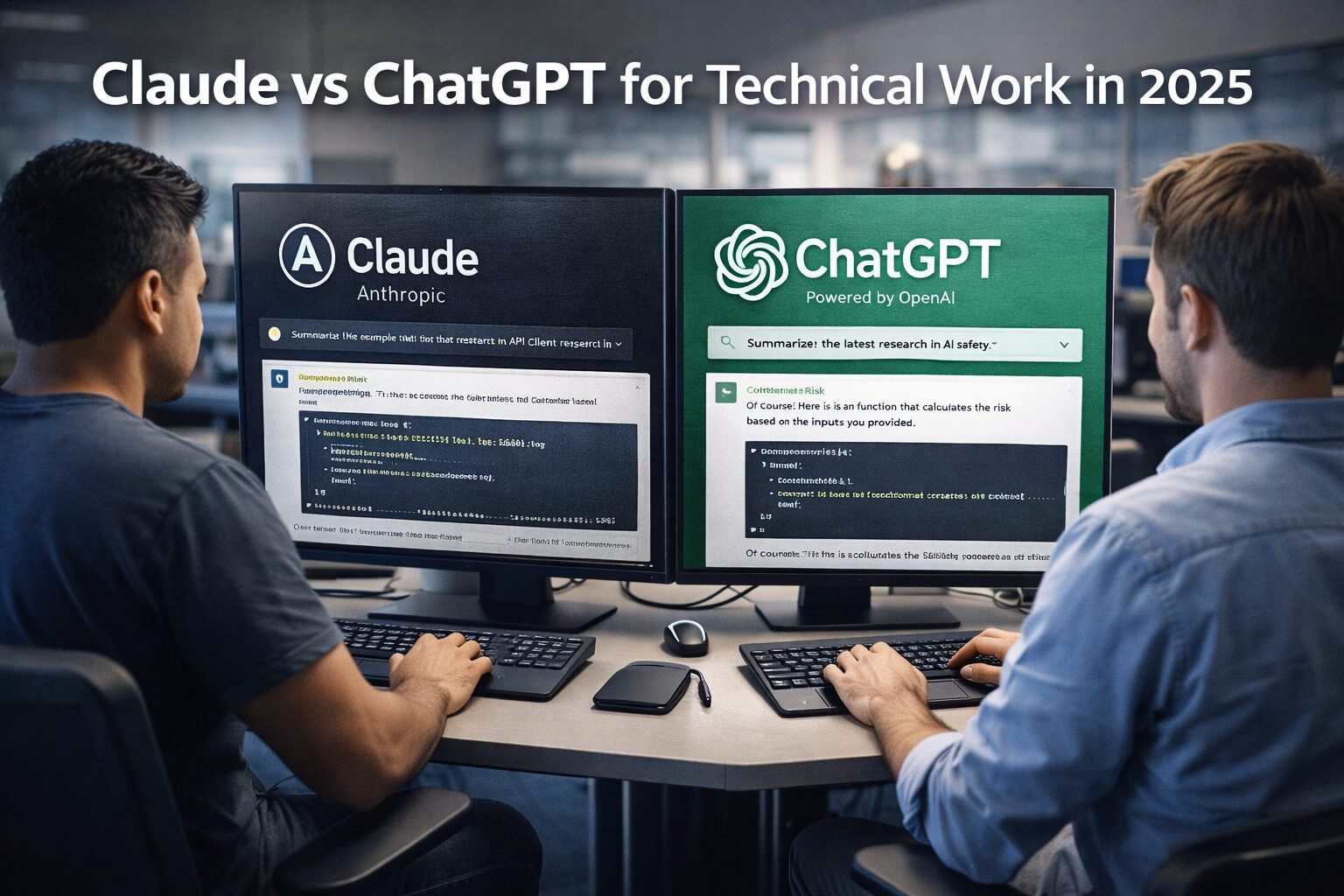
If you write code, debug gnarly bugs, or ship technical docs, you have probably asked yourself a simple question: which AI should you actually keep pinned, Claude or ChatGPT?
In 2025 the answer is not as simple as “pick the newest model.” Both tools are powerful, but they feel very different when you are knee-deep in logs or trying to reason about a tangled codebase. After months of using both across real projects, my view is clear. For serious technical work, Claude vs ChatGPT is less a fight and more a tag-team decision.
In this guide I will walk through how each one handles coding, debugging, and engineering tasks, where each shines, and how I split work between them day to day so you can do the same.
How Claude and ChatGPT Really Differ in 2025

Photo by Matheus Bertelli
At a high level, recent hands-on tests and public comparisons agree on one big point: Claude is usually better for deep technical work, while ChatGPT is usually better for speed and variety.
Fresh benchmarks and developer writeups in late 2025 show a pattern that matches my own use:
- Claude tends to produce more accurate logic, handles multi-file repos better, and gives stronger explanations when you are debugging. A recent breakdown on Claude vs ChatGPT for coding in 2025 points to the same result.
- ChatGPT is quicker for scaffolding UI code, trying ideas, and mixing code with writing or general research. The overview from Zapier on Claude vs ChatGPT in 2025 echoes that split.
I see something similar any time I move from a messy backend issue to a quick prototype. Claude feels like a thoughtful senior engineer. ChatGPT feels like a very fast generalist who is great at shipping drafts.
If you want a broader look at where the big models sit across many tasks, my Top 10 AI chatbots and virtual assistants for 2025 walks through how they stack up outside pure coding too.
Coding performance: backend logic vs frontend speed
When I compare Claude vs ChatGPT purely as coding partners, the difference shows up fastest in structure and correctness.
Here is a simple snapshot based on my usage plus public reports:
| Task type | Better default pick | Why it usually wins |
|---|---|---|
| Complex backend or data logic | Claude | Cleaner reasoning, fewer subtle bugs in conditionals and edge cases |
| Large multi-file refactors | Claude | Big context window and solid cross-file awareness |
| Quick frontend or UI scaffolding | ChatGPT | Faster responses and strong HTML, CSS, JS patterns |
| Small scripts and throwaway code | ChatGPT | Speed matters more than perfect structure |
A recent developer-focused article on Claude vs ChatGPT coding strengths lines up with this table. Claude regularly scores higher on logic-heavy tasks, while ChatGPT often edges ahead on speed and variety.
Debugging and long-context work
For debugging, Claude is simply easier to work with in my day-to-day projects.
When I paste stack traces, several files, and a problem description, Claude tends to:
- Ask a couple of clarifying questions before trying a fix.
- Walk through the code path step by step.
- Explain where state breaks or where an assumption fails.
That style matches what I look for in a human reviewer. I also see the same pattern in my deeper Claude AI review: coding assistance and safety 2025, where multi-file reasoning and careful explanations stand out again and again.
The larger context window on recent Claude models makes a big difference. I can drop in big chunks of a repository and keep a coherent conversation going without trimming every message down. For long-running refactors or complicated migrations, that feels like a superpower.
Rapid prototypes and UI-heavy tasks
On the other side, ChatGPT still wins for me when I just want something on the screen fast.
- Need a quick React dashboard with filters and a simple chart.
- Want a rough landing page with marketing copy and layout hints.
- Testing a couple of API integration patterns before picking one.
In those cases, ChatGPT usually responds faster and offers more variations. It shines even more after the 5.1 update. If you want a closer look at that upgrade, I break it down in my guide on ChatGPT 5.1 release details and new features.
When correctness matters more than speed, I tend to send that same prototype over to Claude for a second pass and sanity check.
Developer experience and workflow fit
Pure code quality is only half the story. How each model feels in your workflow matters just as much.
From my own use and from pieces like this Claude vs ChatGPT coding deep-dive:
Claude usually feels like:
- A patient mentor who slows down and explains why it picked a design.
- More cautious with security and data handling.
- Better at staying consistent with a style or set of constraints over long chats.
ChatGPT usually feels like:
- A fast teammate who throws out three options in seconds.
- More playful with ideas, examples, and teaching content.
- Better integrated into various tools, plugins, and third-party platforms.
I like this split when I work inside cloud IDEs too. When I am focused on the full development experience, from writing code to running it in the browser, I often pair both with tools like Replit. For a closer look at that stack, my in-depth Replit review and AI coding features 2025 walks through how integrated assistants change the coding loop.
The bottom line: if you care most about thoughtful explanations and clean logic, Claude feels nicer. If you care more about speed, options, and integrations, ChatGPT is hard to beat.
Real-world use: how I split technical work between them
Here is how this plays out when I sit down to work.
Greenfield backend service
If I am designing a new service, schema, or data pipeline, I start with Claude. I ask it to:
- Propose an architecture and data model.
- Call out edge cases and failure modes.
- Generate example tests before final code.
Claude tends to produce designs that need fewer rewrites later. When money or safety is on the line, that matters more than a small speed gain.
Legacy refactor or bug hunt
When I inherit a dusty codebase, I paste the key files into Claude and say something like:
“Explain how this module works, where it might break, and how you would refactor it in small steps.”
The long, structured answers make it easier to plan safe, incremental changes. If I want an outside view on code review tools as well, I might pair it with something like Qodo AI, which I cover in my Qodo AI review: code review assistant 2025.
Front-of-house features
For UI changes, marketing pages, or quick product demos, I reach for ChatGPT first. It is great for:
- HTML and CSS scaffolds that look decent out of the box.
- Copy ideas, onboarding flows, and tooltips.
- Small JavaScript helpers, such as input validation or simple widgets.
Once it looks right, I often paste the core logic back into Claude and ask if anything smells off.
Docs, specs, and mixed tasks
When I need both code and clear writing, I tend to mix them:
- Claude for technical specs that must be sharp and logically sound.
- ChatGPT for user-facing docs, FAQs, and onboarding content.
If you are still sorting out where AI fits into your workflow at all, my guide on frequently asked questions about AI tools can help you frame the right questions before you commit money or time.
For a broader take on this split, I also like summaries such as Claude vs ChatGPT use-case advice, which suggest Claude for complex coding and ChatGPT for lighter research and daily help.
How to choose the right mix for your team
So if you are not interested in using both tools for everything, how should you decide?
Here is a quick decision guide I use with teams and clients:
- If most of your work is deep backend, data, or refactors, start with Claude as your main coding partner.
- If your team ships lots of UI and content-heavy features, make ChatGPT your default and pull in Claude for tricky logic.
- If you are budget-sensitive, keep an eye on per-token pricing and where usage spikes. Articles like this multi-model comparison for 2025 offer a nice sanity check.
- If you already rely on strong code review tooling, think about how Claude or ChatGPT will sit next to tools like Qodo, Sonar, or your existing CI.
You do not need a perfect answer on day one. Start with your highest pain point, pair it with the tool that matches it best, then expand from there.
Bringing it all together for your stack
In 2025, the Claude vs ChatGPT question for technical work is less “which is better overall” and more “which is better for this job right now.” Claude is my pick when correctness, long context, and deep reasoning matter most. ChatGPT is my pick when I want fast scaffolds, rich examples, or a mix of code and content.
The smartest developers I talk to use both, just like you might use different IDEs or terminals for different tasks. If you want more help picking the right mix of assistants beyond these two giants, my AI tools FAQ and guides and the broader AI chatbot comparison and rankings 2025 are a solid next step.
Try running your next sprint with a deliberate split, Claude for the hard logic and ChatGPT for the fast drafts, and watch how much mental load that takes off your team. Then refine your setup like you would any other part of your stack: with data, feedback, and a bit of curiosity.