Spotting chart patterns, possible entry points, and exit signals takes time, especially when markets move faster than you can review them manually. Tickeron uses AI to scan stocks and ETFs for patterns, breakout levels, target prices, and confidence scores, but those outputs aren’t a crystal ball or a substitute for risk management.
In this Tickeron AI review, I look at AI pattern recognition, Real-Time Patterns, trading signals, and AI Robots from a skeptical, decision-focused angle. I’ll separate product features and marketing claims from verified performance, explain who may benefit, and show why confidence scores and backtests need careful interpretation. If you’re comparing platforms, my wider guide to AI trading tools compared by use case and TradingView AI capabilities and limitations provide useful context.
First, I’ll examine what Tickeron actually detects and how its signals are presented.
Key Takeaways
- Tickeron AI scans stocks and ETFs for chart patterns, forecasts, breakouts, and end-of-day signals, but these outputs aren’t guaranteed predictions.
- Pattern Search, Real-Time Patterns, and AI Robots may help organize research, while Tickeron’s signal agents require independent review.
- Pricing varies by feature bundle, so compare the exact plan before subscribing.
- Backtests are filters, not proof. Check fees, slippage, market conditions, and out-of-sample results.
- For broader context, compare AI trading tools by use case and AI crypto trading tools.
Tickeron AI pattern recognition & signals: What the Platform Finds
Tickeron is mainly a research and signals platform, not a broker or an automated profit machine. Its pattern tools scan stocks and ETFs for technical formations, possible breakouts, target prices, and directional signals. I view those outputs as a faster starting point for chart research, not as finished trade decisions.
How the Pattern Search Engine and Real-Time Patterns work
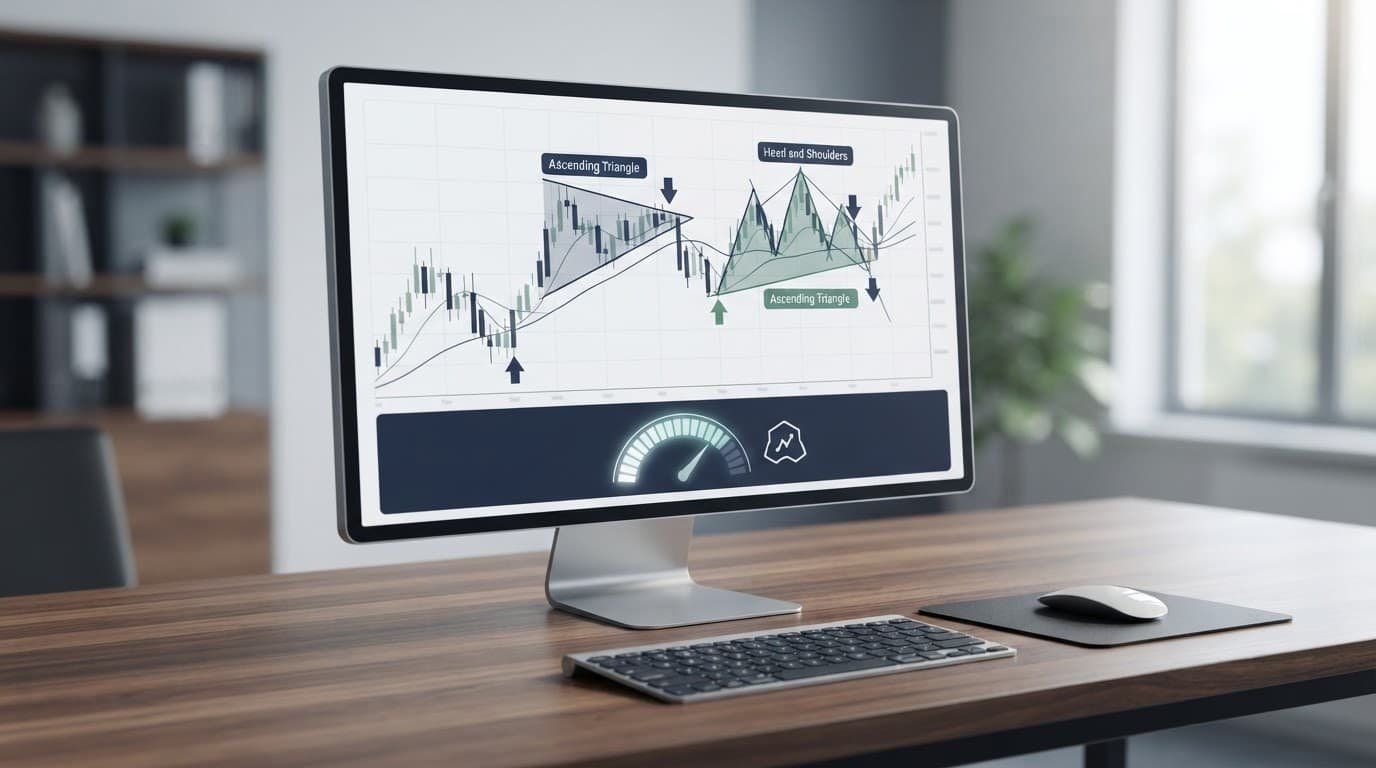
The Pattern Search Engine focuses on recognized chart formations and end-of-day data. Tickeron says it scans 39 pattern types, including flags, wedges, channels, triangles, rectangles, and head-and-shoulders formations. You choose a market or asset, set search criteria, and review the patterns that appear in your feed.
The Real-Time Patterns tool, or RTP, is designed for faster-moving setups. Tickeron says it scans thousands of stocks and ETFs every minute and presents potential breakout, target, entry, and exit levels. That can help narrow a large watchlist when you need ideas quickly.
A signal still needs context. Before acting, I would check:
- The underlying chart and the selected time frame.
- Volume, trend strength, support, and resistance.
- Recent earnings, economic news, and sector movement.
- Overall market direction and the trade’s risk-to-reward ratio.
I would also compare company information with financial research tools and verify the setup independently. RTP may identify possible prices quickly, but it doesn’t know your position size, risk tolerance, or reasons for taking the trade.
What confidence scores can and cannot tell you
Tickeron uses AI-validated confidence language and historical or backtested results to rank detected patterns. That can be useful for sorting ideas, but a confidence score isn’t the same as a probability of profit. Tickeron’s public product descriptions don’t clearly explain the score’s calibration, sample size, training data, or failure rate.
A high score can still fail. For example, a bullish setup may look strong on historical data, then break down after an unexpected earnings report, a volatility spike, thin liquidity, or a broad market sell-off. The score ranked a pattern; it didn’t remove uncertainty.
I treat confidence as a ranking aid, not proof. The SEC’s investor resources are a useful reminder to question performance claims and understand the risks before relying on predictive tools.
Tickeron AI review: Features that matter to active traders
Tickeron’s higher-level features are useful when you want ideas organized quickly, but they don’t remove the need for trade planning. I judge them by workflow value, transparency, and control, not by the number of signals displayed. That approach matches the broader AI tool review criteria, where reliability and limitations matter as much as feature count.
AI Robots and automated pattern-based strategies
AI Robots sit above individual chart patterns. They can generate or follow pattern-based trading ideas, with Tickeron describing robots for different trader types and time frames, including 5-minute, 15-minute, and 60-minute strategies. Current access, available time frames, automation level, and any broker or exchange connections still need confirmation on the live product page.
Receiving a signal is not the same as allowing software to place or manage orders. A notification gives you an idea to review. An automated connection may send instructions to a brokerage account, depending on the permissions and supported setup.

Before connecting any account, I would confirm the exact permissions, position size, stop rules, order types, and emergency shutoff process. Human review should remain part of the workflow for high-risk actions, as explained in this guide to human approval for AI agents. The SEC also explains that auto-trading generally requires an agreement authorizing the broker to accept trading instructions, so don’t treat a connection as a harmless toggle. SEC auto-trading guidance{rel=”nofollow”}
Daily buy and sell signals for faster idea generation
Daily Buy/Sell Signals may suit traders who want a shortlist instead of manually scanning hundreds of charts. Tickeron describes these alerts as Buy, Sell, or Hold recommendations based on end-of-day prices, with notifications available through watchlists, the AI Screener, and ticker alerts.
The trade-off is convenience. If you only see the direction, you may not understand why the signal appeared or when the setup becomes invalid. I would record the signal date, asset, direction, entry logic, exit rule, and result. A meaningful sample tells you more than reacting to one impressive win.
Trend forecasts, filters, and market coverage
Trend forecasts and filters can narrow results by asset, strategy, time frame, or risk preference. That makes the platform easier to use when a broad signal feed becomes noisy. Wider coverage doesn’t automatically produce better signals.
Tickeron’s current materials mention stocks, ETFs, and crypto, but I would verify support before publication or subscription. Coverage, time frames, and account access can change. Never claim that a market, exchange, or broker is supported unless the current official documentation confirms it.
Can Tickeron signals be trusted? Performance, testing, and limits
Tickeron signals can help organize research, but a polished chart, confidence score, or profitable backtest doesn’t prove a strategy will work with real money. Historical performance is a record of what the rules appeared to do, not evidence of what they will do next.
Why backtests and historical win rates can mislead
Overfitting happens when you keep adjusting a strategy until it fits old data unusually well. The result may look impressive while failing on new prices. Look-ahead bias creates another problem by allowing information into the test that wasn’t available when the trade supposedly happened.
Survivorship bias can also make results look healthier. A test may include today’s successful stocks while excluding companies, funds, or ETFs that failed or disappeared. ETF holdings change over time too, so today’s portfolio may not match the assets represented in older data.
Short testing windows are just as risky. A strategy tested during one long bull market tells you little about bear or sideways conditions. Unrealistic assumptions about spreads, slippage, commissions, taxes, liquidity, delayed fills, and outages can inflate returns.
Tickeron’s own disclosures describe its backtested results as hypothetical and explain that the model is created retroactively with hindsight. A point-in-time backtesting study{rel=”nofollow”} shows why using only information available at each historical date matters.
Before changing a promising setup, I would save the original rules, data range, settings, and results. A backtest is useful for filtering weak ideas, not proving future returns.
A safer way to validate a Tickeron trading idea
I would use this process:
- Define the exact entry signal, position size, and exit rule.
- Record every signal in a spreadsheet, including missed trades.
- Test enough trades across bull, bear, and sideways markets.
- Compare results with a low-cost passive benchmark.
- Include realistic costs, then paper trade before risking capital.
I would also reproduce important chart findings independently and review automated order logic line by line. FINRA recommends understanding disclosures and monitoring automated investment tools rather than accepting performance claims at face value. FINRA’s automated investment guidance{rel=”nofollow”} is a useful reference.
This is educational information, not personalized financial advice.
The risks Tickeron cannot remove
Tickeron can’t remove market risk, false signals, sudden news, volatility shifts, data errors, rejected orders, broker or API failures, liquidity problems, or delayed execution. Subscription costs reduce returns before a trade even begins.
Emotional overtrading is another risk. A stream of alerts can encourage action without a clear plan. Tickeron isn’t a substitute for risk limits, independent research, or a written trading process.
Tickeron pricing, usability, and value for different traders
Tickeron’s value depends on how often you trade and which features you need. Pricing appears split across separate products and membership levels, so comparing the total cost isn’t always straightforward. I would judge the platform by your actual workflow, not by the number of signals or the length of a free trial.
What the free access and trials are really good for
The free Member tier and available 14-day trials can help you learn the interface and decide whether Tickeron’s scan results fit your process. Use that time to test the exact markets, time frames, and signal volume you expect to trade.
Reported pricing examples include Daily Buy/Sell Signals at about $60 per year, Trend Prediction Engine access at roughly $30 per month after a trial, and AI Robot plans at higher annual prices. These figures can change, so verify the current details on Tickeron’s membership page{rel=”nofollow”} and its official trial information{rel=”nofollow”}.
Before subscribing, check:
- Whether the trial converts automatically into a paid plan.
- Which signals, markets, and time frames are included.
- Whether the plan limits alerts, scans, or robot access.
- The current billing and refund terms.
A short streak of successful predictions proves very little, especially during a favorable market. I wouldn’t judge value from a handful of wins.

Who may benefit from Tickeron, and who should skip it
Tickeron may suit an active swing trader who understands charts but wants algorithmic ideas to review faster. A technical analyst may also appreciate pattern discovery, provided they track results independently and audit the backtests.
I would skip it if you’re a beginner looking for guaranteed picks, a passive index investor, or someone who doesn’t understand stop losses and position sizing. A long-term index investor likely needs portfolio research and asset allocation, not frequent pattern alerts. Anyone unwilling to review subscription limits or question historical results should keep their money and use a simpler research process.
How Tickeron compares with manual research and other AI trading tools
Tickeron focuses on patterns, forecasts, and signals. Manual charting gives you more control but takes longer. General market research tools are better for company fundamentals, filings, and portfolio context. Broader trading platforms may offer stronger screening, charting, alerts, execution, automation, or broker integration.
There is no universal winner. Choose Tickeron when pattern discovery is the main problem. Choose another platform when you need execution, education, portfolio research, or broker connectivity. Use this AI tool comparison guide, then verify current competitor pricing before relying on older comparison claims. FINRA also recommends understanding how automated investment tools work before using them. FINRA investor guidance{rel=”nofollow”}
A practical workflow for using Tickeron without blindly following signals
Tickeron works better as a research filter than as a decision-maker. I would start with a defined strategy, then use its patterns and signals to narrow the number of charts I review.
Choose one market and time frame first. For example, limit the process to liquid US stocks on daily charts, or ETFs on a four-hour schedule. Then filter for patterns that match your rules instead of opening every bullish result.
Before considering a trade, I would:
- Check the underlying chart, volume, support, resistance, and trend.
- Review earnings dates, major news, sector movement, and broader market conditions.
- Write down the entry trigger, invalidation point, profit target, and maximum position size.
- Paper trade the setup long enough to collect a meaningful sample.
- Log the signal, my decision, the eventual outcome, and the reason for passing or participating.
- Review the results regularly and change the process only when the evidence supports it.
That last step matters. If I adjust the rules after every losing trade, I’m not testing a strategy. I’m reacting to noise. For workflows that involve automation, I’d also keep a human approval step, similar to the controls described in this AI agent deployment guide.
Questions to answer before paying for a plan
Use the trial or free access to answer these questions, not just to admire the signal feed:
- Which assets and time frames does the plan include? Are signals real-time, delayed, or end-of-day?
- What does each confidence score mean? Is it calibrated, or only a ranking indicator?
- Is automation included, or does it require a separate AI Robot, Autopilot, broker, or exchange connection?
- What happens after the trial ends? Check the renewal date, billing cycle, and refund terms.
- Can you export signals, settings, and results for independent tracking?
- Do displayed performance figures include fees, spreads, slippage, taxes, and delayed fills?
- Which broker or exchange permissions are required, if any?
I’d save screenshots of the plan terms, trial language, feature limits, and performance claims when subscribing. Pricing and product pages change, while your purchase decision should remain auditable. The NASAA AI investment fraud alert{rel=”nofollow”} also supports treating unrealistic performance claims as a warning sign. For broader research, I’d compare the workflow with other AI trading tools by use case, rather than assuming more signals mean better decisions.
Frequently Asked Questions
These are the questions I would ask before treating Tickeron signals as part of a real trading process. The answers fit the evidence better than the marketing language.
Is Tickeron a broker?
No. Based on its available product information, Tickeron is better understood as a research, forecasting, pattern-recognition, and signals platform. It provides tools such as chart patterns, forecasts, alerts, and AI Robots, but the public material reviewed doesn’t clearly identify it as a broker-dealer or trading custodian.
You generally need your own brokerage account to place trades. I would still verify current broker connections, supported integrations, and execution permissions directly before subscribing. A signal feed and an account that can automatically submit orders are not the same thing.
Does Tickeron guarantee profitable trades?
No. Tickeron doesn’t guarantee profitable trades, and no legitimate AI signal platform can remove market risk. Signals can fail when market conditions shift, data contains errors, liquidity falls, spreads widen, or execution happens at a different price than expected.
Fees, slippage, delayed fills, outages, and incorrect settings can also turn a promising setup into a losing trade. Tickeron’s own disclaimers state that historical and backtested performance doesn’t guarantee future results. The SEC’s investment management discussion{rel=”nofollow”} is useful context for judging claims about AI and investing.
What does a Tickeron confidence score mean?
Tickeron presents confidence thresholds and odds-of-success information as indicators related to pattern validation or signal strength. The public material reviewed doesn’t fully explain the score’s statistical meaning, calibration, sample size, or whether the same method applies across every product.
I would use the score to rank ideas for further review, not as a guaranteed probability of profit. A high score can still describe a trade exposed to earnings news, volatility, or a broad market sell-off.
Can beginners use Tickeron AI signals?
Yes, beginners can use Tickeron for learning and idea discovery. They shouldn’t follow signals blindly without understanding order types, chart context, position sizing, stop rules, and the amount they can afford to lose.
I would start with paper trading and keep a decision log. Record the signal, entry idea, exit rule, result, and reason for taking or passing on the trade.

Is Tickeron worth the subscription cost?
That depends on your market, time frame, plan limits, and results after independent tracking. A lower-cost plan may be easier to test, especially if you only need daily signals or pattern discovery.
Expensive AI Robot access needs stronger evidence and a clear workflow before I would consider it justified. Compare the subscription cost with your trade frequency, record results after fees, and cancel if the tool doesn’t improve your actual research process.
Conclusion
Tickeron can make chart research faster by scanning stocks and ETFs for patterns, breakouts, target prices, and directional signals. That is useful for active traders who already have a process and want to organize more market ideas in less time. It is a poor fit for passive investors, beginners seeking guaranteed picks, or anyone unwilling to review charts and manage risk independently.
The strongest limitation is the gap between a confidence score and a reliable forecast. Tickeron’s historical success figures and backtests may help rank setups, but they remain hypothetical and can reflect hindsight, changing rules, unrealistic execution assumptions, or favorable market conditions. A high Odds of Success score is not proof of future returns.
I would verify current pricing, plan limits, feature access, and disclosures before paying. Then I would test signals on paper, track results across bull, bear, and sideways markets, and include fees, slippage, and missed trades in the record. Tickeron may be a useful research filter, but strict position sizing and risk controls still matter more than any signal feed.