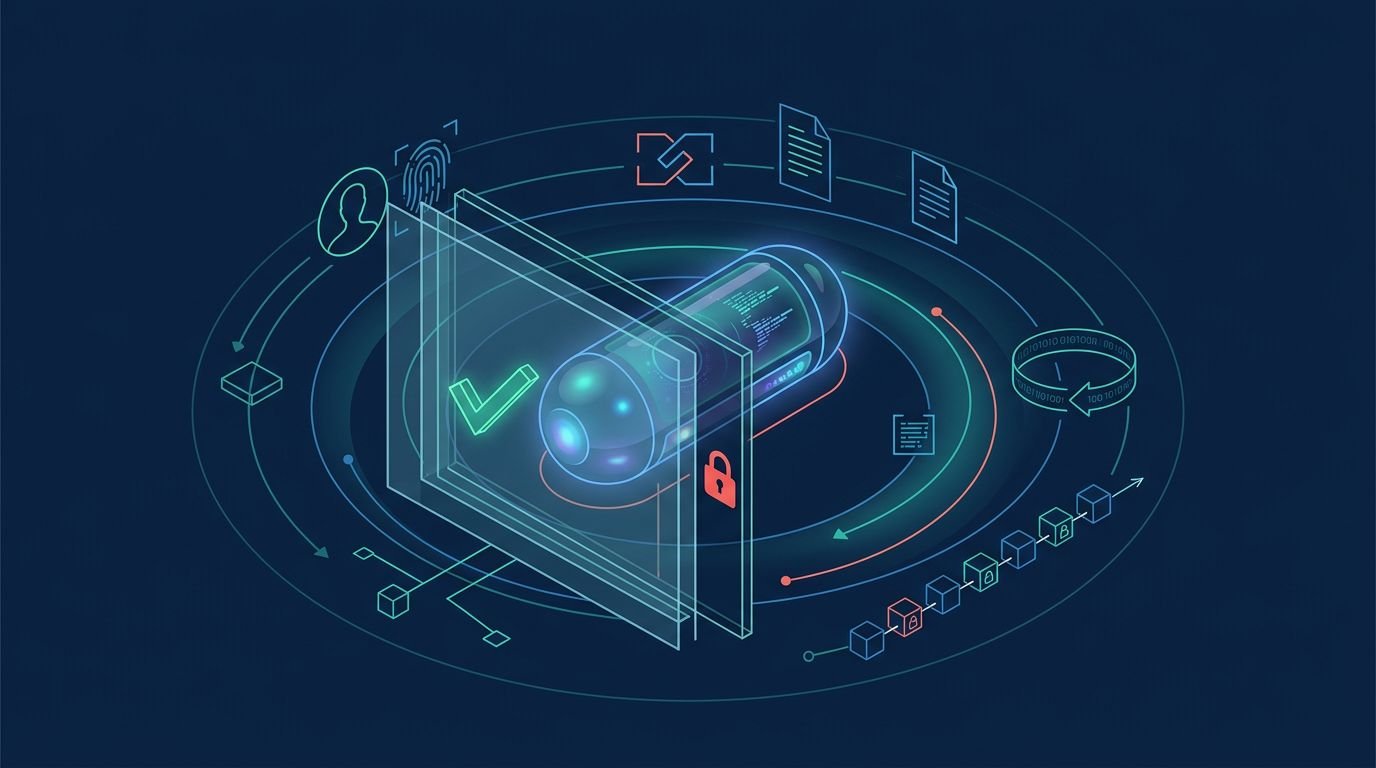
An agent with unrestricted tool access can turn one bad inference into a real operational problem. Human approval AI agents reduce that exposure by stopping proposed actions before money moves, records change, access expands, or sensitive data leaves your systems.
I don’t treat approval as a polite notification. It’s a runtime enforcement boundary that blocks execution, preserves state, verifies the reviewer, and creates evidence you can inspect later.
Key Takeaways
- Human approval must be a runtime enforcement boundary that blocks high-risk actions until an authorized reviewer decides.
- Approval should bind to one exact, sealed tool payload with a canonical hash, reviewer identity, policy version, expiration, and single-use idempotency key.
- Durable state, explicit timeouts, replay protection, role checks, and execution-time revalidation prevent duplicate, stale, or unauthorized actions.
- Keep maker-checker separation and require stronger authentication, such as SSO with step-up verification or passkeys, for high-impact decisions.
- Preserve a complete, replayable audit trail and test rejection, expiry, payload changes, webhook retries, permission changes, and rollback before granting production authority.
How approval gates should stop risky actions
A useful approval workflow sits between an agent’s intent and the side-effecting tool. It creates a human-in-the-loop control: a person must decide before execution. The model can prepare an email, draft a refund, or assemble an access request, but it cannot execute that action until the system receives a valid decision.
That separation matters. Prompt guidance is not a security control for autonomous agents. It can be ignored, manipulated, or lost when a workflow changes. The executor, not the prompt, determines execution behavior outside the model layer.

I use a simple rule: construct the exact tool payload first, evaluate policy second, and execute only a payload that the approval service has sealed. The agent never gets a second chance to rewrite approved parameters on its own.
The Agentic Trust Framework from the Cloud Security Alliance makes the same core point. Agents can observe, recommend, and prepare work, but authority should remain constrained and verified at the action boundary.
A notification is not an approval gate unless the action executor refuses to run without a recorded decision.
This design also protects against a common failure mode: the agent asks a human to approve a broad plan, then executes a different tool call later. Approval must bind to one action, one payload, and one point in time.
Set risk policy before agents can act
I start with the operation, not the model. A reliable agent can still make a high-consequence change. A less reliable agent may be safe when it only retrieves public documentation.
Your policy engine should apply risk classification to every tool call, using authority, consequence, reversibility, data sensitivity, novelty, and the identity of the affected user or account. A model confidence score can help route exceptions, but it should not decide whether an action is safe.
| Policy result | Typical agent action | Required control |
|---|---|---|
| Allow | Reads approved, non-sensitive information | Log the call and continue |
| Warn | Drafts an external message or proposes a low-impact record update | Show the proposed result and retain a review trail |
| Require approval | Calls high-risk functions, sends customer messages, changes production data, issues refunds, or grants access | Pause execution until an authorized reviewer decides |
| Block | Exports restricted data, bypasses a policy, or attempts an unapproved privileged action | Deny the call and create a security event |
The stored risk classification result should control routing, not the model’s confidence score. Approval criteria should state who may approve, what exact action is covered, and what evidence the reviewer must check.
Read actions and create, update, or delete actions should rarely share the same rule. Searching a support knowledge base is not equivalent to changing a customer’s billing status. The lower the reversibility of a result, the closer the approval checkpoint should sit to execution.
I also raise the risk level when an agent encounters an unfamiliar recipient, a new integration, an unusual dollar amount, or a request outside its normal scope. Those signals catch cases that a static list of tool names misses.
For a broader view of decision boundaries, Palo Alto Networks’ guide to agentic AI governance draws the same distinction: some bounded tasks can run autonomously, while higher-impact actions need direct review.
Approval gates work best when policy is explicit. If reviewers have to infer the rule from a vague alert, the system has already pushed too much judgment downstream.
Decide who has control
Human-in-the-loop, on-the-loop, and in command
Human-in-the-loop means the workflow pauses before the side effect. The reviewer can approve, reject, or edit the proposed action. This is the right choice for high-risk functions, including access grants, payment actions, regulated decisions, and material external communications.
Human-on-the-loop means people monitor an agent that can proceed within fixed limits. They review samples, investigate alerts, and retain an override. I reserve this model for low-risk, reversible work, such as categorization or internal draft generation.
Human-in-command is the governance layer above both. A person or accountable team defines permitted tools, spending limits, escalation rules, reviewer roles, and shutdown authority. An approver should not need to negotiate policy while a risky action is waiting.
Keep maker-checker separation
Maker-checker separation is simple in principle. The person who requested, configured, or materially edited an action should not approve it alone.
In practice, I enforce this with identity and role checks. The approval request records who initiated it, which account or tenant it affects, and which role can approve it. The approval service rejects a decision from the same person when dual control is required.
Service accounts also need separation. An agent’s credential can create a draft request, but it should never hold the permission needed to approve its own output. For high-impact actions, require two independent reviewers with distinct roles.
Bind the approval to one exact action
Each decision request should be a bound review artifact, not an informal notification or a green button with no context. A reviewer needs enough evidence to judge the action quickly without opening five other systems.
Each decision request should contain the fields that make an approval request defensible:
- A unique approval ID and a single-use idempotency key that prevents duplicate execution.
- The precise tool name, normalized arguments, and intended side effect.
- The target account, user, recipient, amount, environment, or resource.
- The policy rule and risk factors that caused the approval requirement.
- A compact source summary or supporting records that let the reviewer apply the approval criteria.
- The requesting agent, model version, workflow version, and tool credential scope.
- An expiration time, plus the allowed decisions: approve, reject, or edit.
I serialize that data into a canonical payload and calculate a hash. An Agents SDK adapter must pass the canonical payload unchanged to the approval service. The approval service signs the approval ID, payload hash, policy version, reviewer identity, and expiry. An HMAC is a practical option when the execution service and approval service share a protected secret.
When the worker resumes a deferred tool call, it recomputes the hash. If the payload differs by one field, the approval is invalid. The workflow must return to review or stop.
Editing deserves special treatment. If a reviewer changes the refund amount, recipient, or database update, I create a new proposal with a new hash and a new evidentiary record in the audit trail. Treating edited content as the original approved action creates an audit gap and defeats payload binding.
Approval should authorize a sealed action, not a future category of actions the agent might choose later.
Run a deferred tool call as durable state
A deferred tool call needs durable state. If the process restarts while a reviewer decides, state persistence must preserve the pending action and prevent duplicate execution.
I model the request as a small state machine: drafted, pending approval, approved, rejected, expired, executing, executed, or failed. Each transition is persisted with a timestamp and actor, and the request record includes an idempotency key. The executor can claim an approved request only once.
Framework details differ, but the pattern stays consistent across LLM Agentic frameworks. LangGraph’s interrupt() pattern can pause a graph before a protected tool call and resume it after validated input. Cloudflare’s Agents SDK can hold state in Durable Objects and resume interrupted runs. Protected handlers can also connect through the Agents SDK, while the Agents SDK keeps the execution boundary outside the model. HumanLayer-style function wrapping uses a Python SDK, while frameworks handle waiting mechanics; your policy, identity checks, and idempotency rules remain your responsibility.
For a multi-channel approval interface, route reviewers to one durable decision request, even when notices arrive through Slack, email, or an internal operations portal. Slack and email are routing channels, not the source of truth. Every channel feeds the same approval workflow, and its callback handler validates the webhook and records the decision before execution.
A good notification includes a short action summary, urgency, expiration, and a secure route to the review page. A Slack integration or Knock can deliver it through a webhook, but sensitive payloads should stay out of shared Slack channels and broad approval links should expire quickly.
Timeouts need a deliberate policy. Expiration should reject the action, route it to a backup reviewer, or request a fresh proposal. It should never mean “approved by default.”
That restraint matters in regulated workflows, including those subject to the EU AI Act. As AI21’s compliance use cases for AI agents notes, agents cannot independently approve flagged transactions or submit regulatory filings without human authorization.
Defend approvals against replay, bots, and impersonation
A click is weak evidence. Email forwarding, shared Slack sessions, automated browser scripts, and synthetic voice or video can all create false confidence about who approved an action. Even a Knock webhook needs signature validation, single-use handling, and rejection of forwarded or replayed notifications.
I require a named user account, single sign-on, and step-up authentication for high-risk decisions. FIDO2 security keys or passkeys are stronger than relying on an inbox link. The reviewer role must also be checked at decision time, not only when the alert is sent.
Voice or video can be useful for escalation, but I don’t use either as the final approval channel. A reviewer should return to an authenticated system, where the decision request record displays the sealed payload and records the decision. This reduces the risk of a deepfake request turning into an unverified operational action.
Replay protection requires more than a short expiry. A deferred tool call must not reuse an old approval when a worker resumes. Consume the decision token after first use, require an idempotency key, and lock the record during execution. Record the downstream tool receipt, such as a transaction ID or API response, before marking the action complete. This keeps execution behavior tied to a confirmed result.
The executor should re-check conditions at execution time; an Agents SDK worker can revalidate identity and authorization before acting. A reviewer may have approved access for an employee whose account was disabled five minutes later. The policy can change, permissions can be revoked, and the target resource can disappear while the request waits.
Preserve an audit trail someone can replay
For high-risk AI systems, the EU AI Act’s human oversight requirements make informal approval evidence hard to defend. NIST AI RMF supports a more disciplined approach: identify controls, document decisions, and monitor real behavior.
I log the approval request, not just the final “yes.” The complete record includes the original user request, agent output, retrieved evidence, policy result, and proposed tool payload. It also includes the payload hash, reviewer identity, decision request, decision, timestamps, and edits. Record each deferred tool call, execution result, error, and rollback.
It should show the EU AI Act’s human oversight tied to a specific action, never treating unrestricted model reasoning as audit evidence. Keep the inputs, tools, policies, source records, and action results that an auditor or incident responder can verify. Redact personal data when unnecessary, based on data sensitivity, and protect logs with the same care as the systems they describe.
If your agents connect to external tools through MCP, the Model Context Protocol security practices are a useful baseline. Log externally delivered approval events, including those sent through a webhook, and framework-generated events from the Agents SDK. Tool scope, tenant context, server-side validation, and immutable logs all belong outside the model prompt.
Test gates before you trust them
I test each approval gate with failure cases before I trust it with production authority. A happy-path demo won’t reveal whether an action runs after a timeout, whether an old Slack button still works, or whether two reviewers can approve the same request.
I run controlled tests for changed payloads, expired tokens, a deferred tool call, and duplicate webhook delivery. I test stale-event webhook validation, permission changes during a wait, role failures, and execution retries after network errors.
For framework coverage, I test worker interruption in the Agents SDK, then resume behavior in the Agents SDK. LangGraph interruption and resumption tests should verify state persistence. I also test Knock notification delivery and expiry behavior.
I test rejection and rollback with the same care as approval. For actions that can’t be undone, I document their reversibility limits instead of assuming rollback works.
Track approval latency, expiry rate, rejected-action rate, duplicate-execution attempts, and policy exceptions. Those metrics show where the gate creates useful control and where it creates unnecessary delay.
For production rollout and scoped permissions, my AI agent deployment guide covers the controls I expect before an autonomous workflow touches customer or operational systems.
Keep authority outside the model
The strongest approval workflow is not the one with the prettiest inbox alert. It is the one that blocks the exact risky action, verifies the right person, and leaves an audit trail when something goes wrong.
Human approval AI agents should have narrow authority by default. Let autonomous agents prepare work quickly, but stop them at high-consequence action boundaries until a verified human decides.
Frequently asked questions
When should an AI agent require human approval?
Require approval before actions that are irreversible, high-value, sensitive, or externally visible. Common examples include payments, refunds, production changes, access grants, regulated decisions, data exports, and customer-facing messages. Set thresholds by consequence and data sensitivity, not by tool name alone.
Can an AI agent resume after an approval delay?
Yes, if the workflow stores its state durably. Resume only after validating the decision token, payload hash, reviewer role, expiration, and current policy. An Agents SDK workflow can model this pause and resume path. Python teams can implement the same checks with a Python SDK. Re-run authorization checks before the final tool call.
What stops duplicate approvals and duplicate execution?
Use a single-use approval token, a unique idempotency key, and a state lock around execution. A webhook retry or duplicate notification must not trigger another tool call. The executor should record the external system’s receipt before marking the request complete.
Which related guides help with safer agent workflows?
- AI agent builder tools checklist
- Practical MCP implementation for SaaS teams
- Secure AI agent deployment for SaaS