Physical security is generating more data than ever before.
A single commercial facility can operate dozens or even hundreds of cameras, producing thousands of hours of video footage every week. Yet most security teams still face the same challenge: finding the few moments that actually matter.
The numbers highlight the problem. Studies have shown that security operators monitoring multiple video feeds can miss a significant percentage of critical events due to information overload. At the same time, organizations are facing rising security threats, increasing operational complexity, and growing expectations for faster incident response.
Traditional Network Video Recorders (NVRs) were designed to store footage. They were never built to understand it.
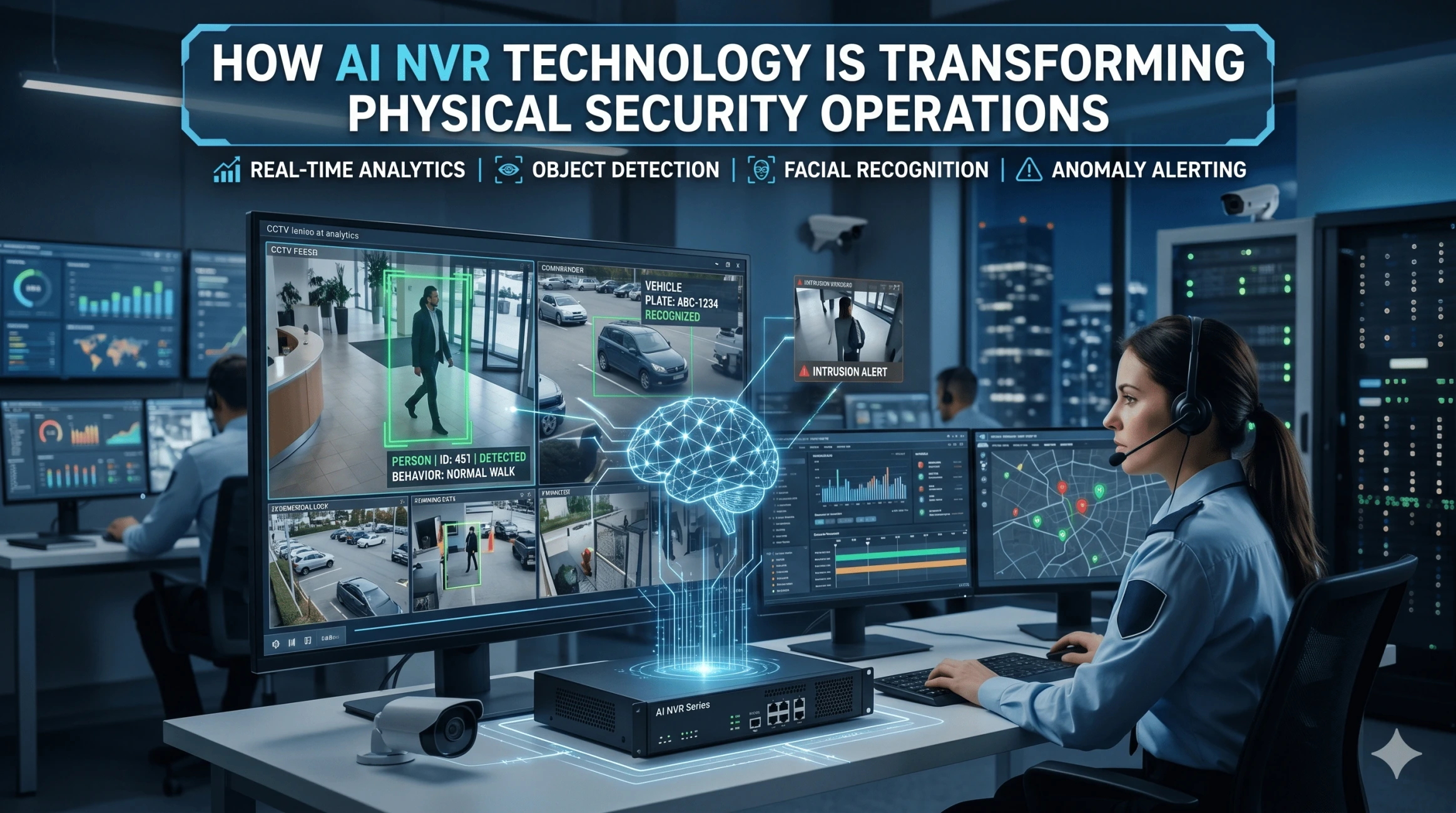
That is why AI NVR technology is rapidly becoming a cornerstone of modern physical security operations. By combining video storage with artificial intelligence, organizations can automatically detect events, search footage faster, and gain real-time insights that were previously impossible to achieve.
From airports and healthcare facilities to corporate campuses and retail chains, AI-powered NVR systems are helping security teams move from reactive monitoring to proactive security management.
In this article, we’ll explore how AI NVR technology is transforming physical security operations and why it is becoming an essential investment for modern organizations.
Image source
1. AI NVRs Turn Video Footage Into Actionable Intelligence
Traditional NVR systems have one primary job: recording video.
While recording remains important, modern security environments generate so much footage that manually reviewing it is no longer practical. A facility with 100 cameras can easily produce thousands of hours of footage each week, making it nearly impossible for security teams to identify every important event.
This is where AI changes the equation.
Instead of simply storing video, AI NVR systems analyze footage continuously and identify events that require attention. Rather than searching through hours of recordings, security personnel can focus on the moments that matter most.
For example, AI can help identify:
- Unusual movement patterns
- Unauthorized access attempts
- Suspicious behavior near restricted areas
- Objects left unattended
- Vehicle activity in controlled zones
This transforms video from a passive record of events into an active source of intelligence.
The result is better situational awareness and significantly improved operational efficiency.
2. Faster Incident Investigations Save Valuable Time
One of the biggest frustrations in physical security operations is investigating incidents after they occur.
When a theft, safety issue, or unauthorized access event happens, teams often spend hours manually reviewing footage from multiple cameras. This process is slow, expensive, and highly dependent on human attention.
Modern AI NVR platforms dramatically reduce investigation time.
Instead of manually searching video, users can quickly identify specific people, vehicles, or activities using intelligent search capabilities. This allows investigators to move directly to relevant footage instead of reviewing countless hours of recordings.
For organizations managing large campuses, warehouses, hospitals, or transportation hubs, this can save dozens of hours every month.
More importantly, faster investigations often lead to faster resolution, which minimizes operational disruption and improves security outcomes.
3. Real-Time Alerts Improve Response Speed
Security incidents become more costly when response times are slow.
Traditional systems often notify teams only after an event has already occurred. By then, the damage may already be done.
AI NVR technology changes this by introducing real-time intelligence.
Modern systems continuously analyze video streams and generate alerts when specific conditions are detected.
For example, security teams can receive notifications for:
- Unauthorized entry into restricted zones
- Perimeter breaches
- Unusual after-hours activity
- Suspicious loitering
- Vehicle access violations
This proactive approach allows organizations to respond before incidents escalate.
Platforms like Coram demonstrate how modern AI NVR technology is evolving beyond simple video storage. Coram’s cloud-based NVR platform works with existing IP cameras and combines recording with AI-powered analytics, intelligent search, and real-time alerts. Security teams can quickly identify specific events, monitor activity across multiple locations, and gain visibility without replacing their existing camera infrastructure.
For organizations managing complex environments, this type of real-time intelligence can dramatically improve response effectiveness.
4. Multi-Site Security Operations Become Easier to Manage
Many organizations no longer operate from a single location.
Retail chains, healthcare networks, logistics companies, and educational institutions often manage dozens or even hundreds of sites simultaneously. Monitoring these locations independently creates visibility gaps and operational inefficiencies.
AI-powered NVR systems help solve this challenge by centralizing video management.
Security teams can:
- Monitor multiple sites from one platform
- Receive alerts from all locations in real time
- Standardize security policies across facilities
- Access footage remotely without local intervention
This centralized approach simplifies management while improving consistency.
Instead of relying on separate systems for each location, organizations gain a unified view of their security operations.
As businesses continue expanding geographically, this capability becomes increasingly valuable.
5. AI Helps Reduce Security Team Workload
Security teams are being asked to do more with fewer resources.
Hiring additional personnel is expensive, and staffing shortages continue to affect many industries. At the same time, camera deployments are growing rapidly.
This creates a challenge.
More cameras typically mean more footage to review and more events to monitor.
AI NVR technology addresses this by automating repetitive monitoring tasks.
Rather than requiring personnel to watch dozens of screens continuously, the system automatically identifies events that need attention.
This allows security teams to focus on:
- Incident response
- Investigation
- Risk assessment
- Strategic security planning
Instead of replacing security professionals, AI enhances their effectiveness by reducing routine workload.
The result is better security coverage without proportionally increasing staffing requirements.
6. Better Search Capabilities Unlock the Value of Video Data
Video footage contains valuable information, but only if it can be accessed quickly.
Traditional systems often require users to search by date, time, and camera location. This process can be inefficient, especially when investigating incidents involving multiple cameras.
AI-powered NVR systems introduce a more intelligent approach.
Users can search footage using descriptive attributes and event-based criteria rather than relying solely on timestamps.
This makes it easier to locate:
- Specific vehicles
- Individuals matching certain characteristics
- Activities occurring in designated areas
- Events spanning multiple cameras
The ability to find relevant footage within seconds instead of hours fundamentally changes how organizations use video data.
Rather than treating video as an archive, businesses can use it as an operational tool.
7. Physical Security Is Becoming More Data-Driven
Perhaps the biggest transformation driven by AI NVR technology is the shift toward data-driven security operations.
Historically, security teams focused primarily on monitoring and incident response. Today, organizations expect security systems to generate insights that support broader operational goals.
AI-powered NVR platforms provide valuable information about:
- Facility usage patterns
- Traffic flow
- Operational bottlenecks
- Security trends
- Resource allocation opportunities
This allows leaders to make more informed decisions using data generated by their security infrastructure.
As organizations continue investing in digital transformation, security systems are increasingly becoming a source of business intelligence rather than just risk management tools.
FAQs
What is an AI NVR?
An AI NVR is a Network Video Recorder that combines traditional video recording capabilities with artificial intelligence to analyze footage, detect events, and provide real-time insights.
How is an AI NVR different from a traditional NVR?
Traditional NVRs primarily record and store footage. AI NVRs can automatically detect activity, generate alerts, perform intelligent searches, and provide analytics.
Can AI NVR systems work with existing cameras?
Yes. Many modern AI NVR platforms are designed to work with existing IP cameras, allowing organizations to upgrade capabilities without replacing hardware.
What industries benefit most from AI NVR technology?
Healthcare, retail, airports, education, logistics, manufacturing, and corporate campuses are among the industries seeing significant benefits from AI-powered NVR systems.
Does AI NVR replace human security personnel?
No. AI NVR systems help automate monitoring and analysis, allowing security teams to focus on decision-making, investigations, and incident response.
Conclusion
The role of video surveillance is changing.
Organizations are no longer looking for systems that simply record footage. They need platforms that can understand activity, identify risks, and help teams respond faster.
That is exactly what AI NVR technology delivers.
By combining intelligent analytics, real-time alerts, centralized monitoring, and powerful search capabilities, AI-powered NVR systems are transforming how physical security operations are managed.
For modern organizations, the question is no longer whether AI will become part of physical security infrastructure.
The real question is how much operational visibility and security intelligence you are missing without it. Have you implemented AI NVR technology in your facility? Share your experience in the comments below.