

If you’re comparing Sora 2 vs Veo 3.1, I’m not here to crown a “best” model. I’m here to pick the better tool for getting paid.
Both tools mostly spit out short clips. That means the money usually doesn’t come from the clip itself, it comes from what you package around it: ads, UGC-style promos, Shorts series, hook bundles, landing page hero loops, and fast creative tests.
In this breakdown, I’ll use five angles I care about when money is the goal: speed to first dollar, volume vs value, platform fit, operational cost, and scalability ceiling. If you want a clean test plan for this week, keep reading.
Speed to first dollar, which tool helps me get paid this week?
When I’m trying to make money fast, I don’t start with “best video quality.” I start with “what can I ship in 48 hours that a real person will buy?”
Here are three quick paths I’ve used (or seen work repeatedly) for short AI video clips:
A $150 UGC-style product clip for a small brand that needs content now. Think: a 9:16 promo with a punchy hook, a product close-up, and a simple call to action.
A $50 Shorts package where I deliver 3 variations of one idea. It’s not glamorous, but it’s easy to sell when a creator wants consistency.
A $300 ad concept bundle, where I give 3 hooks, 3 angles, and 6 total clips (two lengths per angle). The client gets options for A/B tests without paying agency rates.
If you’re banking on Shorts revenue, it helps to understand the rules first. This YouTube monetization requirements guide is a solid refresher on what creators need before the platform pays out.
My fastest cash plays with each tool (UGC, Shorts, and quick ad tests)
For quick iteration, Sora 2 often feels like the “idea machine.” As of February 2026, it’s widely reported as fast at generating short clips (some tests cite roughly half a minute for a 12-second video). That matters when a trend window is short and I want multiple versions before I post.
Veo 3.1, on the other hand, tends to help me close clients when the work needs to look like it belongs in a paid campaign. Veo’s strengths show up in polish, prompt adherence, and especially audio, since Veo is often used with native sound and cleaner dialogue.
My “first sale” readiness checklist is simple:
- 3 deliverables to show: 1 UGC-style clip, 1 hook test (3 hooks, same offer), 1 product loop for a landing page
- Starter pricing range: $50 to $300 depending on packaging and revisions
- Portfolio proof: 5 to 8 clips in one niche, not 30 random experiments
If you want more background on how these tools fit into the wider category, I’d skim this primer on how AI video generators work. It’s a good reset on why short clips and consistency still matter.
A simple decision rule: am I chasing virality or pitching brands?
My rule is blunt.
If I need a lot of shots fast for trend cycles, I lean Sora 2. I care more about volume, speed, and testing weird ideas quickly.
If I need fewer clips that look like paid ads, I lean Veo 3.1. I care more about product handling, consistent looks, and audio that doesn’t scream “AI experiment.”
One more thing decides “speed to payment” more than either model: distribution. If I already have a TikTok account with traction, Sora-style volume can pay sooner. If I already have a client list, Veo-style polish can pay sooner.
Content volume vs content value, where profit really comes from
I think of it like this: one approach is a busy food stall that sells quick meals all day. The other is a small restaurant that sells fewer plates, but charges more and wins repeat customers.
A volume strategy usually looks like daily Shorts, simple formats, and fast remixes. A value strategy usually looks like ad assets, product launches, and “hero” videos for landing pages.
Neither is morally better. The question is which one matches how you like to work.
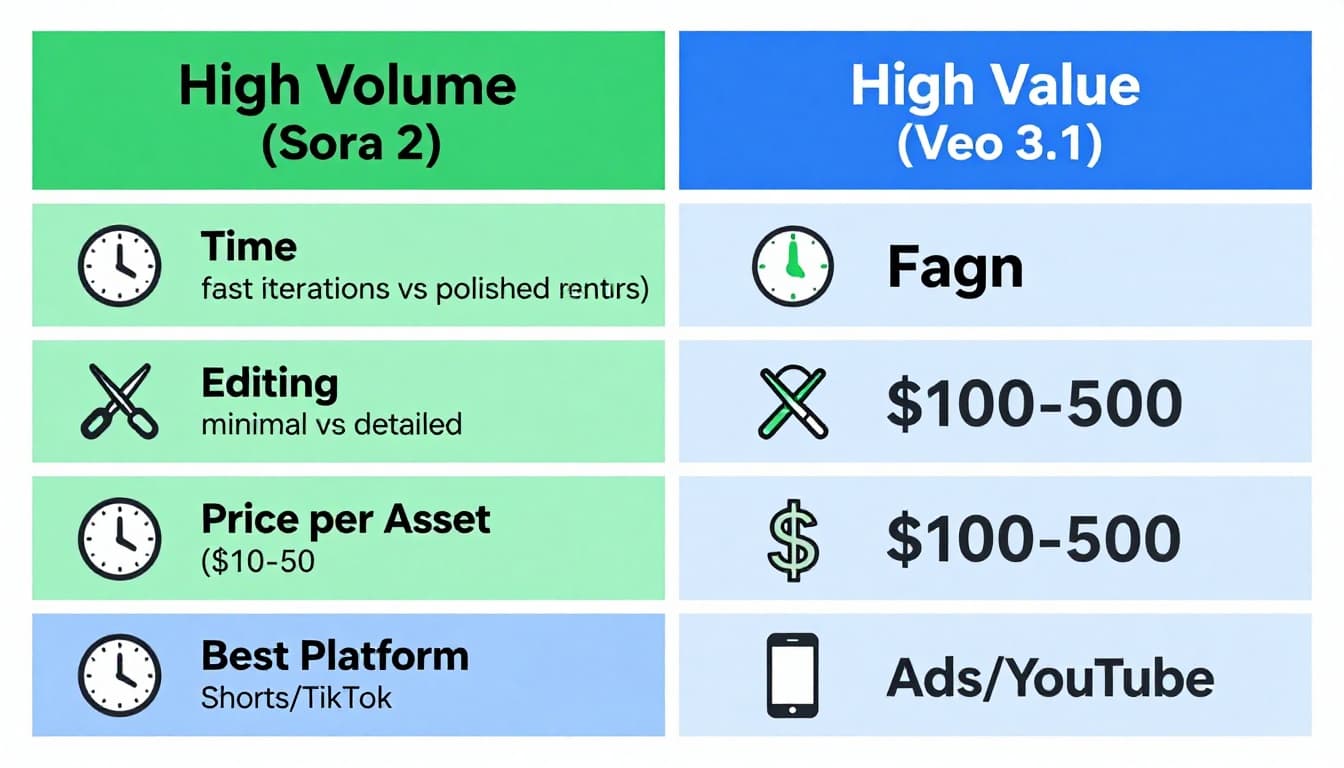
When Sora 2 pays off by shipping more videos
Sora 2 is at its best when I’m trying to publish more, not perfect more. It’s strong for movement, action, and short stories that feel like “real video,” especially when physics and scene motion matter.
In February 2026, Sora 2 is commonly described as capable of longer clips than many competitors (often cited up to around 25 seconds at 1080p in current availability tiers). That extra time makes series formats easier. I can set up a mini plot, hit a punchline, and still have room for a call to action.
Monetization tends to come from systems like:
Affiliate Shorts that push to a link in bio. Channel growth that turns into sponsorships. “Template packs” where I sell prompts, hooks, and editing layouts.
The real limiter is still me. I need a steady posting rhythm, and I need basic editing so the clips feel like a brand, not a demo.
When Veo 3.1 earns more per video because it looks like a real ad
Veo 3.1 tends to shine when the viewer’s trust matters. That’s why it often performs well for product showcases, ad-style shots, and clips where audio clarity and lip sync affect believability.
As of February 2026, Veo is widely described as offering 4K output for shorter clips (commonly cited around 8 seconds at 4K), and longer outputs at lower resolution tiers. That makes it great for “hook-first” ads, where the first 2 seconds carry the whole performance.
Here’s the pricing ladder I use when I don’t want to overcomplicate it:
Basic: 1 clip, 1 aspect ratio, 1 round of edits. Standard: 3 hooks, 2 lengths, captions included. Premium: 6 to 10 total assets, multiple aspect ratios, plus A/B variations.
I’m not charging for “AI video.” I’m charging for fewer decisions and faster testing.
Platform fit, I pick the tool based on where the video will live
Platforms reward different behaviors. TikTok rewards speed and frequency. Shorts rewards retention and clean hooks. Ads reward clarity and conversion. Landing pages reward instant understanding.
That’s why I don’t commit to one model forever. I commit to the platform’s rules, then pick the tool that makes the job easier.
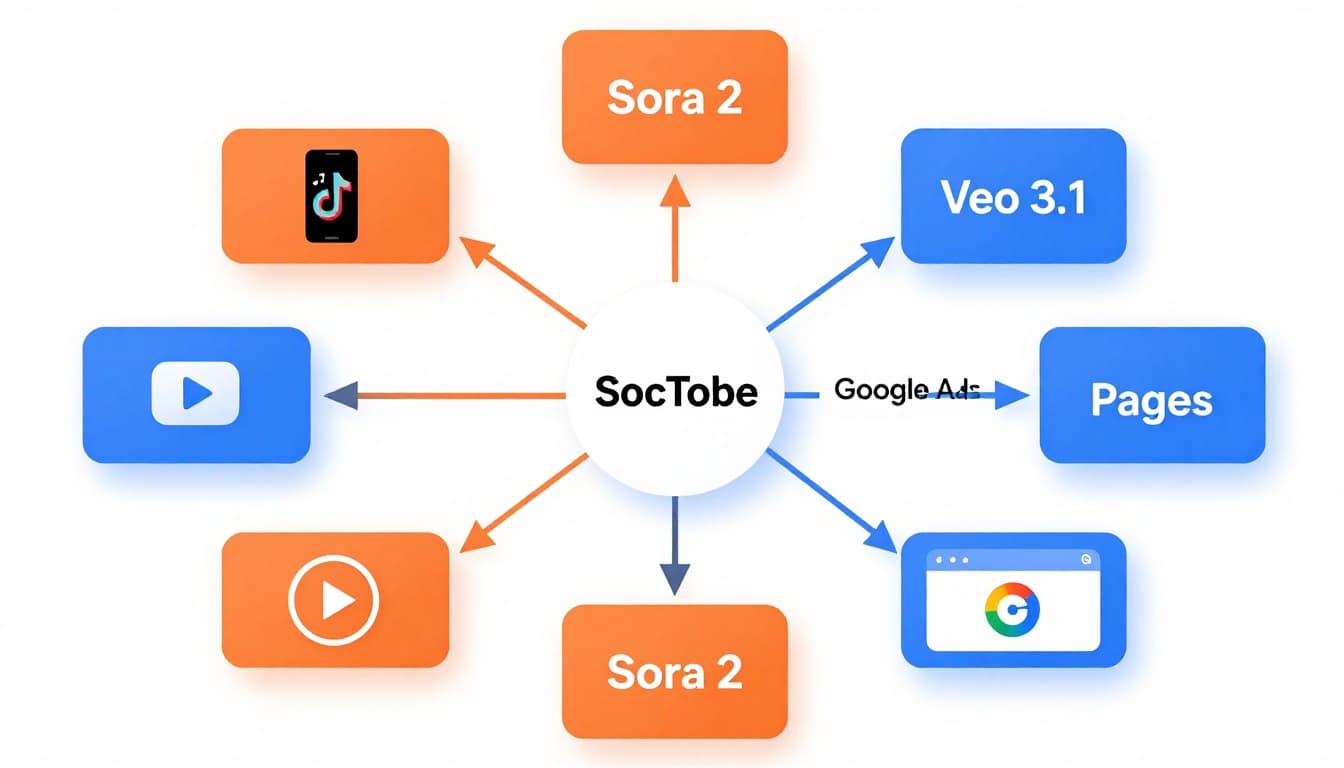
Short-form first: TikTok, Reels, and Shorts (9:16, hooks, and posting cadence)
Vertical 9:16 is the default now. Veo 3.1’s vertical-friendly outputs (and its audio quality) can make the content feel more “native,” which helps with trust. Sora 2’s advantage is that I can generate more variations quickly, which is huge when I’m testing hooks.
My simple posting plan is a 7-day sprint: Two formats (one meme-style, one product-style). One CTA (follow, comment, or click). One niche, no exceptions.
Audio clarity and lip sync aren’t just “quality.” They’re trust signals. If the mouth movement looks off, viewers scroll. If the voice sounds strange, they scroll faster.
If you’re building a bigger tool stack around this, I keep a running list of options in my best AI video and animation tools roundup.
Client work: ads, product pages, and app promos (where polish beats volume)
Client work is where Veo 3.1 often makes more money for me, even if it’s slower per render. Clients don’t pay for novelty. They pay for outcomes, like better click-through or lower CPA.
Sora 2 still has a place here, mainly for concepting and “weird but interesting” creative. If a brand wants fresh angles fast, Sora helps me pitch 10 ideas before lunch.
For client delivery, I stick to a “deliverable stack” that clients understand: 3 hooks, 2 lengths, 2 aspect ratios, plus captions. I add captions in an editor because text inside generated video still tends to break, smear, or drift.
If you want a deeper look at Sora’s workflow and what it changed for creators, this breakdown of the Sora 2 app and features is worth a skim.
Operational cost, what it costs me to produce and deliver paid videos
Cost is not just the subscription. It’s also time, failed generations, revisions, and the extra tools I need to ship a finished deliverable.
As of February 2026, reported entry pricing often looks roughly like this: Sora 2 has a low entry tier around $20/month (limited outputs), with a higher tier around $200/month when you need more volume or higher specs. Veo 3.1 is often cited around $19.99/month for a creator entry plan, with a higher tier around $249/month for expanded features. Access routes change, and pricing moves, so I always tell people to check the official plan pages before committing.
The “tool stack” costs add up too: editor, captioning, music, storage, and sometimes an upscaler.
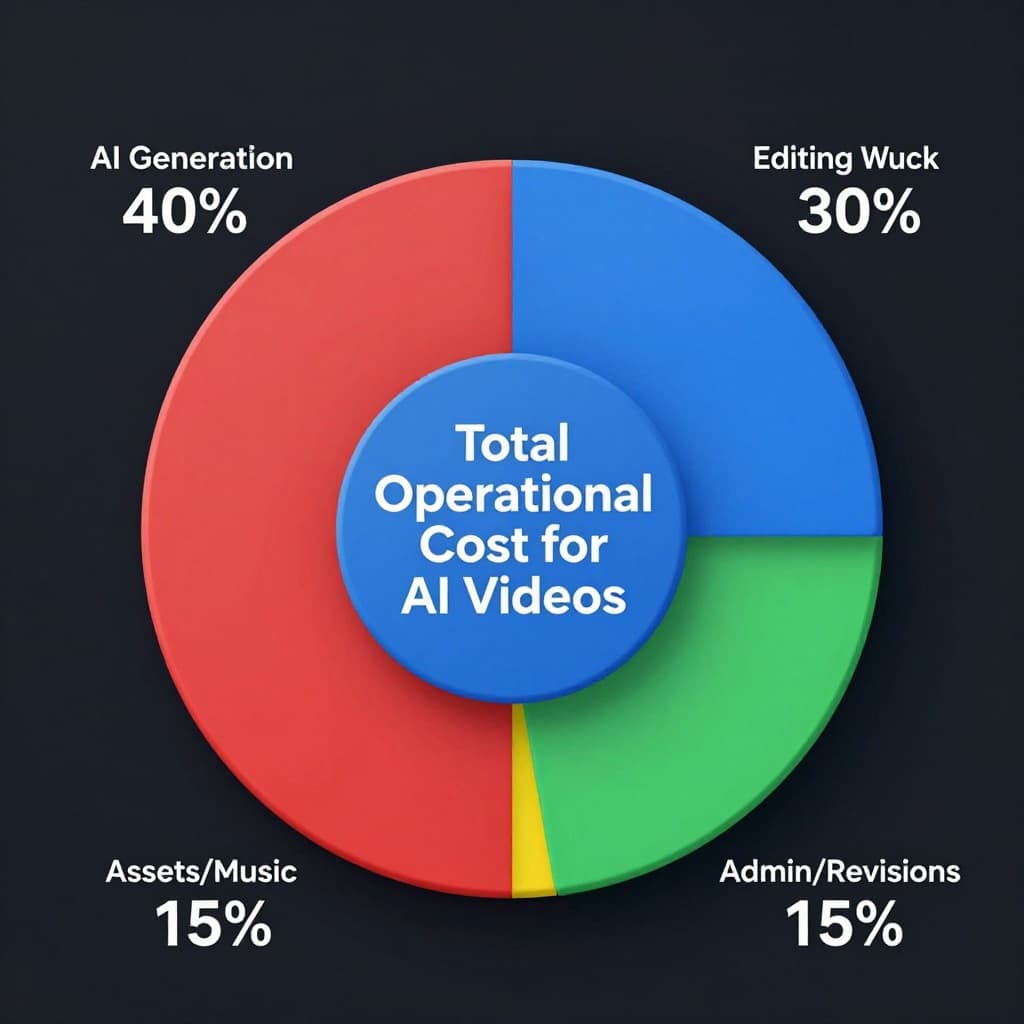
The hidden costs nobody budgets for (revisions, exports, and “good enough” edits)
This is where profit quietly dies. My top hidden costs are:
- Failed generations that burn time and credits
- Client revisions that turn one clip into five
- Captioning, because it’s not optional anymore
- Music licensing or subscription fees
- Storage and versioning, especially for ad variants
My rule is simple: set a max number of re-renders per deliverable, bake it into the price, and put it in writing. That protects both sides.
My break-even math for Sora 2 vs Veo 3.1
I keep the math boring on purpose:
Profit = (price per deliverable × deliverables) minus (tool costs + time cost)
Example scenario 1 (creator bundles): I sell 10 Shorts for $200 total. If my tool cost is $20 and I spend 3 hours, my profit depends on what I value my time at. If I can make it a repeatable format, it becomes worthwhile.
Example scenario 2 (freelance ads): I sell a UGC-style ad set for $450. If I’m on a higher tier (say $200/month) but I land two clients, the software cost becomes a small slice. The bigger cost becomes revisions and editing time.
Numbers change, but the pattern doesn’t. The winner is the model that makes my offer easier to deliver.
Scalability ceiling, what stops me from turning this into a content factory
Both models still hit walls. Short clip limits, object permanence issues (things change between frames), hands that morph, and text that won’t stay readable. These aren’t minor. They create rework, and rework kills margins.
I also treat compliance as part of scaling. If I’m selling video to brands, I disclose AI use when required, and I avoid using real people’s likeness without clear rights.
Policies keep shifting, especially around synthetic media. If you market on TikTok, this TikTok policy update guide for brands and creators is useful context for what platforms want in 2026.
The real bottlenecks: short clips, weird hands, and text that won’t stay readable
When the model breaks, I use workarounds instead of fighting it for hours:
- Keep generated text off-screen, add clean overlays in an editor
- Use close-ups and simple hand interactions, avoid complex finger work
- Chain multiple short clips, then hide cuts with whooshes and captions
- Reuse a small set of “winning” prompts, don’t reinvent every time
- Plan for 2 to 3 bad renders per good one, so I don’t panic when it happens
This is also why I like comparing across models and not getting emotionally attached. If you want a broader benchmark view, I keep notes in this AI video models comparison.
How I scale anyway: templates, batch prompting, and an editing pipeline
My scalable workflow is boring, and that’s the point.
I start with a brief and a fixed prompt template. I batch generate. I pick the best takes. Then I edit in a timeline, add captions, and export platform versions (9:16, 1:1, 16:9). I also save everything in a folder structure that’s easy to reuse, because “where did that file go?” is a real tax.
Scaling also means updating my own content. I refresh posts after a few months, because features, access, and pricing change fast. That’s part of staying profitable, not just staying informed.
My take: the tool doesn’t pay me, the offer does
Here’s where I land: Veo 3.1 tends to win for client-ready commercial work and a lower barrier to entry, while Sora 2 tends to win for speed and trend-driven social content. But profit still depends on my offer, my platform, and my costs.
If you want a practical next step, pick one path to test this week (one client-style ad set or one 7-day Shorts sprint) and track results. After you publish, submit the URL in Google Search Console, check PageSpeed (I aim for 80+), confirm keyword placement (title, URL, meta, first paragraph, 1 to 2 headings), then review Google Analytics after 1 to 2 weeks. In 3 to 6 months, refresh this post with new features, pricing, and fresh long-tail keywords. That’s how the content stays useful, and how the revenue stays real.