
If you’ve ever spent a late night bouncing between Alibaba tabs, waiting on slow replies, and trying to make sense of messy quote spreadsheets, you already know the real problem: sourcing isn’t “hard,” it’s relentlessly manual.
Over the last few weeks, I tested SourceReady in a way that mirrors real procurement work. I started with vague product ideas, turned them into usable specs, built shortlists, sent RFQs, and compared quotes like I had to make an award decision on Monday morning.
Here’s what you’ll learn: what SourceReady does well when AI runs discovery and outreach, where it still needs human control, and which “coming soon” automation features (as of early 2026) I plan around instead of betting my timeline on.
SourceReady is not a supplier database, it feels like an AI sourcing engine
 Photo by Freek Wolsink
Most supplier tools feel like online phone books. You type a keyword, scroll listings, and hope the “verified” badge means something. SourceReady feels different because I don’t start with browsing. I start by describing what I need, and the system behaves more like an agent than a directory.
The big claim is coverage and reach. SourceReady says it can scan 1.2M+ suppliers across 100 countries, which matters because the best supplier for your product often isn’t the one with the prettiest listing. It also supports searching in ways that map to real sourcing work, like category, material, country, and “look-alike” products for white-label or improvement ideas.
What changed for me is the rhythm of the work. Instead of me hunting and copy-pasting, I’m reacting to shortlists, match explanations, and normalized quotes. If you run procurement for a brand, that’s a big deal because speed is only half the win. The other half is consistency, meaning fewer missed requirements, fewer “oops” moments in email threads, and cleaner handoffs to teammates.
For a broader view of how they position supplier matching, I cross-checked SourceReady’s own write-up on AI supplier matching tools.
Suggested filename: sourceready-ai-sourcing-engine.jpg, alt text: “AI sourcing engine matching suppliers to a product spec.”
What SourceReady actually does for me (discovery, vetting signals, and quote comparisons)
I think about SourceReady outputs in three buckets: shortlist quality, quote clarity, and how fast I can move from “maybe” to “send samples.”
Here’s what I typically get back, in a format I can actually use:
| Output I get | What it looks like in practice | What I do with it |
|---|---|---|
| Supplier shortlist | A smaller set of candidates with fit notes | Pick 6 to 12 to contact |
| Match reasoning | “Why this supplier fits” style signals | Spot mismatches early |
| Outreach drafts | Messages tailored to my product constraints | Edit, approve, send |
| RFQ structure | A consistent RFQ format across suppliers | Reduce back-and-forth |
| Quote extraction | Price, MOQ, lead time, shipping terms (when provided) | Build apples-to-apples comparisons |
| Side-by-side comparisons | A view that makes outliers obvious | Shortlist finalists faster |
One caution that matters: AI can sound confident while still missing important risk details. So even when the shortlist looks perfect, I still verify certifications, request samples, and confirm payment terms in writing. If the product touches compliance (food contact, kids products, cosmetics), I treat “looks fine” as a starting point, not a green light.
If you’re building repeatable sourcing workflows, it helps to think the same way I do with automation tools: the system should reduce busywork, but you still need logs and checkpoints. That’s also why I like tools such as n8n for workflow automation when a process needs routing, approvals, and an audit trail.
From product idea to verified suppliers, the end-to-end workflow I follow
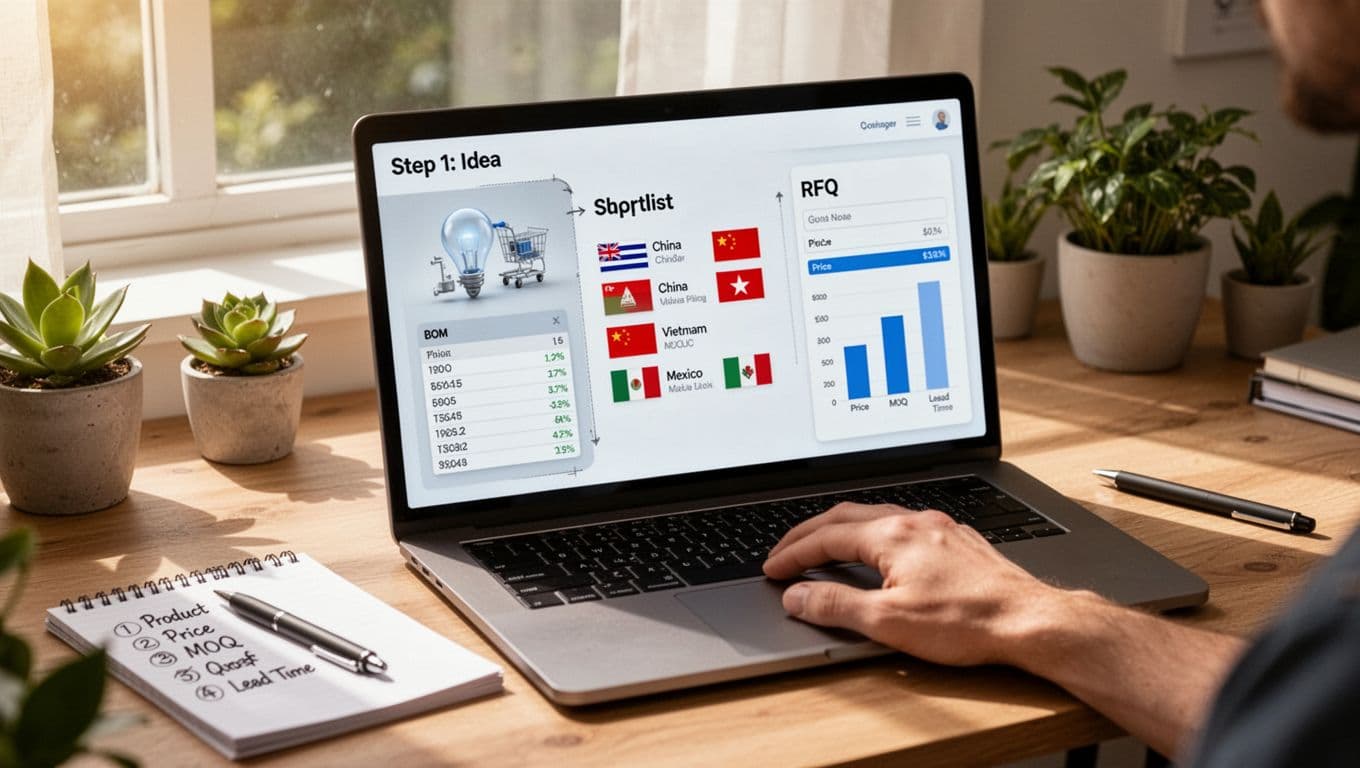
I didn’t get the most value from SourceReady by treating it like “search.” I got value by running a full loop, idea to shortlist to RFQ to decision.
The part that surprised me most was the product ideation layer. SourceReady can generate photorealistic renders, exploded views, and basic BOMs from a sketch or prompt. That’s not just for pretty pictures. In sourcing, visuals and simple BOM structure reduce confusion fast. A supplier can quote accurately when they can see what you mean, not when they’re guessing from two sentences.
Once I have that baseline, I move into supplier discovery and outreach. When I do it manually, I end up writing the same clarifications again and again. With SourceReady, my RFQ stays consistent across vendors, so quote comparisons stop feeling like I’m comparing different products.
If you’re curious about their angle on white-label and look-alike discovery, this post on AI tools for private-label and white-label sourcing matches the exact workflows I see people using in 2026.
One mental model that helps: SourceReady is closer to an “overnight operator” than a chatbox. That’s also the lens I used in my Manus AI vs freelancers breakdown, where the question is simple, does the tool produce real deliverables, or just suggestions?
My step-by-step: prompt or sketch, specs, shortlist, samples, then a clean award decision
- Define constraints first: target cost, MOQ ceiling, lead time, and must-have materials.
- Add compliance needs: food-contact, CPSIA-style constraints, labeling rules, or testing expectations.
- Generate a clear spec pack: simple drawings, key dimensions, finishes, and a “no substitutions” note.
- Pick sourcing regions on purpose: I often compare China, Vietnam, India, and Mexico based on category and timeline.
- Build a shortlist and send RFQs: I keep the initial batch small enough to manage, usually 6 to 12 suppliers.
- Lock sample timelines early: I ask for sample cost, sample lead time, and how they ship samples to the US.
- Normalize quotes: I make sure pricing includes the same incoterms and the same packaging assumptions.
- Score and record the decision in one workspace: I capture who replied fast, who dodged questions, and where risk showed up.
My mini tip: I keep a simple scoring rubric with five fields: price, lead time, quality risk, responsiveness, and clarity. It sounds basic, but it prevents me from “choosing the nicest email.”
If the RFQ isn’t consistent, your quote comparison is fiction. The fastest sourcing teams win by controlling inputs, not by sending more emails.
AI-powered outreach and RFQ automation, where the time savings really show up

Outreach is where sourcing projects go to die. Not because suppliers are bad, but because inbox work is slow and inconsistent. You forget follow-ups, you lose threads, and you end up rewarding whoever replies first.
SourceReady’s outreach angle is simple: let AI draft customized supplier messages, translate them when needed, and follow up 24/7 until you get replies. From the early 2026 info I’ve seen, full omni-channel tracking and more advanced agent behavior are still rolling out, so I treat it as powerful, but not magic.
RFQ automation is the other half. SourceReady can create RFQs, collect responses, extract key terms, and help score quotes. That’s the boring work that still eats hours.
If you want their current framing on RFQs and quote handling, see how they describe Quote Intelligence and RFQ automation.
A quick scenario that felt real: I tested supplier outreach for two very different needs, a packaging vendor and a small electronics manufacturer. Packaging suppliers tended to reply quickly but loosely, with “we can do it” messages. The electronics side replied slower, but with more questions. In both cases, consistent follow-ups increased usable replies, especially when my initial message included clear constraints.
Outreach that does not get tired (and what I still keep human-controlled)
What I’m comfortable letting AI handle:
- First-draft outreach that includes my product constraints
- Translation for supplier communication
- Follow-ups and reminders so threads don’t go cold
- Light quote parsing to pull out price, MOQ, and lead time
What I personally approve every time:
- Final requirements (materials, tolerances, packaging rules)
- Payment terms and deposit structure
- QC plan (inspection timing, AQL targets, rework expectations)
- Red-flag checks (odd bank details, evasive answers, inconsistent docs)
This split also matches how I think about sales automation. A tool can send messages at scale, but I still own the promise and the risk. If that’s your world too, my Apollo.io hands-on review covers the same “automation vs control” tradeoff, just on the outbound side.
SourceReady is built for operators, not casual browsers
When I say “operator,” I mean someone who ships products repeatedly. You manage SKUs, versions, BOMs, packaging, and supplier relationships. You need a system, not a one-time list of factories.
SourceReady fits best for DTC teams, Amazon and Shopify sellers, and brand sourcing teams in categories like apparel, consumer electronics, beauty, and even food and beverage (with the obvious compliance caveats). It’s also a strong fit if you’re doing variation work, like taking an existing product and improving materials, packaging, or features.
On the other hand, if you only want a quick directory, you might find the workflow heavier than you want. SourceReady shines when you run the whole loop.
Pricing is still a question mark in early 2026. A lot of sources point to demos or sales-led onboarding, and I don’t see consistent public pricing snapshots. If I’m on a sales call, I ask for the limits that matter, not vague plan names.
To ground procurement terms and supplier models, I also like referencing their explainer on OEM vs ODM vs contract manufacturing, because misunderstandings there can wreck a timeline.
The questions I would ask before I buy (pricing, data privacy, and team workflow)
These are the buying questions I’d put on one page before I sign anything:
| Question to ask | Why I care |
|---|---|
| How many seats are included, and what’s the add-on cost? | My team needs shared access without account juggling |
| Are there monthly limits on outreach and RFQs? | I don’t want surprise throttles mid-launch |
| Which categories and countries are strongest today? | Coverage varies by niche, I want proof in my lane |
| What export formats do we get (CSV, PDF, audit logs)? | Finance and ops need clean handoffs |
| How do you handle supplier verification signals? | “Verified” needs a definition I can trust |
| What’s the security and retention policy for specs and drawings? | My product info is sensitive |
| Which channels are supported for supplier contact? | Email-only vs multi-channel changes response rates |
For a useful contrast on how rigorous evaluation and audit trails look in other AI-heavy workflows, I’d compare this mindset to enterprise tooling like data labeling. My Labelbox vs Scale AI comparison gets into the practical details of QA, review queues, and traceability.
Why AI-driven sourcing is starting to replace manual supplier hunting
Manual sourcing breaks down for three reasons: it’s slow, it’s inconsistent, and it rewards persistence over accuracy. AI flips that math because it can search nonstop, follow up without ego, and normalize quotes into structured fields.
At the same time, humans still own the parts that matter most: strategy, risk, negotiation, and long-term supplier relationships. I don’t outsource judgment about compliance, quality control, and payment risk to any system.
In 2026, this also connects to how supply chains keep shifting. I’ve seen multiple industry writeups point to 2025 changes in sourcing mix, including reduced reliance on China in some categories and increased share from parts of ASEAN. Tariffs and lead-time volatility push teams to compare more countries, and AI makes that comparison less painful.
If you want SourceReady’s view of what SMB procurement tools are worth paying for, their roundup on AI procurement tools for SMBs is a decent temperature check of how vendors pitch this space.
My honest pros and cons after testing the AI-first approach
Here’s where I landed after running SourceReady like an actual operator.
What I liked: faster shortlists, less inbox grind, clearer quote comparisons, and a single place to keep product versions and supplier threads. I also like the trend support angle, because looking at “look-alikes” is a real sourcing shortcut when you’re iterating quickly.
What I didn’t hand-wave away: some advanced automation is still “coming soon” as of early 2026, and you still need sample discipline and contract discipline. Also, not every category and country will feel equally strong, depending on where the supplier data is richest.
I also noticed a pattern in 2026 user feedback I reviewed: people consistently praise efficiency and vetting without travel, but they keep asking for even more automation and deeper end-to-end agent behavior. That lines up with my experience.
AI can find options fast. Your job is picking the option you can defend six months later.
Where I landed after testing SourceReady
SourceReady helped me move from idea to RFQ to quote comparison with fewer gaps and less manual chasing. The real win is that it keeps the work structured, even when suppliers reply in different formats. Still, I don’t let AI “approve” the critical stuff, so I validate samples, compliance expectations, and payment terms every time.
If you’re considering it, my advice is simple: book a demo, run one real RFQ, and track how many hours you spend versus your current process. Then decide if you want AI to do the chasing, while you keep control of the decision.