Matt Wolfe’s AI news roundup puts lower-cost models alongside a practical question: how useful is their output for a particular task? My main takeaway is that visual quality and functional correctness deserve separate judgments.
If you’re comparing AI tools for development or creative work, those distinctions matter more than a broad claim that one model wins. Wolfe’s Anthropic discussion starts with another judgment call: what insider selling can tell us about confidence in AI.
Anthropic and Investor Confidence
Wolfe’s Anthropic discussion focuses on insider selling as a possible measure of conviction. Employees and early investors know the business better than outside observers, so their decisions about holding or selling deserve attention.
However, he also acknowledges an important limitation: selling doesn’t automatically mean someone has lost faith. Employees may want to buy homes, while investment funds have obligations to return money to their investors.
I find that qualification more useful than treating every sale as a warning. Wolfe’s argument depends on the scale of selling, rather than the mere fact that people sell.
His broader concern is whether enthusiasm for AI survives closer financial scrutiny. That’s an interpretation of investor behavior, not a definitive test of whether the entire AI market is a bubble.

Conceptual illustration of public markets and insider share restrictions.
Model Comparisons Need More Than a Leaderboard
The model discussion emphasizes efficiency: completing comparable work with fewer tokens and a lower overall cost.
That distinction matters because token pricing alone doesn’t describe the expense of finishing a task. Wolfe separates the advertised rate from how much work a model performs before producing an answer.
His evaluation also uses different tasks. SVG generation examines visual output, while recreating a game involves both presentation and working mechanics. Those tasks expose different strengths.
I wouldn’t combine them into a universal verdict. An attractive opening screen doesn’t establish that a model can maintain a large software project, and working gameplay doesn’t automatically mean strong art direction.
Wolfe also questions whether more expensive, higher-effort variants justify their overhead for visual generation. The practical issue is the quality of the finished output relative to the time and resources it consumes.
An Open-Ended Website Prompt Tests Design Choices
One of the more revealing demonstrations gives the models broad creative freedom: build an impressive website and choose the subject.
Two outputs converge on underwater exploration, including similar imagery, depth-based navigation, and wording. Another takes a different direction with a mechanical-watch concept and an interactive magnifying-glass effect.
Wolfe prefers the watch-themed design. More importantly, the repeated ocean concept supports his concern that AI-generated websites can begin to look alike when the prompt leaves design decisions open.
My reading stays narrow: this demonstrates the choices made for that prompt. It doesn’t establish consistent originality across repeated attempts.
Similar-looking outputs matter here because the prompt deliberately leaves the subject and visual direction to the model.

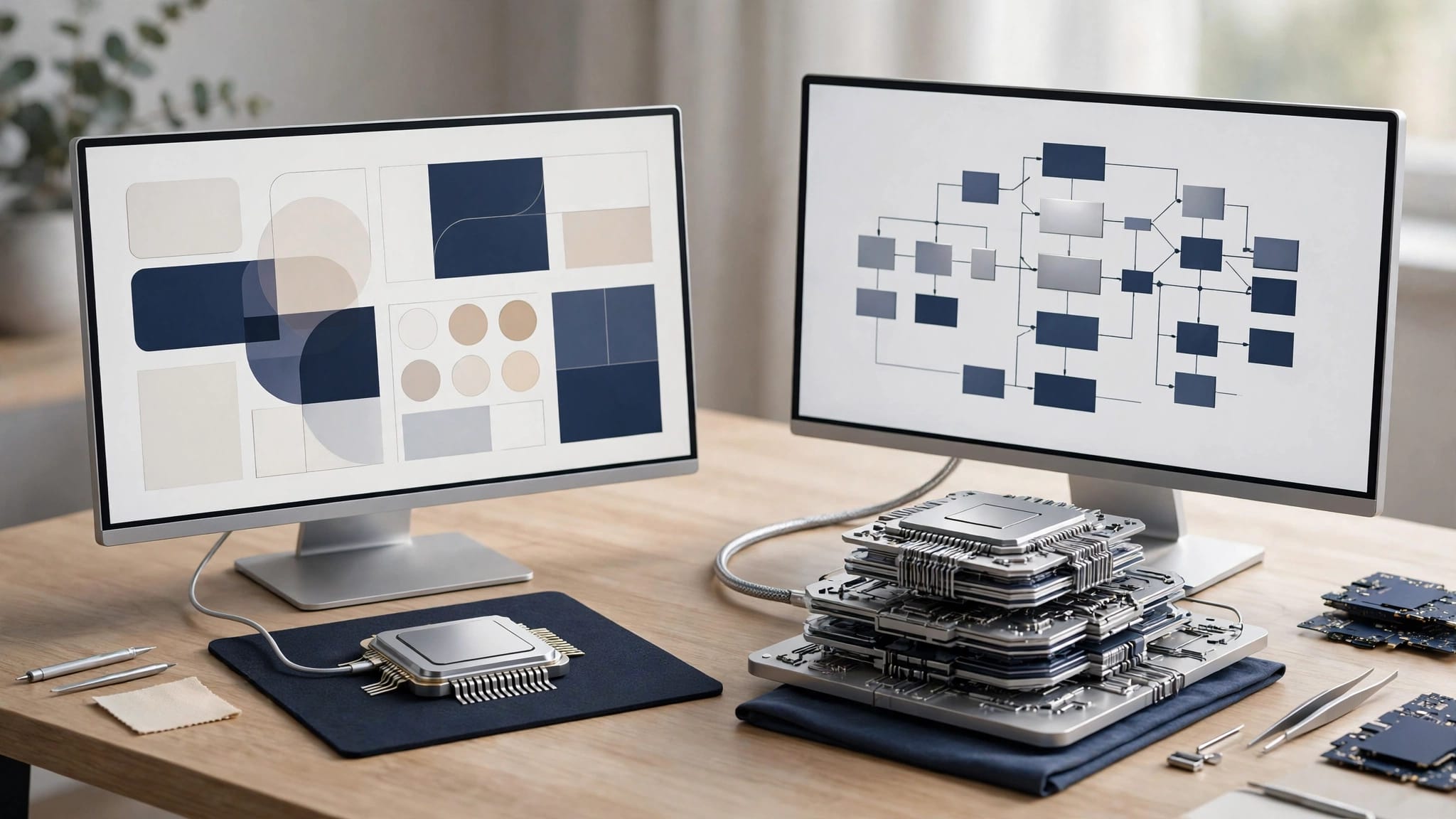
Conceptual illustration of contrasting digital design directions, not screenshots of the tested tools.
Source-Based Websites and Coordinated Research
Gemini Notebook Turns Documents Into a Site
In Wolfe’s Gemini Notebook website demonstration, he supplies collected AI news and requests a website that organizes it.
The result uses a newspaper-style layout with headlines, charts, tables, and filterable sources. Some source websites blocked ingestion, so the notebook didn’t contain every item he initially wanted.
That limitation matters: the polished presentation organizes the material available to the tool. It doesn’t establish that the underlying collection is complete.
Hyperagent Divides an Interview Workflow
The sponsored Hyperagent segment describes a concrete division of work. One agent researches an interview guest, another develops questions, and a third assembles an interview outline.
Wolfe also describes human participation in the shared workspace. That’s a more useful workflow example than a vague promise of virtual employees because each role has a defined output.
The segment is paid promotion, which should remain separate from an independent recommendation. For broader context, our AI agent overview covers the category.
Music and Voice Features Have Different Production Limits
Suno Adds Visual Assets Around Songs
Wolfe describes Suno Visuals as a way to create lyric videos, album artwork, and short video clips around existing songs. Clips can follow song structure and synchronize mouth movement with lyrics.
The workflow has two meaningful constraints in his account: clips have a duration limit, and visual credits are separate from song-generation credits. Creating the music therefore doesn’t cover the entire visual-production budget.
These are visual-production features around audio, rather than evidence of improved composition or sound quality.
Avatar Length Doesn’t Establish Production Readiness
The HeyGen Avatar 6 segment describes talking videos generated from a single photo. Wolfe discusses the company’s realism claims but says he hasn’t personally experimented with the tool.
That distinction limits the conclusion. Long examples can demonstrate continuity, but the segment doesn’t establish pronunciation quality, expressive control, or editing reliability across different projects.
Microsoft’s voice-model discussion is similarly price-focused. It doesn’t include a listening evaluation sufficient to judge naturalness. Neither segment establishes commercial-use rights or voice-consent terms.
Coding Tools Still Need Maintenance and Review
Microsoft’s coding-model pitch centers on simpler development work at a lower cost. Wolfe attributes the performance comparisons to Microsoft and distinguishes that positioning from demanding, long-running projects.
Meanwhile, Google Stitch Loop addresses a different problem: checking generated applications for security, speed, and accessibility issues, then proposing fixes for review. Wolfe describes it as waitlist-only and says he hasn’t tested it.
That makes the distinction between an announced capability and demonstrated reliability important. The segment explains the intended workflow, but it doesn’t show how well the checks catch problems or how much review the proposed fixes require.
Claude Code’s custom desktop themes are a smaller change. Wolfe treats them as interface customization rather than a meaningful productivity improvement.
Smaller Updates Address Specific Workflow Friction
Wolfe describes expanded Claude Duet access with a usage caveat: background activity draws on ordinary Claude limits.
ChatGPT live dictation addresses a simpler inconvenience by displaying words while someone speaks. Meanwhile, the sales-workflow discussion covers prospect research, call preparation, follow-ups, and identifying deals that need attention, with workspace restrictions attached.
The creative roundup also includes interactive world generation. Wolfe describes changing a generated environment through additional prompts while exploring it, alongside generated sound.
These features solve different problems. A dictation improvement reduces input friction; a world-generation demonstration explores a creative interface. Neither needs a sweeping productivity claim to be interesting.
Task Fit Matters More Than a Broad Winner
The strongest thread in Wolfe’s roundup is the effort to deliver useful AI output more efficiently. His demonstrations also show why visual appeal, working mechanics, and workflow completeness need separate evaluation.
I put more weight on those concrete distinctions than on a universal model ranking. For an independent assessment, the boundary remains clear: a promising demonstration is evidence of that demonstration, not proof of dependable performance across an entire production workflow.