

Shopify returns management software handles return requests, labels, item routing, and refunds or exchanges. AI can help with recommendations and analysis, but I would choose a system around workflow reliability before its AI branding.
For a small store, Shopify’s built-in returns tools may be enough. A separate app becomes more useful when policy enforcement, shipping, exchanges, and warehouse coordination create repetitive work.
Start by separating the return workflow you need from the features a vendor wants to sell.
Key Takeaways
- Shopify’s native self-service returns are a starting point for stores with manageable return volumes.
- Compare subscription fees, included requests, overages, labels, and implementation costs separately.
- Exchange recommendations should respect inventory, product compatibility, and customer choice.
- Receipt, inspection, refund, and restocking are separate events. Treating them as interchangeable creates inventory and accounting errors.
My preference is straightforward: automate stable rules first, then add AI where recommendations or unstructured feedback create a measurable opportunity.
What Shopify Returns Management Software Does
The Customer-Facing Return Portal
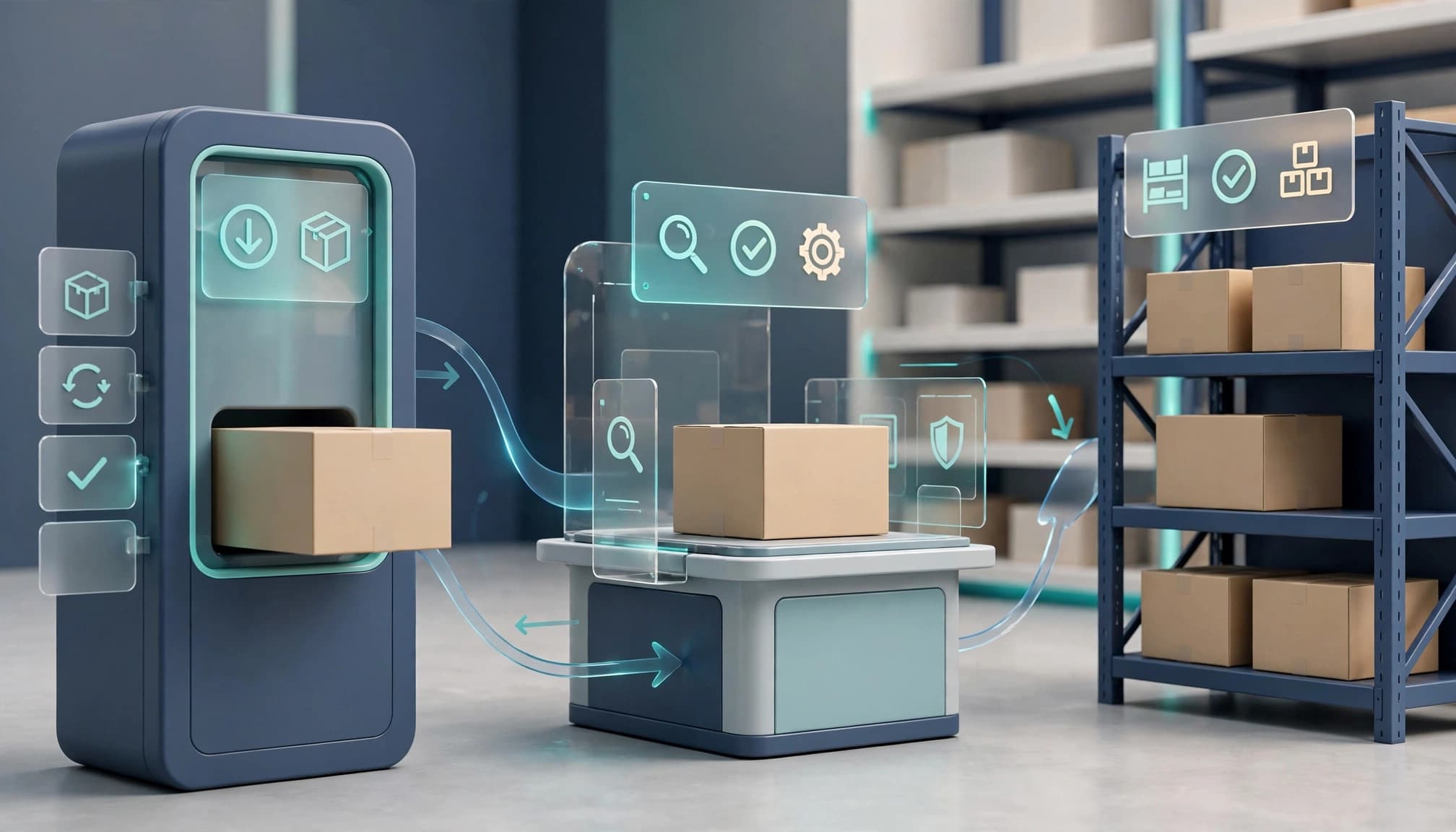
A self-service portal lets customers identify an order, select items, explain the problem, and request a resolution without contacting support. It should show return eligibility before customers submit a request.
The branded portal should match the store and explain eligibility before customers complete a request. A branded portal should also state who pays return shipping and what customers can expect from each resolution.
Behind that interface, returns management software can coordinate return authorizations, return labels, routing, tracking, refunds, and exchanges. The important question is which steps each app executes automatically and which still require staff approval.
A chatbot answering policy questions doesn’t establish that it can perform those actions. My guide to Shopify AI chatbot tools covers that adjacent support workflow.
Shopify’s Built-In Alternative
Shopify’s self-serve returns documentation describes a native process where customers request returns and merchants review them in the admin. After approval, merchants can provide instructions, send labels, and add exchange items.
That makes native returns a reasonable baseline. I wouldn’t add another subscription simply to reproduce a request form.
The stronger justification is a documented improvement in approvals, exchange handling, shipping coordination, or reporting.
Where AI Adds Value to Returns
Exchange Recommendations Need Commercial Controls
AI exchange suggestions can help customers find a suitable replacement. Their usefulness depends on available stock, accurate variant data, and the reason for returning.
A recommendation should account for size, color, price differences, and product eligibility. Suggesting another size when the complaint concerns material quality is poor personalization.
The same discipline applies to Shopify AI personalization tools: recommendations need relevant product data and explicit commercial controls.
I would measure completed exchanges, subsequent returns, and contribution margin. Counting every suggested replacement as retained revenue overstates the result.
Recommendations and Financial Actions Are Different
A model can suggest an exchange without having authority to issue credit, reserve inventory, or process a refund. Those permissions deserve separate evaluation.
For customer money, I favor deterministic eligibility rules, transaction logs, and human review for exceptions. An AI-generated explanation shouldn’t override the published return policy.
Instant store credit can offer a faster resolution when supported by the app. An optional bonus also has a cost. Evaluate it against margin and redemption behavior, rather than counting issued credit as profit.
Customers should still see the refund options available under your policy.
Shopify Returns Apps and Pricing
Pricing deserves more scrutiny than a simple starting-price ranking. Forthroute’s October 2026 comparison supplies detailed figures for several competitors, but those remain secondary reporting.
The table separates that reporting from AfterShip’s directly published pricing.
| Option | Published Price | Included Allowance | Evidence Basis |
|---|---|---|---|
| Forthroute | $0 software cost | Unlimited returns | Provider’s claim |
| Return Prime Grow | $19.99/month | 60 requests; $0.49 per extra | Forthroute comparison |
| ReturnGO Premium | $147/month | 110 returns; $1.25 per extra | Forthroute comparison |
| ReturnGO Pro | $297/month | 300 returns; $0.90 per extra | Forthroute comparison |
| Loop Essential / Advanced | $155 / $340 monthly | Volume limits not established here | Forthroute comparison |
| AfterShip Essentials | Starting at $16/month | 240 returns/year; $0.50 per extra | Official pricing |
| AfterShip Premium | Starting at $99/month | 1,200 returns/year; $1 per extra | Official pricing |
AfterShip’s official pricing uses annual return allowances. Those aren’t monthly allowances, and the advertised starting rates aren’t complete shipping-inclusive quotes.
The secondary comparison also reports Return Prime’s free-install option with five included requests and $0.49 per additional request. It describes Loop Checkout+ as free software with return shipping charged separately.
My takeaway: free installation, free software, and free returns describe different things. None establishes a zero-cost operating model.
What You’ll Pay Beyond the Subscription
A useful budget separates software from transportation and handling.
Return shipping, replacement shipping, packaging, inspection labor, damaged inventory, and exchange incentives can outweigh the app fee. Integration work and staff training also belong in the calculation.
For an existing operation, use actual monthly return requests and carrier invoices. Calculate subscription plus overages, then add shipping and internal handling. Keep request counts separate from returned item counts, since vendors may bill different units.
Feature gates matter too. A lower-priced plan isn’t economical if the workflow requires capabilities sold only on a higher tier.
I would compare the current process and the proposed app using the same measures: cost per completed return, staff handling time, resolution time, and margin after exchanges.
A higher exchange rate can coexist with worse economics when incentives and replacement shipping absorb the retained sale. The financial question is what remains after the customer receives a satisfactory resolution.
Set Return Rules Before Adding Automation
Translate the Policy Into Explicit Conditions
Translate the store’s return rules into explicit conditions: when the return window starts, which products qualify, who pays shipping, and when each resolution becomes available.
For an app with automatic approval rules, eligibility can combine timing, value thresholds, and product exclusions. Before launch, test automatic approval rules with orders just inside and outside those limits. Items tagged Final Sale should follow the published policy, with a review route for damage or fulfillment errors.
Don’t assume a Shopify product tag automatically enforces a rule in every app. The integration must map that tag to the appropriate decision.
Customer-facing wording should explain deadlines, item condition, exclusions, shipping charges, and the trigger for refunds or credit.
Keep Exceptions Reviewable
High-value requests, repeated unusual activity, missing delivery records, and conflicting item details deserve attention. These are review signals, not proof of fraud. Staff review should override automatic approval rules when these signals conflict or key records are missing.
I’d avoid automatic rejection based only on a model-generated risk score. Record the reason for each decision and give staff a way to correct it.
Data access also needs boundaries. Order history and customer details may support eligibility, but that doesn’t justify unrestricted access across unrelated systems.
A useful audit trail connects the request, policy rule, staff override, shipping event, and financial transaction.
How to Install a Returns App on Shopify
Installation is the easy part. The configuration and acceptance test determine whether the workflow is usable.
- Open the app listing. Start in Shopify admin’s Apps area and open the Shopify App Store. Select the returns app and click Install.
- Review access before authorization. Read the requested data access and privacy information. Permissions vary by app; there isn’t a universal list that every returns app requires.
- Configure policy and shipping. Set eligibility, exclusions, resolution options, destinations, and label funding. Distinguish app-purchased labels from shipping charged through your carrier account.
- Publish the returns entry point. Shopify’s current self-serve returns setup instructions use Content > Menus > Footer menu > Add menu item for the customer-accounts link. A third-party app’s branded portal uses its own destination URL.
- Run an end-to-end acceptance test. Use a controlled order to request a return, review eligibility, and approve it. Use return tracking to follow shipping and resolution through inventory and financial records.
The test should also cover an excluded item, an unavailable exchange, and a failed action. Confirm that retrying a request doesn’t produce duplicate labels or refunds.
I wouldn’t treat a portal that opens successfully as evidence that the full return workflow works.
QR Code Returns and Prepaid Labels

With QR code returns, a customer presents a code at a participating location instead of printing and attaching a label. Unlike ordinary printed labels, printerless QR labels let the customer complete drop-off with a code. The service behind that code determines what happens next.
Some workflows still require packaging. Others use a separate box-free collection program. Carrier acceptance, location availability, parcel restrictions, and fees depend on the supported service, not QR technology itself.
Forthroute’s documented QR example concerns eligible UK Evri ParcelShop returns. That example doesn’t establish US availability.
For a US store, check the carrier service and customer geography before choosing QR code returns. Don’t treat printerless returns as a deciding feature until you confirm coverage.
Prepaid return labels need clear funding rules. State whether the merchant covers the cost or deducts a disclosed amount from the resolution.
Connect Warehouses Without Corrupting Inventory
Receipt Doesn’t Mean Ready for Resale
A warehouse management system, or WMS, should distinguish arrival, inspection, and restocking. A third-party logistics provider, or 3PL, may own parts of that process.
Forthroute describes an inbound warehouse-event workflow that uses webhooks to report those events. That documents an integration approach, not confirmed support for every warehouse platform.
My requirement is that an arrival scan mustn’t make an uninspected item available for sale through inventory sync. Financial resolution and physical disposition also need separate records.
Design for Missing and Repeated Events
Webhooks need retry handling, duplicate-event protection, and a visible queue for unresolved failures. Assign ownership when Shopify and warehouse records disagree.
The same requirements apply across online orders and Shopify POS. Shared return windows, approval rules, and inventory treatment are useful goals, but verify WMS integrations with your warehouse system and confirm that the app documents support for the unified workflow.
My approach to AI workflow automation tools favors these recoverable handoffs. An impressive automated path has limited value if staff can’t recover a failed refund or inventory update.
Use Return Analytics to Fix the Cause

Returns are a merchandising problem as well as a support workflow. NRF’s 2025 Retail Returns Landscape estimated that 19.3% of online sales would be returned. That broad benchmark doesn’t establish your store’s category rate.
A useful analytics dashboard connects frequently returned products, variants, stated reasons, and financial impact. Keep the denominator visible: a bestseller may generate many returns but have ordinary return rates relative to sales.
AI can help group free-text explanations. Staff should still inspect the underlying comments before changing size charts, product descriptions, or sourcing decisions.
Separate fit problems from damaged shipments and inaccurate product expectations. Each requires a different response.
For marketing teams, judge acquisition campaigns after returns and incentives. Gross order revenue can flatter a campaign that attracts customers whose expectations the product doesn’t meet.
Which Option Fits Your Store?
Small Stores With Straightforward Returns
I would start with Shopify’s native process when staff can handle requests without a complicated shipping or exchange workflow.
Forthroute’s $0 software claim makes it a budget candidate, but price alone doesn’t establish the required geographic coverage or operational fit.
A small store gains little from paying for advanced automation before it has a repeatable policy and enough volume to justify the maintenance.
Teams Ready for a Dedicated App
AfterShip is my starting shortlist pick for a team that needs a separate returns platform and values directly published pricing. That judgment concerns evaluation clarity, not a claim that it wins every feature comparison.
Return Prime, ReturnGO, and Loop remain candidates where their documented workflows match the operation. I wouldn’t rank them by starting price alone when allowances, feature access, and shipping costs differ.
Frequently Asked Questions
Is AI Necessary for Shopify Returns?
No. Eligibility rules, return requests, labels, and approval queues can operate without AI. I would add AI when product recommendations or unstructured return feedback justify it. A dependable rule-based workflow is preferable to a more expensive system with poorly controlled financial actions.
Which Shopify Returns Apps Have Free Options?
Forthroute advertises $0 software cost for unlimited returns. Forthroute’s comparison reports Return Prime’s five-request free-install allowance with paid overages, and Loop’s Checkout+ free-software option with separate return shipping. These aren’t equivalent plans, and none makes transportation or internal handling free.
Can Returns Software Turn Refunds Into Exchanges?
Yes, when it presents relevant alternatives and can complete the exchange correctly. Stock availability, price differences, shipping charges, and customer consent all matter. Evaluate completed exchanges and their margin rather than counting recommendations, credit offers, or abandoned exchange attempts as revenue retained.
Can a Chatbot Issue Refunds Automatically?
Only if its integration and permissions allow that action. Answering a policy question doesn’t establish refund authority. I would require transaction limits, eligibility checks, audit logs, duplicate protection, and escalation before allowing a support agent to initiate customer financial transactions.
Conclusion
The strongest Shopify returns management software fits your policy, shipping geography, and inventory process. Its AI features deserve credit only when they improve a measurable outcome without weakening control.
Start with the simplest reliable workflow. Pay for additional automation when it removes a documented bottleneck.
My deciding factor is operational fit: customers can complete legitimate returns, staff can resolve exceptions, and the financial records match what happened.