

If you’re trying to plan AI capacity for late 2026, Nvidia Vera Rubin is the name you keep running into. It’s the platform Nvidia is positioning after Blackwell, and it’s not just “a new GPU.” It’s a full stack that pairs Rubin GPUs with the new Vera CPU, faster GPU-to-GPU links, and a networking lineup aimed at rack-scale AI.
I track AI infrastructure because token costs and training time aren’t abstract problems anymore. They decide whether a product ships, whether a model refresh happens this quarter, and whether your budget survives the year. So when Nvidia says Rubin can cut token cost by an order of magnitude, I pay attention.
Who is this review for? AI builders, platform teams, cloud buyers, and researchers who need to map announcements to real purchase plans. As of January 2026, some public facts are clear (platform design, stated specs, and a broad timeline). Street pricing and independent benchmarks may still be limited until real systems are in the wild.
Do you need lower token cost right now, or do you need faster training at rack scale later this year? And are you bottlenecked on compute, memory, or network traffic between GPUs?
What Nvidia Vera Rubin is, and what’s actually shipping in 2026
Nvidia introduced the Vera Rubin platform at CES 2026 as a “six-chip” approach for AI supercomputers, not a single part you swap into an old server. The theme is co-design: CPU, GPU, interconnect, and networking are meant to act like one machine, especially when you scale to racks.
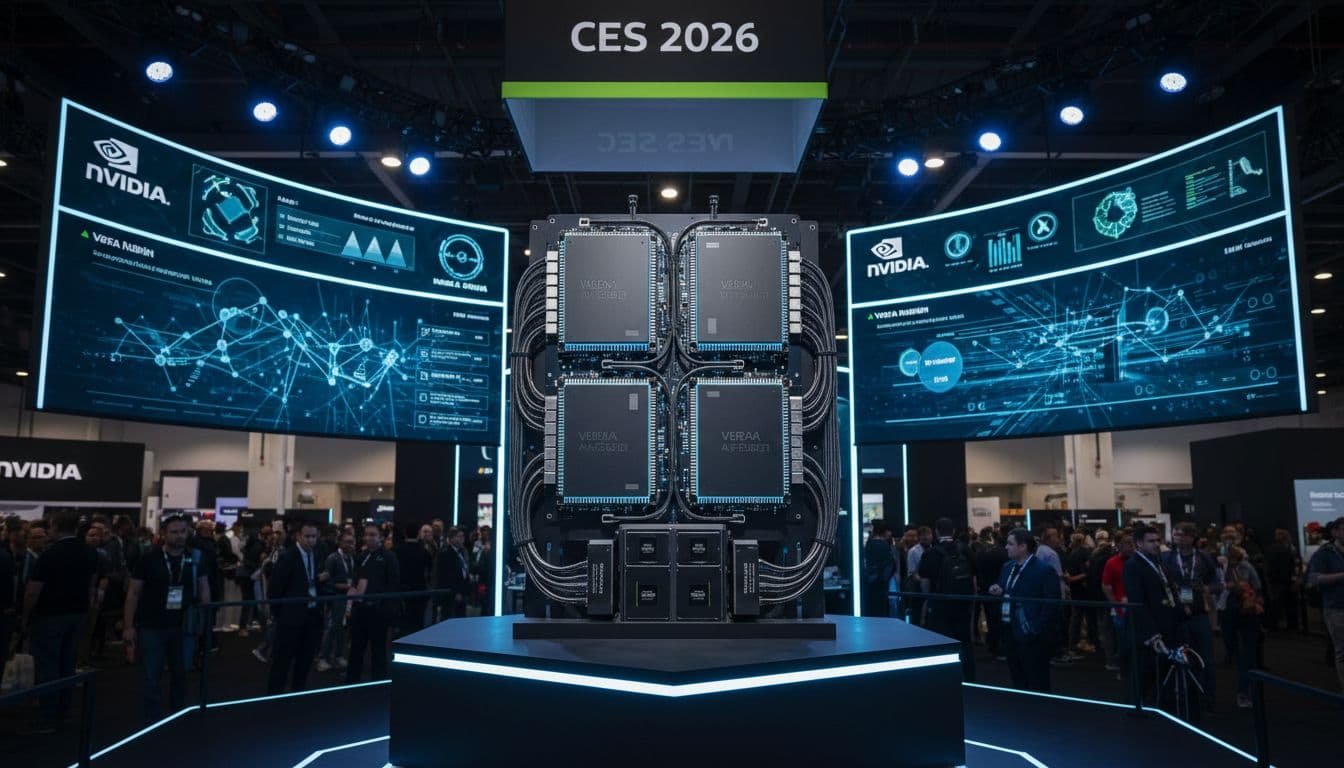 The key timeline point I’m using for planning is this: Nvidia says production and shipping are expected in the second half of 2026, with partner systems following that schedule. For the most grounded source, I start with Nvidia’s own CES announcement and product notes, then I compare it with what system vendors and clouds actually commit to publicly. Here’s Nvidia’s press release that frames the platform and the “why now” story: NVIDIA Kicks Off the Next Generation of AI With Rubin.
What I don’t assume in January 2026: that you can buy racks on demand in Q1 or Q2. There’s usually a gap between “chip exists” and “I can get capacity in my region with my preferred networking.”
Rubin GPU, Vera CPU, and the rack platforms in plain English
Here’s the simplest way I explain it to teammates: Rubin is the engine, Vera is the traffic controller, and NVLink plus the network switches are the highway system between engines.
Rubin GPU (the main event):
- Built on TSMC 3 nm and uses HBM4, which is high-speed memory stacked next to the GPU.
- Public specs include 288 GB of HBM4 and about 22 TB/s of memory bandwidth per GPU.
- Nvidia’s headline inference claim is up to 50 PFLOPS NVFP4 per GPU. NVFP4 is Nvidia’s low-precision format aimed at pushing more inference throughput with acceptable model quality for many workloads.
- NVLink 6 bandwidth is stated at 3.6 TB/s per GPU for GPU-to-GPU traffic.
- Nvidia also describes each Rubin GPU package as using two dies (two compute slices in one package), but you don’t need chiplet vocabulary to plan around it. The practical impact is the platform is built to move data fast enough that the compute doesn’t sit idle.
Vera CPU (the “keep the GPUs fed” piece):
- Arm-based, with 88 custom Olympus cores and 176 threads.
- Nvidia states 1.2 TB/s memory bandwidth and 1.5 TB LPDDR5X memory per CPU, plus 1.8 TB/s NVLink-C2C (chip-to-chip) to talk to the GPUs.
- It also supports PCIe Gen6 and CXL 3.1, and Nvidia highlights confidential computing features for secure workloads.
Rack and server form factors you’ll hear about:
- HGX Rubin NVL8, a common “server building block” style configuration for partners.
- Vera Rubin NVL72, a rack-scale design with 72 GPUs and 36 CPUs, tied together with NVLink 6 and high-speed networking.
- Supporting silicon includes an NVLink 6 switch, ConnectX-9 networking, BlueField-4 DPUs, and Spectrum-6 Ethernet.
Availability and ecosystem, where I expect you will access Rubin first
Most teams won’t touch Rubin first through owned hardware. They’ll touch it through cloud instances or managed GPU providers, because clouds can absorb early supply constraints and offer smaller commitments.
Nvidia has positioned Rubin for the big AI infrastructure buyers, and press coverage points to the usual early pipeline: hyperscalers and large GPU clouds. As one example of how the rollout is being framed publicly, Tom’s Hardware summarizes Nvidia’s CES message as Rubin coming in 2H 2026, with claims around higher inference performance and lower token cost: Nvidia launches Vera Rubin NVL72 AI supercomputer at CES.
Practically, I plan access in three phases:
- Pilot in managed cloud: Run 1 to 3 real workloads and measure cost per token and time-to-train.
- Reserved capacity: Lock in availability windows once region and instance types stabilize.
- Owned hardware: Only if utilization, compliance, and power planning make the math work.
If you’re in a regulated environment, I’d also watch how confidential computing is implemented end-to-end, because Nvidia is explicitly tying Rubin and Vera to that story.
Performance claims that matter, token cost, training scale, and bandwidth
Specs are fun, but the outcomes I care about are boring and expensive:
- Cost per token delivered (not list price, not peak TOPS).
- Wall-clock training time to a target quality.
- Stability at scale, meaning fewer failures and less time spent baby-sitting distributed jobs.
- Ability to run long-context or MoE models without falling apart due to memory and network overhead.
As of January 2026, Nvidia’s stated claims include numbers like:
- Up to 50 PFLOPS NVFP4 inference per Rubin GPU.
- Up to 10x lower inference cost per token compared to Blackwell (as a platform-level message, not a guarantee for every model).
- Rack configurations such as NVL72 (72 GPUs, 36 CPUs) and NVL144 variants, with Nvidia also publishing rack-scale throughput figures.
One detail that’s easy to miss: some of these gains only show up when your workload is limited by data movement. If your current cluster spends a lot of time waiting on GPU-to-GPU transfers, higher compute alone won’t save you. Better interconnect can.
When I want a clean reference for the “what is Vera, exactly?” side, I use Nvidia’s own product page because it includes the CPU’s positioning and feature claims in one place: Next Gen Data Center CPU, NVIDIA Vera CPU.
NVLink 6, why rack-scale bandwidth is the real story
I think NVLink 6 is the headline, even if marketing slides lead with PFLOPS.
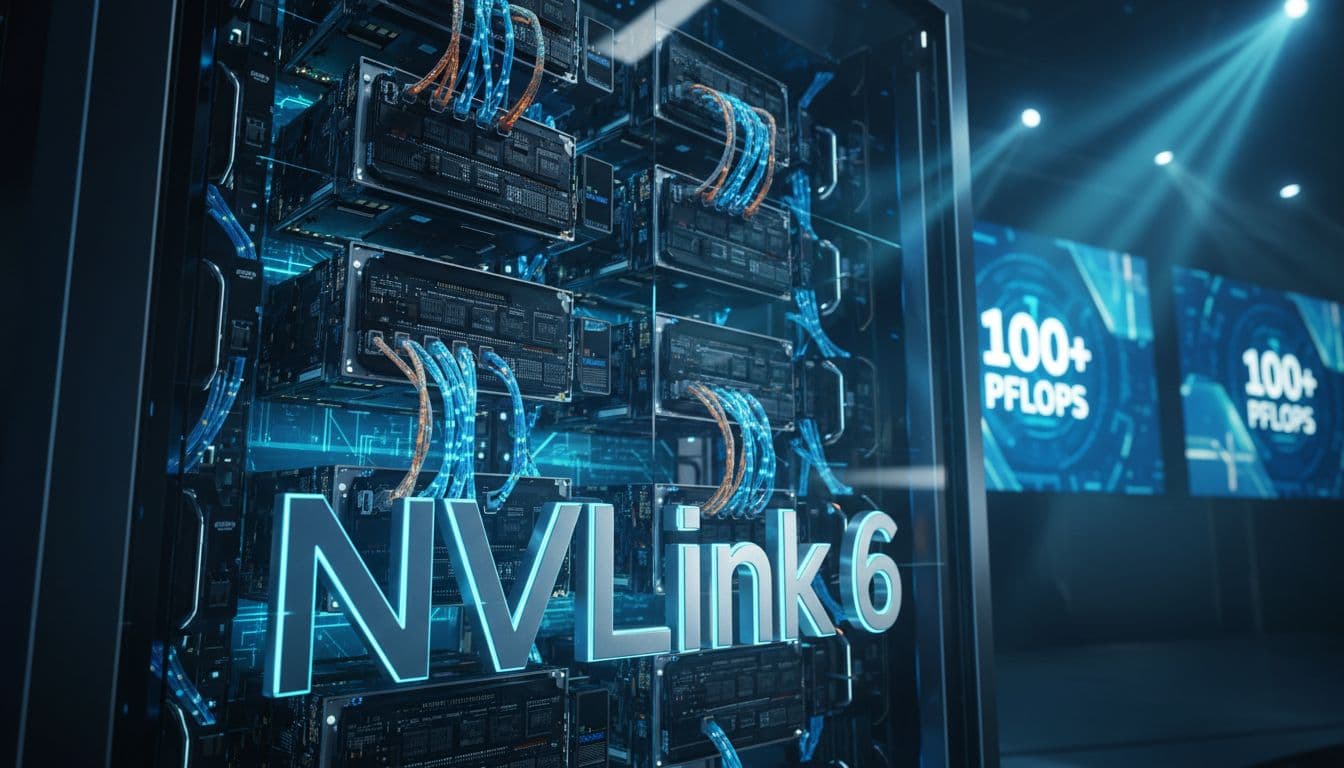 Nvidia’s public figure is 3.6 TB/s of NVLink 6 bandwidth per GPU. At rack scale, Nvidia also talks about extremely large aggregate bandwidth, with NVLink switching built to keep GPU groups coherent and fast.
Why that matters in real life:
- Distributed training: Large models split across many GPUs need constant parameter and activation exchange. Bandwidth and latency decide whether your training run scales cleanly past a node.
- MoE training: Mixture-of-Experts models can turn network traffic into your main bottleneck. If experts sit on different GPUs, you need fast routing and predictable fabric behavior.
- Multi-node inference: When a model is too large for one GPU, you shard it. Sharding is only “cheap” when the interconnect is fast enough that you don’t pay a big latency tax per token.
- Higher utilization: The less time GPUs wait on data, the more your expensive hardware does useful work.
If you’ve ever watched GPU utilization bounce between 35% and 70% during training and wondered why, it’s often the network and memory system, not the GPU math itself.
Rubin CPX and million-token workloads, who should care
Rubin also has a variant Nvidia calls Rubin CPX, positioned for dense compute and long-context style workloads. Nvidia has indicated CPX is targeted for later in 2026, so I treat it as “plan, but don’t bet your Q2 roadmap on it.”
Here’s who should care about CPX style positioning:
- Teams working with very long context (huge codebases, long legal docs, big retrieval packs).
- Video generation and multi-step reasoning systems where intermediate state gets heavy.
- Agent systems that keep a lot of context in play at once, including tool traces and memory.
The simple mental model: when you can keep more state in fast memory, you can reduce how often you page data in and out, and you can batch more intelligently. But it’s not magic. You still need to watch latency, batching strategy, and memory pressure because long context can turn into slow context if you’re not careful.
If Nvidia later provides clearer guidance on how CPX behaves for long-context inference at different batch sizes, that’s where I expect the most useful “real benchmark” conversations to happen.
My take, who should buy, who should wait, and what to ask vendors
I’m optimistic about Rubin, but I’m not blindly bullish. New platforms often ship with a gap between peak claims and what you get on your messy, real workload. The right move is to plan a pilot, define your success metrics, and keep optionality.
Here’s how I’d guide buyers today:
- If you’re a startup renting GPUs: I’d wait for cloud access and test cost per token on your own prompts and traffic patterns. Your win condition is predictable unit economics, not bragging rights.
- If you’re a mid-size team buying reserved capacity: I’d start vendor talks early, then time a pilot for when regions go live. Your win is steady capacity and fewer performance cliffs at scale.
- If you’re building an enterprise AI factory: I’d treat Rubin like a platform transition. Power, cooling, networking choice, and security posture will matter as much as raw throughput.
On procurement calls, I keep a short checklist and I don’t let anyone dodge it:
- Availability window (region, quarter, and realistic ramp).
- Supported frameworks and software stack versions.
- Network choice: Ethernet vs InfiniBand, and what topology they recommend.
- Power draw, rack density, cooling requirements, and facility readiness.
- Confidential computing and how keys, attestation, and isolation work.
- Migration effort from Hopper or Blackwell (drivers, libraries, kernel versions, orchestration).
Pricing still isn’t widely public in a way you can treat as stable. So I compare on total cost per token delivered and expected utilization, not just a per-hour rate card.
Best fit use cases, training, inference, and agentic AI pipelines
If Rubin delivers even a decent chunk of the stated platform gains, I expect the biggest wins in workloads where bandwidth and scale costs dominate:
- MoE training that struggles on interconnect overhead.
- Large-scale inference where cost per token is the entire business model.
- Long-context reasoning where memory and fabric efficiency decide latency.
- Agentic pipelines that are data hungry, including heavy retrieval and tool usage, where the CPU-to-GPU path matters more than people expect.
If I already had solid Blackwell capacity, I wouldn’t rip it out. I’d move the most bandwidth-bound jobs first, the ones where I see poor scaling or big utilization gaps, and I’d keep stable inference on proven hardware until Rubin pricing and performance settle.
Questions I would ask before committing to Rubin capacity
Before I commit to Rubin capacity, I want answers that map to my workloads, not a generic demo. These are the questions I’d bring to any cloud or server vendor:
- When can I get access, and in which cloud regions or data centers?
- What’s the minimum commitment for reserved capacity?
- What do tokens per second and latency look like across batch sizes for my model class?
- What networking topology do you recommend for my scale target?
- Which reliability features are enabled (RAS), and what’s the failure recovery story?
- How is confidential computing implemented across CPU, GPU, and interconnect?
- Which driver, CUDA, and framework versions are required at launch?
- Can we run a proof with my real workload, not a synthetic benchmark?
If a vendor can’t support a real workload test, I treat that as a signal to slow down.
Where I land after watching Rubin’s launch
Nvidia Vera Rubin looks like a platform shift built around rack-scale bandwidth and the promise of lower cost per token, not just a faster GPU spec sheet. The public timeline points to H2 2026 availability for partner systems, with Rubin CPX positioned for later in 2026, especially for long-context and heavy reasoning use cases.
 My advice is simple: decide whether you need Rubin’s scale benefits this year, or whether Blackwell is already enough for your next two model cycles. Then plan a pilot, pick success metrics (token cost, latency, time-to-train, utilization), and make vendors prove it on your workload. If you do that, you’ll buy Rubin for the right reasons, and you’ll know it’s worth it before the first rack hits your floor.