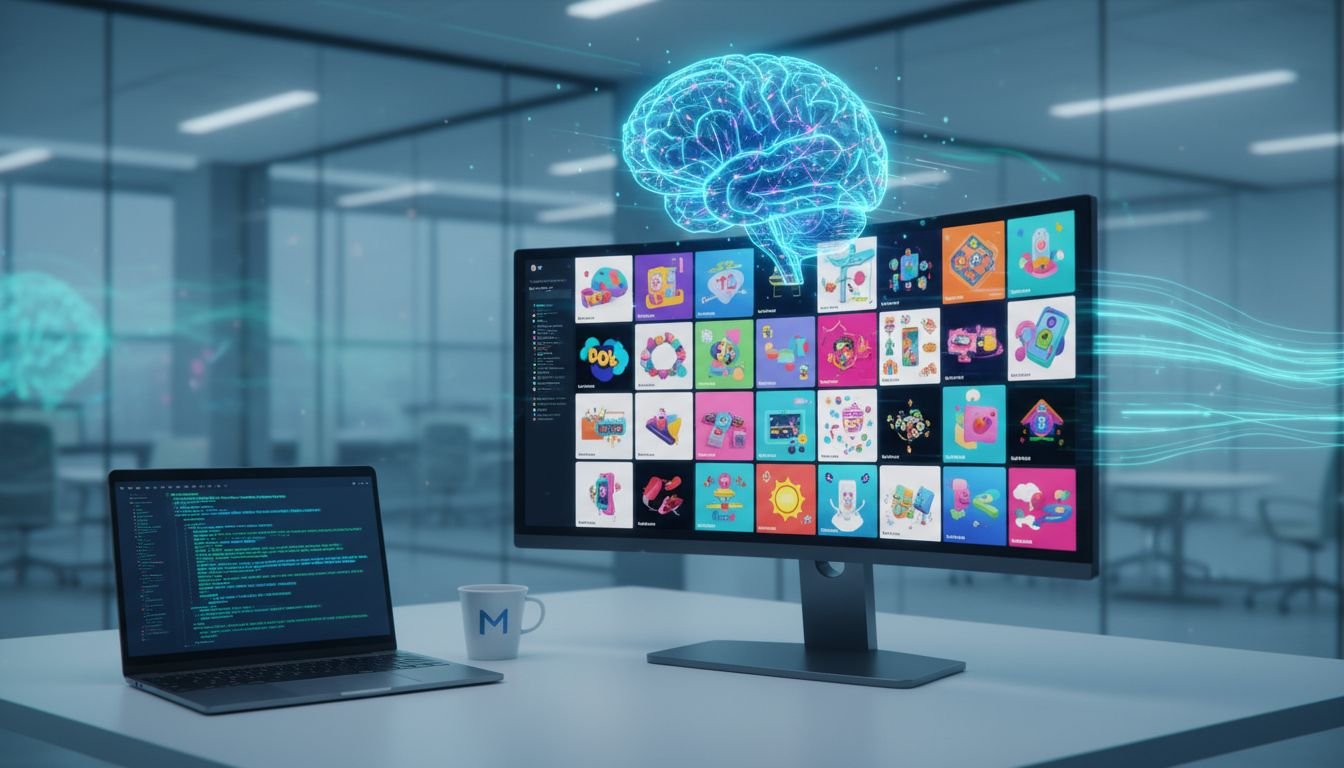
Meta ads still reward the same thing they always have: fresh ad creatives that match the feed. What changed by February 2026 is the pace of social media ads, with speed requirements similar to those in Google Ads. If you wait on a designer for every iteration, you lose weeks to ad fatigue; an AI ad creative generator changes that.
That’s why I treat it as a testing engine, not a magic button. The goal is fast variation, clean brand control, and a workflow that makes it easy to ship the next 20 experiments without lowering quality.
Below is the shortlist I’d use for Facebook and Instagram campaigns in 2026, plus the exact criteria and workflow that keep results grounded in reality.
What I require from an AI ad creative generator for Meta (so it doesn’t waste budget)
Most tools can spit out “an ad.” The problem is that Meta performance usually comes from dozens of small, disciplined changes that produce high-converting ads, not one big concept. So I score tools on how well they support controlled iteration using machine learning.
Here’s what matters in practice:
- Variant throughput with constraints: I want 50 to 200 variants quickly, but inside fixed rules (fonts, ad copy, offers, disclaimers, tone, safe image style).
- Creative built for placements: If a tool can’t handle 9:16 Stories and Reels cleanly, it’s a non-starter. Auto-cropping helps, but I still need manual overrides.
- Asset reuse and templating: The winning workflow is modular. Hooks, proof points, product shots, CTAs, and end cards should be swappable without rebuilding.
- Performance feedback loop: Creative scoring only helps if it connects to what I can measure (thumbstop, CTR, CVR, CPA, ROAS). Otherwise it’s just vibes.
- Governance: For regulated brands, I need audit trails, approval steps, language guardrails, and safeguards for brand identity.
If the tool can’t keep my brand tight while generating volume for the target audience, it will produce “more ads” that fail to drive conversions and still lose money.

The best AI ad creative generator options for Meta Ads in 2026 (my practical shortlist)
I group these by what they actually replace: design production, user-generated content-style video production, or copy iteration and compliance. Some teams need one category, others need two. These tools help beat competitor insights by shipping faster.
Before the table, one quick context link: vendors keep pushing “agent” style ad creation. I don’t rely on vendor claims, but it’s useful to see how the category is positioning itself, for example in AdStellar’s overview of AI-powered ad creation tools.
Quick comparison (what each tool is best at)
| Tool | Best for Meta ads | Outputs | Where it fits in a real workflow | Main trade-off |
|---|---|---|---|---|
| AdCreative.ai | High-volume testing of ad creatives | Ad banners, static images plus copy variants | Rapid creative sprints for prospecting and retargeting | Can drift into generic patterns without strong inputs |
| Creatify | UGC-style product video ads | Short video ads from product inputs via AI video generator | Fast video angles for Reels and Stories | You still need taste to avoid “samey” UGC |
| Zeely.ai | Speed for small teams | Quick statics and UGC-style video ads | Solo operator or small e-commerce brands that needs output today | Less control than enterprise stacks |
| Smartly.io | Enterprise creative automation | Template-driven ad creatives at scale | Marketing agencies managing many SKUs, markets, or segments | Premium complexity and cost |
| Persado | Regulated, performance-driven ad copy | Message variants with guardrails | Copy experimentation when compliance is a bottleneck | Overkill if you just need casual DTC copy |
| Copy.ai | Fast ad copy angles for testing | Ad copy (hooks, primary text, headlines) via text generator | Filling the copy matrix for Meta tests | Needs human editing for specificity and claims |
Where each one wins (and when I’d avoid it)
AdCreative.ai is the tool I reach for when I need volume and structured testing. It’s most useful when the “idea” is already clear and I’m iterating formats, offers, and hooks.
Creatify is the fastest way I’ve seen teams turn product inputs into multiple short video ads. It’s not a substitute for a real creative strategy, but it’s a strong way to produce enough shots to find a winner for Reels.
Zeely.ai fits the “I need decent ads tonight” use case. For smaller US e-commerce brands, speed sometimes beats polish, as long as you keep your claims tight and your landing page does the heavy lifting.
Smartly.io is the most complete option in this list for creative operations, especially if you need templating, personalization, and workflow control across channels. My hands-on notes are in my Smartly.io review for creative automation and Meta ad iteration. I like it when the problem is scale, not ideation.
Persado is where I go when copy needs to be both experimental and defensible. In regulated categories, the real cost is review cycles, not writing time. My take is in this Persado AI review focused on compliant, high-control messaging.
Copy.ai is a practical copy workhorse for Meta testing. It’s strongest when you need breadth fast (angles, pain points, CTAs) and you’ll refine after. I broke down the strengths and limitations in my Copy.ai review for ad and campaign copy workflows.
The workflow I use to turn AI outputs into Meta winners (without flooding the account)
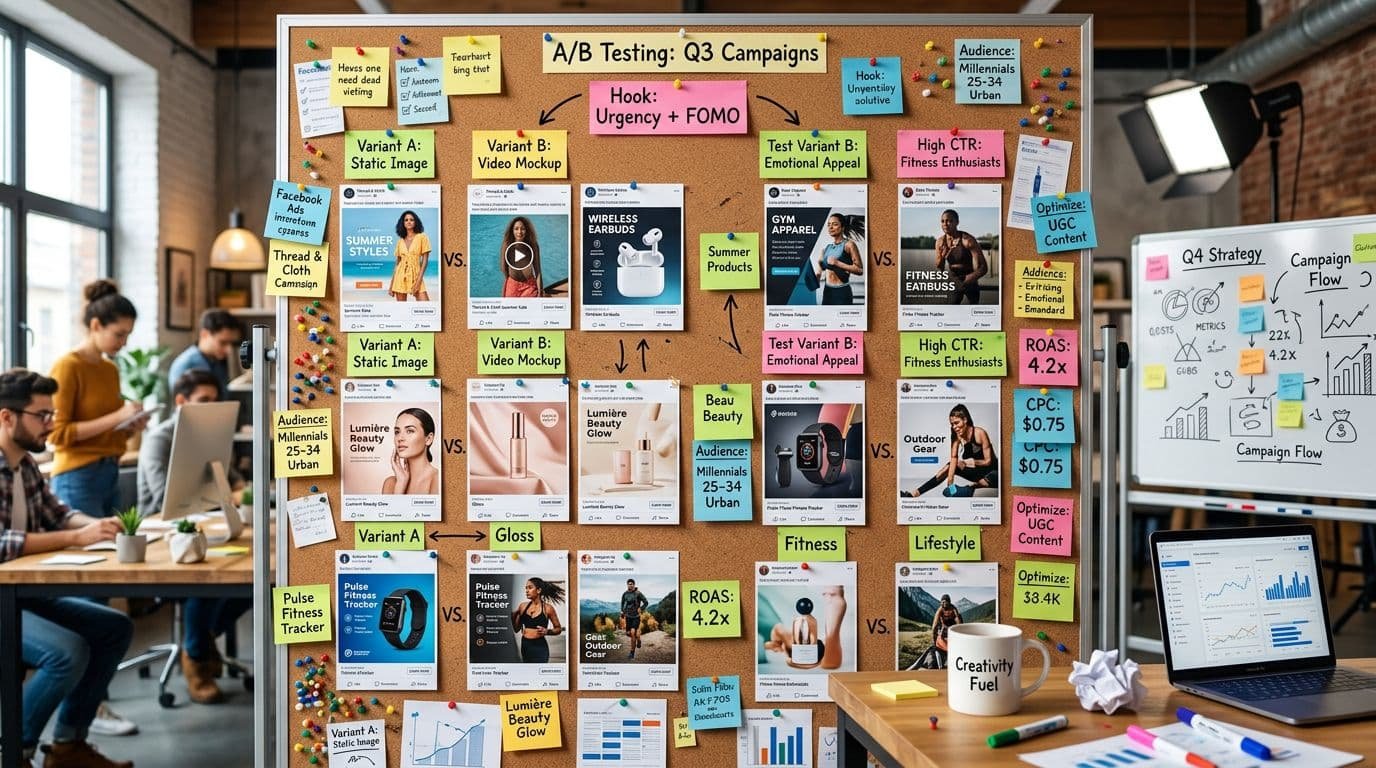
The most common failure mode I see is teams generating 200 creatives and testing them with no structure. Meta doesn’t reward chaos. It rewards consistent inputs and fast learning.
This is the marketing strategy I use:
- Lock the test variable for A/B testing: I decide what changes and what stays fixed. Example: same offer and landing page, new hooks only.
- Build a creative matrix: Tailor it to buyer personas using product photography as a base asset, modularized with 5 hooks, 3 proof points, 3 CTAs, 2 formats (static and 9:16 video). That is 90 combinations on paper, before design polish.
- Generate, then filter hard: I use the AI ad creative generator for breadth, then I delete anything that isn’t on-brand content, unclear, or risky.
- Export in placement-first formats: 1:1 and 4:5 for feed, 9:16 for Stories and Reels, with safe margins for UI overlays.
- Test with tight budgets and clean naming: I keep names consistent so I can trace winners back to a hook or concept.
- Promote winners, rebuild losers: When a hook wins and delivers strong ROI and ROAS, I don’t just scale spend, I rebuild it into 10 new executions.
Two practical US-focused examples:
- For a DTC brand, I’ll run “problem aware” hooks in cold traffic, then shift to proof-heavy ad creatives in retargeting.
- For lead gen, I keep copy short and push the real detail into the landing page, because long primary text often gets skipped.
FAQ: AI ad creative generators for Meta Ads in 2026
What’s the best AI ad creative generator for Meta if I need volume fast?
If the goal is fast static iteration, AdCreative.ai is built for high output, faster than many Google Ads generators. Still, you’ll get better results if you bring a clear offer and audience insight.
Can AI generate Meta-compliant ads for regulated industries?
It can help, but you need guardrails. Tools that focus on controlled ad copy and review workflows (not just “write me an ad”) reduce risk.
Should I use one tool or multiple?
I usually pick one primary platform, then add a specialist only when a bottleneck appears (for example, UGC video volume or compliance review delays). Marketing agencies manage multiple clients this way for efficient scaling.
Will AI replace designers for Meta ads in 2026?
No. AI reduces production friction, including videos with AI actors. Humans still set the concept, select winners, and keep brand quality high.
What I’d pick first for your 2026 Meta creative stack
If you’re a small team, I’d start with one AI ad creative generator that aligns with your campaign goals and biggest constraint (static volume, video volume, or copy volume), so you can move away from generic stock images in favor of generated, custom assets. Then I’d build a repeatable testing loop, with conversions as the primary metric to watch, before buying anything else. Process beats tool count every time, delivering high-converting ads.