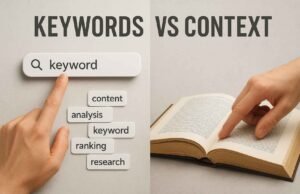

Most AI copy goes off-brand for a simple reason: the model was never taught what “sound like us” means in usable terms. Teams upload a style guide, add a prompt, and expect a reliable AI brand voice. What they get is clean, generic copy that could belong to any US software company.
I don’t treat voice training as a prompt trick. I treat it as an editorial system. If the source material, rules, and review process are weak, the model will drift. If they’re solid, AI writers get faster without flattening the brand.
Start with evidence, not adjectives
The first mistake I see is vague voice guidance.
“Friendly.” “Trusted.” “Bold.” “Human.” None of that is trainable on its own. A model can’t infer how much certainty you use, how long your sentences run, whether you lead with opinion or evidence, or how often you use contractions.
What works is behavioral detail. I document patterns the model can imitate:
- how we open
- how much context we give before advice
- what claims need support
- whether we sound more operator than cheerleader
- which phrases are banned because they make us sound generic
If a new writer couldn’t use the document to sound like your team on day one, the model won’t be able to use it either.
That’s why I build a voice brief from real copy, not from branding language. The best brief looks more like an editorial operating manual than a marketing statement. That view lines up with this framework for training AI on brand voice, which makes the same core point in different words: the bottleneck is often documentation, not model quality.
I also separate brand voice from channel rules. A homepage, product email, knowledge-base article, and executive LinkedIn post should not all sound identical. The voice should feel related, but the sentence patterns and content constraints can change by format.
Most AI writing tools explained can produce grammatical copy. Grammar isn’t the hard part. The hard part is getting the model to make the same choices your best editor would make.
When I train AI writers, I start with a simple question: what does my team do on the page, over and over, when the writing is at its best? That’s the material worth training on.
Pick the training method that fits the job
I use three layers for brand voice work: prompt design, retrieval, and model tuning. The right one depends on risk, scale, and how often your source material changes.
This quick comparison is how I frame the trade-off.
| Method | Cost and setup | Consistency | Best use case | Main limitation |
|---|---|---|---|---|
| Prompt engineering | Low | Medium | Emails, social posts, rough drafts | The model forgets under longer or more complex tasks |
| Custom GPT or RAG | Medium | High | Daily marketing content, sales enablement, support content | Needs clean source docs and ongoing upkeep |
| Fine-tuning or PEFT | High | Very high | High-volume, high-risk, repeatable content operations | Takes more data, testing, and technical support |
The most practical setup in 2026 is usually hybrid. I use prompts for task framing, retrieval for brand rules and factual context, and tuning only when output volume or compliance pressure makes it worth the cost.
Use prompting for quick wins
Prompting is the fastest start. It’s also the easiest place to overestimate progress.
A good prompt does more than describe tone. I give the model role, audience, objective, structure, approved terminology, banned phrases, and a few strong examples. Few-shot examples still matter because they show the model how the voice behaves under a real assignment.
If you’re still comparing platforms before you build that layer, my guide to the best AI content writing tools in 2025 is a good starting point.
Still, prompting has a limit. The longer the output, the more chances the model has to slip back into default assistant language. That’s why I don’t trust prompts alone for landing pages, case studies, or executive messaging.
Use RAG or custom workspaces for daily production
Retrieval-augmented generation, or RAG, is often the best middle ground. Instead of asking the model to “remember” your brand, you let it pull from approved documents at generation time.
That matters when the brand rules evolve or the content needs live product context. A style guide in a folder doesn’t help much if the model never sees it. A retrieval layer does. Search Engine Land’s guide on training in-house LLMs for brand voice makes a practical case for this approach, especially for teams that need brand control without full model retraining.
In practice, I use retrieval for voice rules, messaging pillars, product facts, claim boundaries, and examples of approved writing. That reduces both drift and invented details.
Platforms with persistent brand settings can also cut repetition. I’ve seen that in products that support saved voice profiles and reusable guidance, which is part of what I looked at in this Jasper AI brand voice review.
Fine-tune only when the workflow justifies it
Fine-tuning sounds attractive because it promises deeper consistency. Sometimes that promise is real. Sometimes it’s overkill.
I consider fine-tuning, or lighter PEFT methods, when a team produces a lot of similar content, needs tighter control, and has enough approved data to train on. Think large sales teams, customer support agents, or a content operation with strong editorial governance.
The catch is data quality. Fine-tuning on mixed or weak content simply teaches the model bad habits at scale. That’s why I like Datawhistl’s breakdown of model fine-tuning for marketing AI as a framing device. It separates prompt design from actual model customization, which many teams blur together.
Build a training set the model can trust
The model learns your patterns from examples. If the examples are average, outdated, or inconsistent, the output will be too.

I like to start with 20 to 30 approved pieces for a first pass. Not “published” pieces, approved pieces. Those are different. A lot of published copy exists because deadlines won. That doesn’t make it training-worthy.
My baseline filter is simple. Each sample should be recent, representative, and good enough that I’d hand it to a new hire as an example. Then I tag it by use case: blog post, landing page, sales email, nurture email, ad copy, help center, founder post.
That tagging matters because voice is not one flat layer. A cybersecurity vendor can sound direct and skeptical on a blog, careful on a pricing page, and warmer in onboarding email. I don’t want the model blending those into one muddy middle.
I also collect negative examples. These are outputs that look competent but miss the mark. Maybe they’re too chirpy. Maybe they overstate the claim. Maybe they use filler phrases no one on the team would ever write. Negative examples are useful because they teach boundary, not only style.
One more thing, I remove junk before training. Old positioning, outdated product names, obsolete features, and SEO-era filler all need to go. If your archive still contains low-value content written for search engines five years ago, don’t feed it to the system and hope for better behavior.
Turn voice into operating rules
Good samples matter, but examples alone aren’t enough. I want the model to know what to copy, what to avoid, and how to check itself before it responds.

My voice brief usually has five parts.
First, I define editorial posture. Are we teacher, operator, analyst, or advocate? That choice affects certainty, pacing, and how much opinion belongs in the draft.
Second, I document sentence and structure patterns. Do we prefer short paragraphs? Do we lead with the answer? Do we use lists often, or only when the content calls for them? Does each section need a clear takeaway?
Third, I set vocabulary rules. This includes approved terms, terms we avoid, how we refer to the customer, and how technical we get before we add explanation.
Fourth, I add refusal rules. These matter more than teams expect. I tell the model what it must not do: inflate claims, invent statistics, write in hype language, or use banned transitions and canned closers.
Fifth, I attach examples. A rule without examples is easy to misread.
This is also where I add an exclusion list. If the model keeps falling into lines you’d never publish, write them down and ban them. The 2026 best practice here is simple: refine based on patterns, not one-off mistakes. If the system misses the same way three times, change the rules or the training set.
When I build prompts on top of this, I don’t ask for “a blog post in our tone.” I ask for a draft that follows the brief, uses the approved claims, avoids the banned language, and self-checks against the rubric before returning copy.
Test the AI like an editor, not a fan
A lot of teams stop at “this sounds pretty close.” I don’t.

I test AI brand voice output the same way I’d test a new writer. I give it repeat assignments, compare drafts side by side, and score them against a fixed rubric. One strong result doesn’t tell me much. Five similar results do.
My rubric is usually short:
- brand match
- factual accuracy
- structural fit
- clarity
- claim discipline
- rewrite effort
“Rewrite effort” is the metric many teams ignore. If the draft sounds good but still needs heavy line editing, the system isn’t trained well enough yet. Speed without trust doesn’t save much time.
I also run edge-case tests. Give the model a topic with limited source material. Ask for a high-stakes page, then a low-stakes social post. Ask for a contrarian opinion piece, then a neutral support answer. Voice systems often hold up in one lane and collapse in another.
For launch, I keep a human in the loop. Always. The review burden can shrink over time, but it shouldn’t disappear until the failure rate is low and well understood.
What I want is not “AI that sounds human.” That’s too loose. I want AI that sounds like my team under real constraints, with predictable limits and a clear correction path when it misses.
Where teams usually lose control
Most failures come from process, not from model intelligence.
Here are the patterns I watch for:
- The training set includes mediocre content because no one wanted to judge the archive.
- One prompt is forced across every channel, even when the audience and stakes are different.
- The team documents tone but skips banned phrases, weak claims, and other failure modes.
- No single owner updates the brief when messaging, products, or compliance rules change.
- Success is measured by output speed, not by edit time or publish quality.
I also see teams confuse tool choice with brand control. The model matters. The workflow matters more. A weaker model with clean rules and strong review often beats a stronger model with messy inputs.
That’s why I keep the system simple enough to maintain. If the brief is too long to use, the team will ignore it. If the evaluation rubric is too loose, quality will drift. If nobody owns updates, the AI brand voice will slowly become a copy of old content and stale positioning.
What I won’t scale without
The fastest way to get generic AI writing is to skip the boring part. Document the voice loosely, dump in random examples, and hope the model figures it out. It won’t.
What works is a system: approved samples, negative examples, operating rules, the right training method, and an editor-grade test loop. That’s what keeps an AI writer from sounding like everyone else.
When the model misses, I don’t ask for more magic in the prompt. I go back to the source material and the rubric. That’s usually where the real fix lives.
FAQ
How many samples do I need to train AI on brand voice?
For a practical starting point, I like 20 to 30 approved examples. That’s enough to identify repeatable patterns and build a usable brief. If you’re fine-tuning a model, you’ll need far more than that, and the quality bar has to stay high.
Is prompt engineering enough for brand voice control?
Sometimes, yes. For low-risk tasks like social posts, internal drafts, or quick email variations, good prompts can get close. For long-form content, product pages, or executive messaging, I usually want retrieval, saved brand guidance, or both.
What’s the difference between RAG and fine-tuning for AI brand voice?
RAG pulls the right brand documents and examples at the moment the model writes. Fine-tuning changes how the model itself behaves based on training data. I use RAG when the brand or product facts change often, and fine-tuning only when scale and consistency demands are high enough to justify it.
Who should own brand voice QA?
One person or one small editorial group should own it. If everyone can edit the rules, nobody owns drift. Marketing, content ops, or brand editorial usually makes the most sense, depending on how your team is structured.