
The biggest technology companies are preparing to spend more than $1 trillion on artificial intelligence across 2025 and 2026, according to the Reuters reporting cited in the original analysis. Companies such as Microsoft, Alphabet, and Meta describe these historic capital expenditures as foundational investments in enterprise digital transformation. A separate Reuters estimate suggests that Microsoft, Alphabet, Amazon, Meta, and Oracle could spend around $1.57 in additional capital expenditure for every $1 of additional operating cash flow by 2027.
Add NVIDIA, Chinese laboratories, xAI, IBM, Liquid AI, Netflix, Databricks, and the growing market around reinforcement-learning environments, synthetic data, model evaluation, and post-training, and one question becomes difficult to avoid:
How will all of this spending eventually produce a sustainable return on investment?
There are plenty of answers circulating online. Some forecasts place the future AI market at $30 trillion or more. Other commentators, including Ed Zitron and Gary Marcus, have argued that the current boom resembles a bubble that will eventually collapse.
I think both positions miss the more useful question.
There isn’t one “AI model industry” with a single template. Companies are pursuing fundamentally divergent AI business models, each with distinct risk tolerances and revenue paths. Their preferred customers and definitions of success aren’t the same.
The usual industry map doesn’t always help. We often place companies into categories such as model providers, application companies, cloud platforms, or infrastructure businesses. That classification becomes awkward when one company operates in several of those layers at once.
Google is a model company, a search company, an advertising business, a cloud provider, a mobile platform, and an enterprise software vendor. Microsoft operates across cloud infrastructure, productivity software, developer tools, business applications, and consumer products. NVIDIA sells hardware, software, development tools, and cloud access. OpenAI is building consumer products, enterprise tools, developer infrastructure, advertising, commerce, devices, and chips.
The category boundaries are already blurred.
A better way to understand the market is to examine what each company wants to make cheaper, what dependency it wants to create, and where it expects to collect revenue once that dependency exists.
This article uses a six-part business model framework to evaluate the primary commercial AI strategies of major model makers. Chinese laboratories are excluded from the main comparison because state support and domestic market conditions give them a different set of incentives.
Many companies are pursuing more than one strategy. Even so, sales priorities, product decisions, infrastructure investments, and distribution choices usually reveal which direction matters most.
Key Takeaways
- There is no single AI business model. Major companies are pursuing different profit pools based on what they make cheaper, which dependencies they create, and where they expect to capture value.
- Established technology companies such as IBM, Google, Microsoft, and Amazon use AI to strengthen broader cloud, software, data, and enterprise ecosystems, while Mistral, Cohere, and Databricks focus on fitting intelligence into customers’ existing environments.
- Anthropic is positioning Claude as premium labour that completes valuable knowledge work, whereas OpenAI and xAI want intelligence distributed across communication, software, commerce, devices, and everyday interactions.
- NVIDIA and AMD benefit when more companies build and run AI systems, while Meta can use open models to reduce the cost of intelligence and strengthen advertising, social platforms, commerce, devices, and internal operations.
- The most valuable AI companies may not be the ones selling the strongest models. Long-term value is more likely to accrue to businesses that control sticky workflows, proprietary distribution, transactions, cloud relationships, devices, or the hardware used to run AI.
Six AI business models across three groups
The six AI business models can be organised into three larger groups within this business model framework.
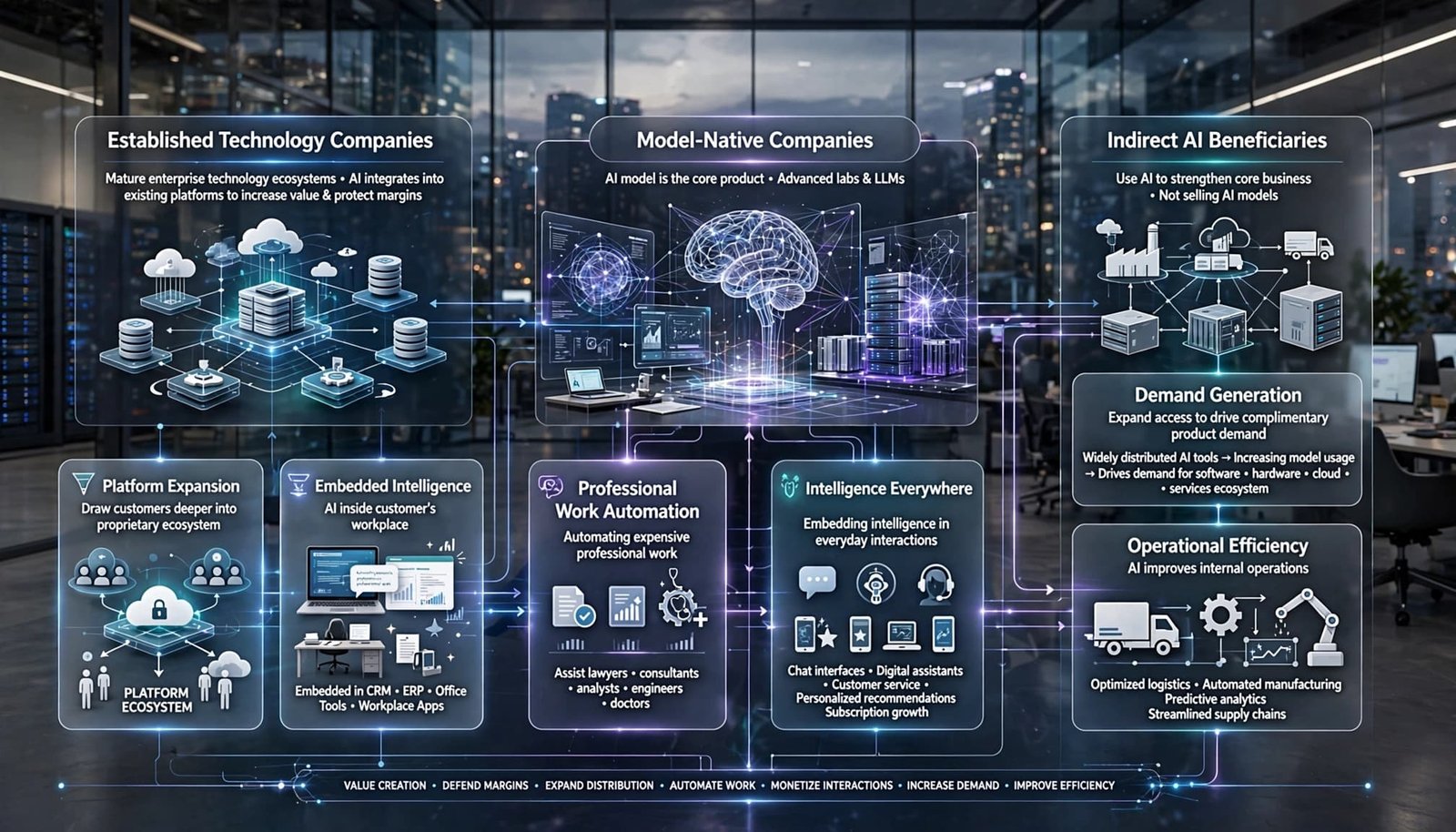
The first group contains established technology companies that built valuable software, infrastructure, and data ecosystems before large language models became popular. They use AI to make those ecosystems more valuable and defend lucrative gross margins.
The difference inside this group is where the customer is expected to move. One strategy tries to bring the customer further into the company’s own platform. The other tries to place the company’s intelligence inside the customer’s existing environment.
The second group consists of model-native companies. The model is the main product they’re known for, rather than an additional feature inside a larger business.
These companies split into two camps. One wants AI to take over increasingly expensive pieces of professional work. The other wants intelligence to appear in as many interactions as possible, then find ways to monetise those interactions.
The third group doesn’t need to make most of its money from selling models. One strategy is to make models more widely used so that demand for another product increases. The other deploys models internally to improve operational efficiency.
Those two approaches can coexist inside the same company because they don’t depend on the same customer decision.
The key lesson is simple:
There is no universal AI business model. The important question isn’t which company has the smartest model. It’s what each company wants to make cheap, what dependency it wants to establish, and where the true locus of value creation sits when it charges for access later.
Strategy one: use intelligence to pull customers into the stack
Before ChatGPT, AI was often treated as a feature inside a broader enterprise or cloud strategy.

IBM built Watson into healthcare, analytics, financial services, the Internet of Things, and consulting. Google worked on systems such as LaMDA and MUM to improve Search and Assistant. Microsoft used AI in products such as GitHub Copilot, Microsoft 365, and Azure.
These companies had impressive research programmes long before the public had a general-purpose chatbot. That doesn’t mean they failed to understand what conversational AI could become. Their commercial incentives were different.
For most of the industry, AI wasn’t supposed to be the product. It was supposed to support broader digital transformation programmes and make existing products easier to sell.
There was limited demand for standalone model APIs before ChatGPT. Cloud infrastructure, enterprise software, consulting, data platforms, and managed services were already large businesses. AI teams were often expected to improve those businesses rather than create a separate commercial channel.
The unit of value was different.
OpenAI had to create a new market for direct access to general-purpose intelligence. Google, Microsoft, IBM, and Amazon could use AI to increase the value of products that already had customers, contracts, distribution, and sales teams.
IBM remains a useful example.
Watson was never designed primarily as a mass-market chatbot. IBM packaged AI into enterprise offerings, automation services, and consulting while using it to deepen relationships with IBM Cloud, Red Hat, software, and consulting. That combination lets enterprise vendors capture larger lifetime contracts. In its 2016 annual report, IBM described the company as both a cognitive solutions business and a cloud platform company:
That logic remains visible in IBM’s current model strategy. Its Granite models focus on smaller and more efficient systems designed for enterprise deployment, rather than competing for consumer attention with the largest general-purpose models.
IBM has also used open-source releases to build credibility around surrounding products. Its Docling document-processing system is a good example. The open-source project attracts developers and establishes technical credibility, while IBM can sell managed document processing through watsonx:
This explains why IBM can release models and tools without treating the model itself as the entire business. The model helps open the door. The larger commercial opportunity may sit in deployment, governance, cloud infrastructure, data integration, Red Hat, and consulting.
Google has followed a similar pattern for years.
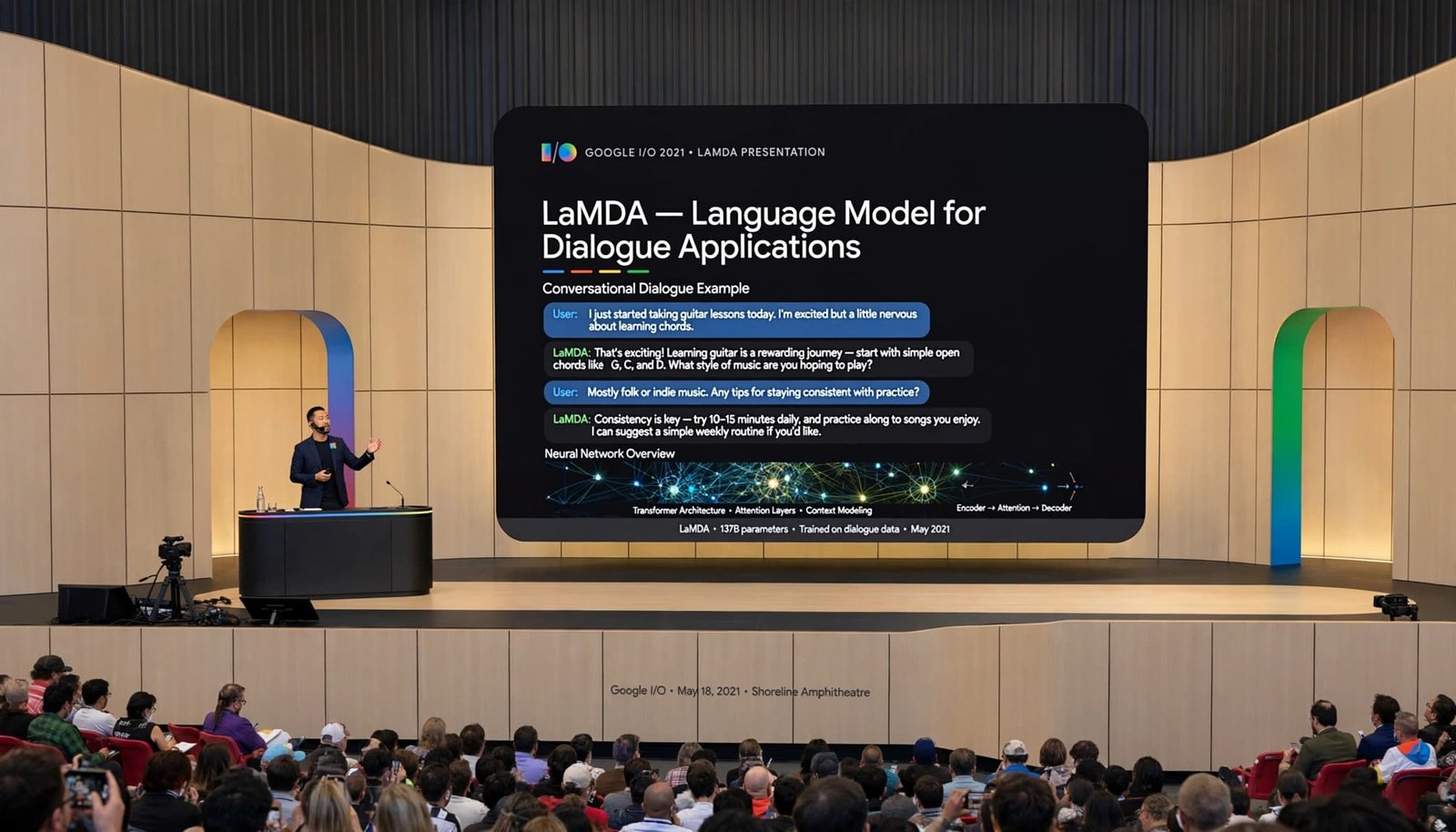
When Google presented LaMDA in 2021, the company discussed conversational technology in the context of Search and Assistant. MUM was designed to help Search understand information across different formats, including text and images.
The assumption was not that users would abandon Google’s products and spend their entire day talking to a model. The model was supposed to operate behind the products Google already owned.
Gemini is now available as a standalone product, but it also supports Google’s efforts to connect users to Workspace, Search, Android, and Google Cloud.
I have seen this pattern in practice through API usage at Irys. As our use of Gemini increased, Google began discussing whether more of our infrastructure should move to Google Cloud. From Google’s perspective, that is the ideal outcome. Selling standalone AI-as-a-service endpoints may generate revenue, but it also creates a top-of-funnel route to high-margin compute and cloud data infrastructure.
Microsoft and Amazon are pursuing related strategies.
Microsoft can embed AI directly into software-as-a-service suites such as Microsoft 365, protecting high-margin subscription gross margins from platform commoditization. It can also use AI to make Azure, GitHub, and its business software harder to replace. Amazon’s Nova models give organisations another reason to train, customise, and deploy within AWS. With Nova Forge, customers can start with Amazon model checkpoints, add their own data, and build customised models without leaving AWS.
The commercial logic is not simply “sell model access”. It is:
Make intelligence useful enough that customers eventually buy more of the ecosystem around it.
That may include cloud storage, compute, security controls, data platforms, developer tools, business applications, consulting, and long-term contracts.
Strategy two: place intelligence inside the customer’s environment
At first glance, this may look like a minor variation of the previous strategy. It isn’t.
The first group wants customers to move into its stack. This group wants its models to work inside the customer’s existing stack.
Google would prefer an organisation to adopt Gemini, then Vertex AI, then BigQuery, followed by more Google Cloud services. IBM may take a more service-heavy approach, but it still benefits when customers move further into its integrated environment.
The assumption is that AI becomes more useful when the surrounding infrastructure is centralised and controlled by one provider.
Mistral, Cohere, and Databricks make a different bet. They assume that many organisations, especially banks, government departments, healthcare providers, and large industrial companies, won’t reorganise their entire technology estate around a new AI vendor.
These customers already have data stores, identity systems, security rules, internal networks, permissions, compliance requirements, and legacy infrastructure. Organisations pursuing digital transformation also can’t always send sensitive assets through multi-tenant public APIs. A model that fits those conditions may be more attractive than a marginally more capable model that requires sensitive information to leave the organisation.
This is a different product philosophy from asking customers to send everything to a provider’s public API or host all their workloads in one cloud.
Mistral makes this position clear through its support for self-hosting, private cloud, on-premises deployments, and edge use. Its Forge offering tailors foundational models directly to an enterprise’s proprietary data, permissions, and internal compliance boundaries, as described through Mistral Studio and Mistral Forge.
Cohere takes a similar route for organisations that are more concerned with data control than public benchmark performance.
The questions for these customers are practical:
- Where does the data go?
- Can the model run inside our environment?
- Can our security team control access?
- Can we connect it to internal knowledge without exposing confidential information?
- Can we deploy it inside a virtual private cloud, on-premises, or in an air-gapped environment?
- How much hardware does the model require?
Cohere’s private deployment options address those concerns. Its Command A model was also designed to run on a relatively small number of high-end GPUs compared with much larger models, as outlined in its private deployment options and Command A documentation.
Databricks approaches the problem through enterprise data.
In 2023, Databricks spent $1.3 billion acquiring MosaicML, a move documented in its announcement that Databricks completed the MosaicML acquisition.
The acquisition made sense because Databricks already controlled core data infrastructure where enterprise proprietary data resides, including transactions, documents, customer records, logs, and internal data. Once an organisation has collected and centralised that information, the next question is how to make it useful.
Before generative AI, the answer usually involved dashboards, SQL, analysts, and business intelligence software. With language models, the possible interfaces include internal search, document generation, process automation, secure AI agents, and autonomous agentic AI workflows querying corporate repositories.
Databricks’ DBRX release was not mainly an attempt to create the next consumer chatbot. It demonstrated that the company had the infrastructure and expertise to train models on enterprise data. The commercial point was the surrounding data and machine learning platform.
This helps explain why companies in this group may be comfortable releasing open weights or supporting private deployments. Direct API revenue was never the only reason they entered the model market. Open models can start a customer conversation, prove technical credibility, and lead to contracts for deployment, data management, governance, customisation, and support.
That is less likely to be the preferred route for a company whose main business depends on owning the entire serving relationship. Large platforms may support virtual private clouds and customised deployments, but those arrangements often come with high minimum contracts and still keep the customer inside the provider’s broader environment.
The disagreement between these two groups reflects two different views of enterprise AI.
The first view says that intelligence will concentrate inside a few large, integrated platforms. The best results will come from centralised infrastructure, tightly connected products, and a single provider managing more of the technology stack.
The second view says that the most valuable intelligence will be institutional. It will be adapted to a company’s data, permissions, workflows, risk tolerance, and operating habits. In this model, controlling data and limiting risk may matter more than gaining a few additional percentage points of model performance.
I currently think the second approach has stronger alignment with enterprise buying behaviour over the next several years. That doesn’t mean private deployment will win every workload. Public cloud models are easier to start with, and large platforms can offer impressive breadth. On-premises and VPC deployments can also help enterprises scale inference without eroding enterprise software gross margins through runaway API billing. But enterprise adoption is often limited by security, procurement, governance, and integration rather than model quality alone.
Strategy three: sell AI as premium labour
The largest AI revenues may not come from maximising the number of interactions. They may come from owning a smaller number of interactions that are valuable enough for customers to delegate.
Anthropic is pursuing a more focused strategy than most of its major competitors. Its goal is not simply to make Claude appear in every possible interface. The company is trying to make Claude useful for expensive, difficult, and repeatable knowledge work.

Its pricing structure illustrates the challenge.
A lower-priced subscription can serve ordinary users who ask Claude to draft emails, summarise documents, or answer questions. Higher-priced plans support heavier research and coding workloads, but frequent users can consume enough model capacity to rapidly undermine standard subscription tiers.
The most demanding personal plans may be even more expensive to operate for users who regularly reach their limits. That pushes Anthropic towards more sustainable enterprise usage-based pricing.
That creates an unusual commercial model.
Severe compute consumption directly compresses consumer gross margins. A smaller number of power users may still be valuable if Anthropic can target specialised enterprise labour, where complete solutions can support healthier gross margins.
Most users won’t consume enough capacity to make the entry-level plan uneconomic. A smaller number of power users will use the service heavily, provide valuable product feedback, and recommend Claude inside their organisations. Those recommendations can lead to enterprise contracts and API usage priced differently from consumer subscriptions.
Some heavy users may also purchase additional credits. That provides direct revenue and evidence that demand is strong enough to continue after a subscription limit is reached.
The web product, Cowork, and coding tools all draw on the same basic strategy. Anthropic is looking for work that is valuable enough for customers to pay a meaningful amount to complete it.
That requires two things.
First, Claude must work on tasks that save users a substantial amount of time or replace expensive external labour. Second, it must complete those tasks rather than merely provide suggestions that still require the user to do most of the work.
Coding is an obvious focus because it meets several of these conditions.
It has clear economic value. There is a large amount of code and documentation available for training and evaluation. Most importantly, parts of the work are easier to verify than subjective tasks such as making an image more beautiful or improving the tone of a presentation.
A coding AI agent can run tests, inspect errors, measure latency, compare outputs, and check whether a change breaks an existing feature. Those signals aren’t perfect. A poor test suite can make a bad system look reliable, and software quality involves maintainability, security, and design decisions that tests may not capture. Even so, coding offers a cleaner feedback loop than many other forms of knowledge work.
That is one reason Anthropic has focused on long-running agent tasks. A chatbot that suggests a code snippet can be compared with other chatbots. Full agentic AI systems can execute end-to-end process automation, reading repositories, changing files, running tests, fixing errors, and preparing pull requests.
The pricing comparison also changes.
If customers compare Claude with a £20 or $20 chatbot subscription, the price ceiling is low. If they compare it with the cost of several hours of specialised work, the potential value is much higher. This supports outcome-based pricing, where customers pay for completed knowledge tasks rather than raw tokens.
Anthropic’s long-term ambition appears to be revenue that grows with the amount of work delegated to Claude, rather than revenue that depends only on the number of people paying for a subscription or the number of API tokens consumed.
The subscription and API can be entry points into a much larger relationship. In the fullest version of this strategy, a user asks Claude to complete a job, and Claude handles the surrounding work: creating files, configuring infrastructure, setting up continuous integration, deploying the result, and reporting what happened.
That would make Claude an interface for work rather than a chatbot that provides advice about work. The roadmap points towards an autonomous AI worker that orchestrates complex workflows and competes directly with outsourced IT automation services.
The strategy has serious weaknesses.
Anthropic would need reliable systems for orchestration, computer use, tool calling, permissions, monitoring, and error recovery. Those systems are expensive to train and operate. Deploying advanced agentic AI also requires outcome-based pricing to justify the high underlying compute costs.
The company must also be meaningfully better at completing valuable tasks, not merely slightly better at answering questions. If Claude can only help users rewrite an email, it has to compete with cheaper tools. If it can read an inbox, draft appropriate replies, route sensitive messages for approval, and send the approved responses, it can be compared with the cost of an assistant or an outsourced service.
That is a much harder standard.
Anthropic also needs to charge more than some competitors because high-quality, long-running work consumes more compute. The company can survive that cost only if customers perceive a clear difference between asking for an answer and delegating a complete job.
I think the 20-year vision is compelling. I am less confident that a company can focus on that vision alone and survive the next few years of intense competition.
Anthropic needs a financial supply line while it builds towards that future. Enterprise sales, focused coding products, API contracts, and field engineering can provide that support. The challenge is that OpenAI, Google, Meta, and other companies can also pursue delegated work, often with greater distribution or access to capital.
Anthropic wants to own the work. Its competitors are trying to make intelligence available everywhere.
Strategy four: distribute intelligence across every interaction
OpenAI and xAI are pursuing a broader, messier, and more expensive strategy.

OpenAI’s product expansion includes consumer ChatGPT, Codex, enterprise tools, APIs, advertising, commerce, apps, devices, chips, and infrastructure. That list can look unfocused until the underlying thesis becomes clear.
OpenAI appears to assume that intelligence will create value across thousands of different surfaces. Nobody knows which surface will become the largest business, so the company wants to be present across as many of them as possible.
The strategy is not built around a single revenue stream. Subsidising mass consumer inference puts severe pressure on operational gross margins, so OpenAI needs massive optionality to reach profitability.
A user may eventually generate revenue through subscription tiers, an enterprise seat, an API call, an advertisement, a merchant transaction, a referral, an app, or a device. The company doesn’t need to decide today which one will matter most if it can retain distribution and keep users dependent on its products.
That also explains why lower inference costs matter so much to OpenAI.
Cheaper intelligence doesn’t only improve margins. It makes new forms of usage economically possible. If a model becomes cheap enough, people may use it for tasks they would previously have ignored. More usage creates more opportunities to sell subscriptions, enterprise access, advertising, referrals, transactions, and services.
This is the basic idea behind the Jevons paradox: when a resource becomes cheaper to use, total consumption can rise rather than fall.
OpenAI’s consumer distribution gives it a large audience with many possible monetisation paths. The company has also introduced advertising, in-conversation purchases, and applications that can appear when relevant to a discussion. The current performance claims around these products should be treated as company-reported figures rather than independently verified outcomes.
The commercial opportunity is still easy to understand.
Suppose I tell an assistant that I need dinner near a particular location. One person is vegetarian, I want somewhere quiet, and we plan to walk afterwards. I haven’t searched for a restaurant. I have described a situation.
An assistant can turn those constraints into commercial intent before I submit a conventional search query. This is a form of ambient agentic AI, woven directly into the daily customer experience. It may recommend a restaurant, make a booking, or take a fee from a merchant.
That is different from an advertising platform waiting for me to search for “quiet vegetarian restaurant near me”. The assistant sees a need forming before it becomes a formal search.
Take the idea further and the implications become more uncomfortable.
An assistant connected to a device might know that I train in combat sports, recognise that I have completed an unusually demanding session, and infer that I may need food and water. It could recommend a nearby option based on my preferences and ask whether I want to place an order.
That would create commercial demand rather than simply capture demand that already exists.
The same logic applies to professional services. If someone asks an assistant enough health questions, the most useful next step may not be another paragraph. It may be an appointment with an appropriate doctor. Consumer AI agents capable of booking services or scheduling appointments could bridge the gap between informational retrieval and merchant transactions.
The same could apply to solicitors, accountants, tutors, consultants, tradespeople, financial advisers, or specialist practitioners.
An AI platform could answer what it can, identify when human expertise is needed, select suitable professionals, present several options, and charge a referral fee. Connecting users with qualified professionals and merchants also creates opportunities for compliant data monetization, provided the platform respects consent, privacy, and applicable regulations.
High-intent transaction routing could eventually move beyond flat-fee referrals. Platforms might use outcome-based pricing tied to completed purchases, bookings, or engagements.
There are obvious privacy, safety, regulatory, and commercial concerns. An assistant that knows enough to create demand also knows enough to influence behaviour. The more sensitive the context, the more important consent, transparency, data minimisation, and human review become.
From a business perspective, though, the model is clear. OpenAI could eventually monetise intelligence it doesn’t provide directly by connecting users with companies and professionals.
This also helps explain the company’s interest in multiple interfaces. Intelligence has less economic value if it is trapped inside the instruction to open ChatGPT and type a prompt.
OpenAI’s full-stack strategy includes data centres, chips, models, developer infrastructure, consumer products, enterprise software, and devices:
The full stack behind abundant intelligence
The company needs to make intelligence cheaper, more available, and easier to access. That creates pressure to invest in model compression, inference hardware, specialised chips, and different types of compute.
The upside is optionality and time.
The downside is divided attention.
OpenAI may be less focused than Anthropic on any one category of delegated work. A company spread across consumer products, enterprise software, infrastructure, advertising, commerce, devices, and chips can miss opportunities or produce mediocre versions of several products instead of an excellent version of one.
Some of OpenAI’s successful consumer launches have generated significant attention without producing an equally clear path to revenue. That matters because the company remains highly capital intensive.
OpenAI’s advantage is that a large and familiar user base gives it several future options. If the company can keep users attached to ChatGPT, it can eventually test different ways to collect revenue:
- subscriptions;
- API usage;
- enterprise licences;
- advertising;
- merchant fees;
- application partnerships;
- professional referrals;
- devices;
- financial or commercial services.
The strategy may fail if the cost of serving users remains too high or if competitors make switching easy. It may also fail if users reject advertising, commerce, or proactive recommendations inside an assistant.
Still, I think this is one of the strongest strategic positions in the market because it buys the company time and choice. Anthropic is trying to become the default interface for valuable work. OpenAI is trying to become the default interface for a much wider set of human activity.
xAI is pursuing a related strategy through X.
X has described its ambition as an “Everything App” covering information, communication, media, payments, banking, and commerce. Grok can become an intelligence layer across those services:
SEC filing describing X’s Everything App strategy
The logic is similar to OpenAI’s, although the distribution, product mix, and execution are different. Intelligence becomes more valuable when it appears wherever users communicate, discover information, transact, and manage parts of their lives.
Strategy five: sell more AI by making AI easier to build
NVIDIA and AMD don’t need their own models to win. They need enough other companies to build enough AI that demand for compute keeps growing.
This is probably the simplest business model in the group.

NVIDIA publishes open models, datasets, training recipes, reinforcement-learning environments, evaluation tools, and deployment software. Its Nemotron releases include open weights, training data, and reproducible training recipes:
NVIDIA has also released large language datasets alongside open resources for robotics, autonomous driving, and biomedical research:
NVIDIA open models, data, and tools
Why spend money making these resources available?
Because every reduction in the difficulty of building an AI system can create more workloads.
The chain is straightforward:
Make models easier to build, more companies build them, more organisations train and customise them, and more inference is required.
NVIDIA doesn’t need every model developer to buy a model subscription. It benefits when the model developer buys GPUs, networking, software, cloud capacity, or access to an ecosystem built around NVIDIA technology.
AMD is pursuing the same general strategy from a challenger position. Its Instella models include weights, datasets, training configurations, and code, while the project highlights the use of AMD Instinct GPUs and ROCm:
Cerebras has taken a similar approach with its Cerebras-GPT models, which demonstrated what its wafer-scale systems could train:
It may seem strange that NVIDIA doesn’t try to own more of the application or cloud layers. A traditional strategy would be to move upwards, launch software products, and capture more of the value chain.
There are several reasons not to do that. NVIDIA can focus on commanding hardware compute gross margins exceeding 70%, rather than diluting its capital efficiency across more operating layers.
Cloud providers, neoclouds, model companies, and AI platforms are major NVIDIA customers. Competing directly with all of them would create a conflict with the companies buying its infrastructure. NVIDIA has invested in CoreWeave and launched DGX Cloud Lepton, which connects developers to capacity from CoreWeave, Crusoe, Nebius, Nscale, Lambda, and other providers:
The approach gives NVIDIA exposure to rising demand without requiring it to build every customer-facing business itself.
If a cloud company grows, NVIDIA can sell more infrastructure. If that cloud company struggles, NVIDIA hasn’t taken on the full cost of operating its business.
The same applies to software. NVIDIA deliberately avoids competing directly in the commoditized software-as-a-service market. Instead, it supplies the infrastructure layer that every SaaS application depends on.
NVIDIA could spend billions building a dominant SaaS product, but that would put it into direct competition with the companies it wants to standardise around CUDA, NeMo, NIM, and its hardware.
The better move is often to make the layers above it larger.
Open models bring in developers. Open datasets support training runs. Synthetic data creates specialised workloads. Training recipes make customisation easier. Deployment tools increase the number of systems that reach production.
Every successful experiment has a chance of becoming another inference workload.
This is why hardware companies may be happy to give away intelligence. They monetise the consumption of intelligence rather than the model itself.
Anthropic needs Claude to win.
OpenAI needs enough of its experiments to succeed.
NVIDIA and AMD mostly need organisations to keep using more compute.
If the model isn’t where you make your money, making models cheaper can be more valuable than selling them.
Strategy six: make the model layer cheaper to strengthen the products above it
Meta has invested billions in models such as Llama and has released model weights to external developers. When Meta started taking this approach, some investors questioned why the company would spend heavily on AI and then make parts of the technology available to competitors.

The answer becomes clearer when you look at where Meta actually makes money.
Meta’s main businesses include Facebook, Instagram, WhatsApp, advertising, commerce, and devices. It also spends heavily on content review, software development, customer support, and internal operations.
If capable models become cheaper and more widely available, Meta’s businesses may benefit even when it earns little or nothing from model serving. By open-sourcing Llama, Meta can depress the model-serving gross margins of competitors such as OpenAI and Anthropic, while keeping its own cost of intelligence low.
Cheaper models can reduce Meta’s dependence on OpenAI, Anthropic, Google, or any other company that temporarily controls the strongest closed model. They can also improve advertising, recommendation systems, content moderation, customer service, development tools, and internal workflows. Applying high-performing open models across ad ranking, content moderation, and developer productivity could drive multi-billion-dollar gains in operational efficiency.
This is a familiar strategy: make an important input cheaper, then capture value in the products that depend on it.
Meta’s open releases also create two additional benefits.
Open models outsource experimentation
External researchers, developers, start-ups, and independent engineers can test fine-tuning methods, architectures, tools, agents, and applications that Meta would never have the time or budget to investigate internally.
Meta pays to develop a base model. The wider ecosystem carries out thousands of experiments around it.
Some of those experiments will reveal valuable product opportunities. Others will identify weaknesses, unexpected use cases, or technical directions that Meta can study without funding every attempt itself.
Open development provides market intelligence
Open-source activity can act as a form of market intelligence.
If developers begin adapting Llama for a certain workflow, architecture, or interface, Meta can see where technical demand is moving. It gets evidence from actual usage rather than relying only on surveys, sales conversations, or internal forecasts.
Meta has used related strategies with projects such as React and PyTorch. These releases don’t simply distribute software. They create an ecosystem that helps Meta observe how developers work and what they need next.
The core idea is:
Open source doesn’t only distribute your technology. It gives thousands of outsiders a role in showing you what the technology should become.
Meta is now also willing to monetise some model capabilities directly, so open distribution is no longer the entire AI strategy. But direct model revenue doesn’t invalidate the underlying logic.
Meta can sell premium services while still benefiting from lower margins across the wider model market. Its economics sit mainly in advertising, social platforms, commerce, and devices, not in charging for every model response.
That gives the company more freedom to push model prices down than a model-native company whose main revenue depends on API margins.
Frequently Asked Questions
What are the main AI business models discussed in the article?
The article identifies six strategies: pulling customers into an integrated technology stack, placing AI inside existing customer environments, selling AI as premium labour, distributing intelligence across many interactions, making AI easier to build, and using cheaper models to strengthen products above the model layer.
Why might a company give away AI models or tools?
Free models, open weights, datasets, and development tools can encourage adoption and create future demand for another product. The company may benefit from cloud usage, hardware sales, enterprise contracts, advertising, transactions, or stronger products rather than from charging for the model itself.
How do Anthropic and OpenAI differ strategically?
Anthropic is focused on making Claude complete expensive and specialised knowledge work, particularly coding and other agentic tasks. OpenAI is pursuing broader distribution across consumer products, enterprise tools, APIs, advertising, commerce, devices, and other interfaces.
Why are private and on-premises AI deployments important?
Many enterprises need to keep sensitive data within controlled environments because of security, compliance, privacy, and integration requirements. Models that can run in a private cloud, on-premises, or in an air-gapped environment may therefore be more attractive than models that require all data to pass through a public API.
Where will long-term AI value be captured?
The model provider will not necessarily capture the largest share of revenue. Value may instead accrue to the company that controls the customer workflow, cloud account, transaction, advertising relationship, distribution channel, device, or infrastructure required to run the AI system.
Following the subsidy
When I try to understand an AI company’s strategy, I start with what it is willing to give away.

Is the company offering open model weights? Free inference? Subsidised subscriptions? Generous usage limits? Large amounts of developer infrastructure? Discounted hardware? Private deployment options? Massive cloud credits?
The giveaway isn’t always generosity. It may be an investment in a future dependency.
Anthropic subsidises some usage because it wants customers to delegate high-value work later.
NVIDIA releases models, data, and tools because it wants more compute consumption.
Meta is willing to pressure model margins because cheaper intelligence supports the businesses above it.
OpenAI is willing to spend heavily on access and distribution because each interaction could later become a subscription, advertisement, transaction, enterprise seat, referral, or a new product that doesn’t exist yet.
Applying a rigorous business model framework helps cut through the hype and assess how competing AI business models actually capture capital.
Model rankings change. Prices change. Hardware changes. New training methods can make an old advantage less important. A company that leads on benchmarks today may not lead on distribution, enterprise integration, operating cost, or product execution tomorrow.
When certainty is limited, I would rather study strategy.
Ask:
- What is the company trying to make cheap?
- Which part of the stack does it want to commoditise?
- What customer dependency does that create?
- Which product or service benefits from wider usage?
- Where can the company charge once the dependency is established?
- How much capital does it need before that revenue arrives?
- What happens if competitors copy the product before the strategy matures?
These questions reveal the difference between the major players.
IBM, Google, Microsoft, and Amazon use AI to make their broader ecosystems more valuable.
Mistral, Cohere, and Databricks want intelligence to fit inside existing customer environments.
Anthropic wants customers to delegate expensive work to Claude.
OpenAI and xAI want intelligence to appear across many forms of communication, commerce, software, and daily activity.
NVIDIA and AMD want more companies to build more AI systems.
Meta wants cheaper intelligence to improve the products and services that already generate its revenue.
None of these strategies is guaranteed to work. Each carries different risks.
The ecosystem companies may struggle if customers refuse to consolidate around their platforms. Their survival also depends on whether corporate buyers see a clear return on investment from generative AI rollouts. Private-deployment companies may face higher support and implementation costs.
Anthropic has to finance an expensive path towards reliable autonomous work. OpenAI must prove that distribution can become durable revenue rather than just expensive usage. NVIDIA and AMD depend on continued investment from the rest of the industry. Meta needs to make open models useful without allowing competitors to capture all the value created around them.
The AI market is also unusually fluid. Model companies are building chips. Chip companies are moving into software and cloud services. Open-source companies are launching paid APIs. Consumer AI companies are pursuing enterprise workflows. Cloud providers are training their own models.
Sustained enterprise adoption will depend on substantive digital transformation, not vanity pilot projects.
The labels are becoming less useful because the companies are buying options across multiple business models.
That is probably what the next phase of competition will look like. Model quality will remain important, but it won’t be enough to explain who makes money.
The more important question is who can afford to make a particular layer cheap, and what that company owns when the value moves somewhere else.
Long-term value creation won’t belong to the companies with the highest benchmark scores. It will belong to those that control sticky customer dependencies and proprietary distribution channels.
The company that sells the model may not capture the most revenue. The most valuable business may own the cloud account, the enterprise workflow, the transaction, the distribution channel, the device, the advertising relationship, or the hardware used to run everything.
That is where I would focus my attention.
Don’t ask only which AI model is strongest today. Ask what each company is subsidising, what it wants customers to depend on, and which profit pool that dependency could eventually open.